answer.
Ask question
Login Signup
Ask question
All categories
  • English
  • Mathematics
  • Social Studies
  • Business
  • History
  • Health
  • Geography
  • Biology
  • Physics
  • Chemistry
  • Computers and Technology
  • Arts
  • World Languages
  • Spanish
  • French
  • German
  • Advanced Placement (AP)
  • SAT
  • Medicine
  • Law
  • Engineering
Katena32 [7]
2 years ago
9

15. A cold-chamber die-casting machine operates automatically, supported by two industrial robots.The machine produces two zinc

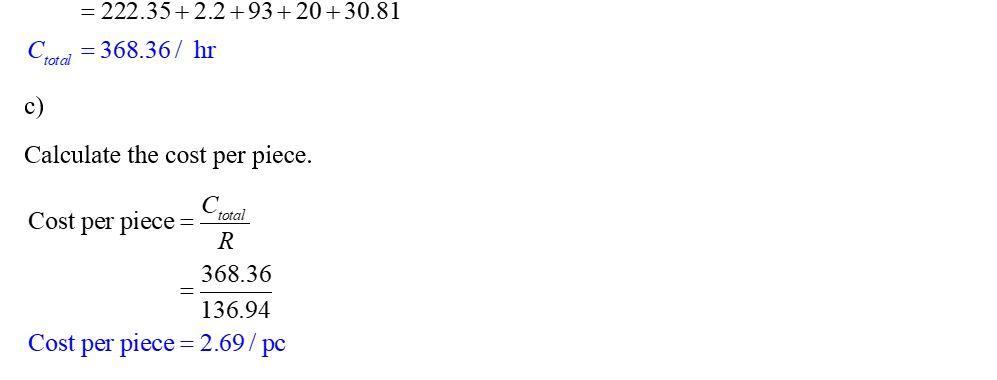
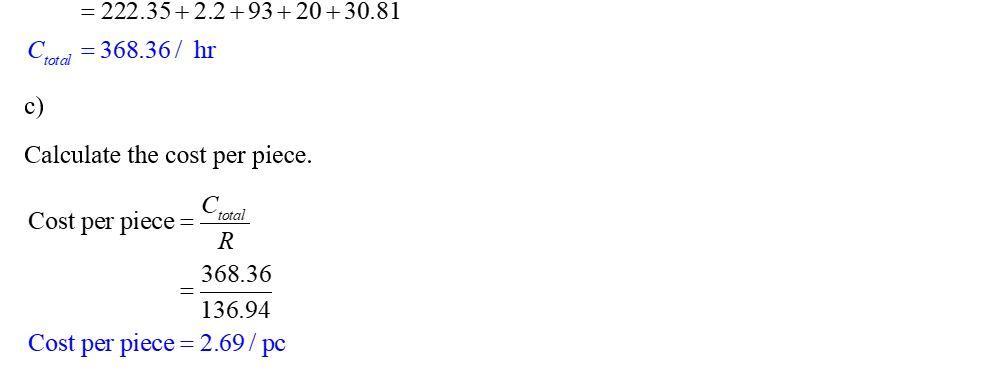
castings per cycle. One robot ladles molten metal into the chamber each cycle, and the other unloads the two castings from the machine and sprays lubricant onto the die cavities. Cycle time = 0.85 min. Each casting weighs 0.75 lbm, and the gating system weighs 0.40 lbm. The gating system can be recycled to cast more parts. Die cost = $45,000. The total production run = 200,000 pc. Scrap rate = 3%. Assume reliability = 100%. Cost of zinc = $1.05/lbm. Melting temperature of zinc = 787F. Its density = 0.258 lbm/in3 , heat of fusion = 49 Btu/lbm, and specific heat = 0.091 Btu/lbmF (use the same values of density and specific heat for solid and molten zinc). Pouring temperature = 860F. Heat losses account for 35% of the energy used to heat the metal. Cost of power for heating = $0.15/kWh. The cost rate of the die casting machine = $57/hr, and the cost rate of each robot = $18/hr. As part of the operation sequence, the casting is trimmed from the gating system, which is done manually at a labor rate of $20.00/hr. The worker recycles the zinc from the gating system for remelting. Determine (a) unit energy for melting and pouring, (b) total cost per hour to operate the cell, and (c) cost per part

Engineering
2 answers:
MAVERICK [17]2 years ago
5 0

Answer:

a) The unit energy for melting and pouring is 121 Btu/lb

b) The total cost per hour is 368.31/h

c) The cost per part is 2.7/pc

Explanation:

a) The unit energy for melting and pouring is:

U=C_{p} (T_{m,Zn} -T_{0} )+deltaH_{fus}+C_{p}  (T_{p}- T_{0})

If we assume that the surrounding temperature is 70°F

U=0.091(787-70)+49+0.091(860-787)=121Btu/lb

b) The hourly production is:

R=(\frac{number-of-castings}{t_{cycle} } )*(1-scrap-rate)\\R=(\frac{2}{0.85min} *\frac{60min}{1h} )*(1-0.03)=136.9good-parts/h

The total weight of zinc is:

W_{total} =(\frac{number-of-castings}{t_{cycle} } )*(2*weight-of-casting)\\R=(\frac{2}{0.85min} *\frac{60min}{1h} )*(2*0.75)=211.8lb

The total cost of zinc is:

C=W_{total} *cost-of-zinc=211.8*1.05=222.3 $

The total heat transfer is:

Q=(\frac{number-of-castings}{t_{cycle} } )*((2*weight-of-casting)+gating-system-weight)*U\\Q=(\frac{2}{0.85min} *\frac{60min}{1h} )*((2*0.75)+0.4))*121=32462Btu/h=541Btu/min

541 Btu/min = 9.51 kW

The power is:

Power=\frac{Q}{1-Q_{loss} } =\frac{9.51}{1-0.35} =14.6kW

The hourly cost is:

C_{H} =P*cost-of-power-for-heating=14.6*0.15=2.2/h

The cost for die casting is:

C_{d} =cost-rate-of-die-casting+(2*cost-of-each-robot)=57+(2*18)=93/h

The die cost per casting is:

C_{die,casting} =\frac{45000}{200000} =0.225/pc

The hourly rate is:

Hourly-rate=R*C_{d,casting} =136.9*0.225=30.81/h

The total cost per hour is:

C_{total} =C+C_{H} +C_{d} +C_{1} +Hourly-time=222.35+2.2+93+20+30.81=368.31/h

c) The cost per part is:

C_{per part} =\frac{C_{total} }{R} =\frac{368.36}{136.9} =2.7/pc

Softa [21]2 years ago
4 0

Answer:

a. 121 Btu/lb

b. 211.8lb

c. 2.69/pc

Explanation:

See the attachments please

You might be interested in
A liquid with a specific gravity of 2.6 and a viscosity of 2.0 cP flows through a smooth pipe of unknown diameter, resulting in
sasho [114]
.......,.,.,.,.,.,,.,.,,.,.,.,.,.,.,.,,.,.,,.,,,.,,.,,.,.,.,.,,............,,,,,,’mmdjidvdhxxkf jkkk he in d
6 0
2 years ago
Consider insulation on a circular pipe For the same thickness and type of insulation, the thermal resistance of the insulation i
leonid [27]

Answer:

b). The same for all pipes independent of the diameter

Explanation:

We know,

R_{conduction}=\frac{ln(\frac{r_{2}}{r_{1}})}{2\pi LK}

R_{convection}=\frac{1}{h(2\pi r_{2}L)}

From the above formulas we can conclude that the thermal resistance of a substance mainly depends upon heat transfer coefficient,whereas radius has negligible effects on heat transfer coefficient.

We also know,

Factors on which thermal resistance of insulation depends are :

1. Thickness of the insulation

2. Thermal conductivity of the insulating material.

Therefore from above observation we can conclude that the thermal resistance of the insulation is same for all pipes independent of diameter.

5 0
2 years ago
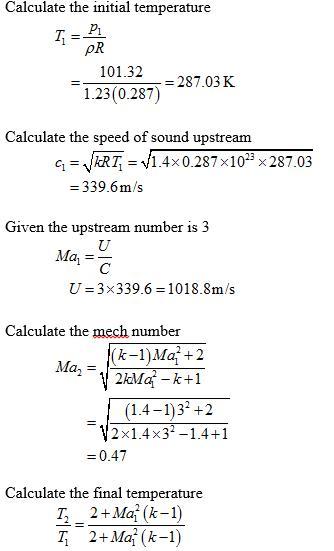
Consider a normal shock wave in air. The upstream conditions are given by M1=3, p1 = 1 atm, and r1 = 1.23 kg/m3. Calculate the d
mart [117]

Answer and Explanation:

The answer is attached below

7 0
2 years ago
An excited electron in an Na atom emits radiation at a wavelength 589 nm and returns to the ground state. If the mean time for t
11Alexandr11 [23.1K]

Answer:   Inherent width in the emission line: 9.20 × 10⁻¹⁵ m or 9.20 fm

                length of the photon emitted: 6.0 m

Explanation:

The emitted wavelength is 589 nm and the transition time is ∆t = 20 ns.

Recall the Heisenberg's uncertainty principle:-

                                 ∆t∆E ≈ h ( Planck's Constant)

The transition time ∆t corresponds to the energy that is ∆E

E=h/t = \frac{(1/2\pi)*6.626*10x^{-34} J.s}{20*10x^{-9} } = 5.273*10x^{-27} J =  3.29* 10^{-8} eV.

The corresponding uncertainty in the emitted frequency ∆v is:

∆v= ∆E/h = (5.273*10^-27 J)/(6.626*10^ J.s)=  7.958 × 10^6 s^-1

To find the corresponding spread in wavelength and hence the line width ∆λ, we can differentiate

                                                    λ = c/v

                                                    dλ/dv = -c/v² = -λ²/c

Therefore,

      ∆λ = (λ²/c)*(∆v) = {(589*10⁻⁹ m)²/(3.0*10⁸ m/s)} * (7.958*10⁶ s⁻¹)

                                 =  9.20 × 10⁻¹⁵ m or 9.20 fm

     The length of the photon (<em>l)</em> is

l = (light velocity) × (emission duration)

  = (3.0 × 10⁸  m/s)(20 × 10⁻⁹ s) = 6.0 m          
                                                   

6 0
2 years ago
As the porosity of a refractory ceramic brick increases:
ivolga24 [154]

Answer:

A) strength decreases, chemical resistance decreases, and thermal insulation increases

Explanation:

Strength always decreases, chemical resistence decreases, and thermal condictivity must be reduced therefore themal insulation must increase.

7 0
2 years ago
Other questions:
  • A 0.2-m^3 rigid tank equipped with a pressure regulator contains steam at 2MPa and 320C. The steam in the tank is now heated. Th
    9·1 answer
  • Problem 5) Water is pumped through a 60 m long, 0.3 m diameter pipe from a lower reservoir to a higher reservoir whose surface i
    13·1 answer
  • What can your employer do to protect you from overhead power lines?
    8·1 answer
  • Some states have osha programs, but you should always defer to the federal program.
    8·2 answers
  • The function below takes a single string parameter: input_string. If the input contains the lowercase letter z, return the strin
    15·1 answer
  • 4.9 Given that I 4 amps when Vs 40 volts and Is 4 amps and I 1 amp when Vs 20 volts and Is 0, use superposition and linearity to
    5·1 answer
  • Argon contained in a closed, rigid tank, initially at 33.7°C, 2.1 bar, and a volume of 4.2 m3, is heated to a final pressure of
    12·1 answer
  • A dryer is shaped like a long semi-cylindrical duct of diameter 1.5 m. The base of the dryer is occupied with water-soaked mater
    9·1 answer
  • Find the velocity and rate of flow of water through a rectangular channel of 6m wide and 3m deep when it's running full. The cha
    13·1 answer
  • Most fatal collisions in Florida happen during
    8·2 answers
Add answer
Login
Not registered? Fast signup
Signup
Login Signup
Ask question!