answer.
Ask question
Login Signup
Ask question
All categories
  • English
  • Mathematics
  • Social Studies
  • Business
  • History
  • Health
  • Geography
  • Biology
  • Physics
  • Chemistry
  • Computers and Technology
  • Arts
  • World Languages
  • Spanish
  • French
  • German
  • Advanced Placement (AP)
  • SAT
  • Medicine
  • Law
  • Engineering
Sauron [17]
2 years ago
6

2.24 Carbon dioxide (CO2) gas in a piston-cylinder assembly undergoes three processes in series that begin and end at the same s

tate (a cycle). Process 1-2: Expansion from state 1 where p1 = 10 bar, V1 = 1 m3, to state 2 where V2 = 4 m3. During the process, pressure and pV1.5 volume are related by = constant. Process 2-3: Constant volume heating to state 3 where p3 = 10 bar. Process 3-1: Constant pressure compression to state 1. Sketch the processes on p –V coordinates and evaluate the work for each process, in kJ. What is the net work for the cycle, in kJ?

Engineering
1 answer:
Gekata [30.6K]2 years ago
4 0

Answer:

Explanation:

Given that:

From process 1 → 2

P_1 = 10 bar   \\  \\ V_1 = 1 m^3  \\ \\  V_2 = 4 m^3

PV^{1.5} = \ constant

\gamma = 1.5

Process 2 → 3

The volume is constant i.e V_2 =V_3 = 4m^3

P_3 = 10 \ bar

Process 3 → 1

P = constant  i.e the compression from state 1

Now, to start with 1 → 2

P_1V_1^{1.5} = P_2V_2^{1.5}

P_2 = P_1 (\dfrac{V_1}{V_2})^{1.5}

P_2 = 10 \times  (\dfrac{1}{4})^{1.5}

P_2 =1.25

The work-done for the process  1 → 2 through adiabatic expansion is:

W = \dfrac{1}{1-\gamma}[P_2V_2-P_1V_1]

We know that 1 bar = 10^5 \ N/m^2

∴

W = \dfrac{1}{1-1.5}[1.25 \times 10^5 \times 4- 10 \times 10^5 \times 1]

W =1000000 \ J

W_{1 \to 2} = 1000 kJ

For process 2 → 3

Since V is constant

Thus:

W = PΔV = 0

W_{2 \to 3} = 0

For process 3 → 1

W = PΔV

W _{3 \to 1} = P_3(V_1-V_3)

W _{3 \to 1} = 10 \times 10^5 (1-4)

W _{3 \to 1} = 10 \times 10^5 (-3)

W _{3 \to 1} = -3 \times 10^6 \ J

W _{3 \to 1} = -3000  \ kJ

The net work-done now  for the entire system is :

W_{net} = W_{1 \to 2} + W_{2 \to 3 } + W_{ 3 \to 1 }

W_{net} = (1000 + 0 + (-3000)) \ kJ

W_{net} =-2000 \ kJ

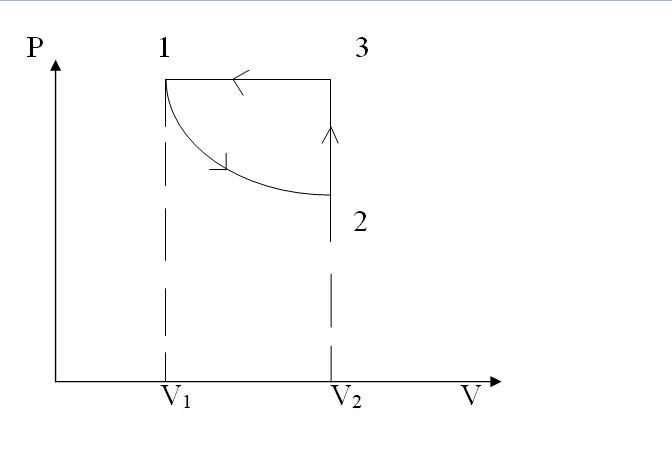
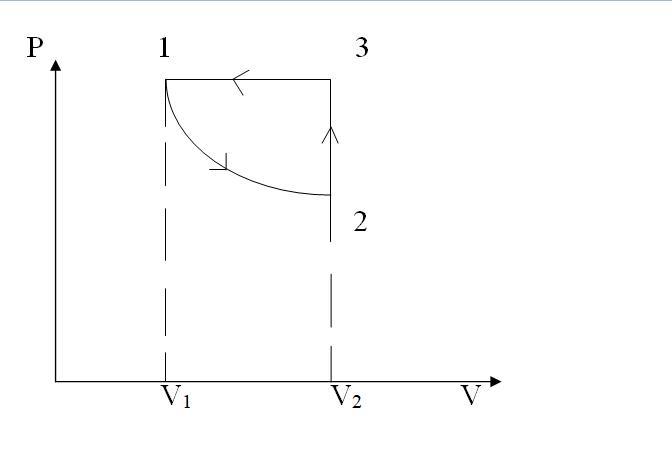
The sketch of the processes on p -V coordinates can be found in the image attached below.

You might be interested in
If a server takes precisely 15 seconds to serve a customer and customers arrive exactly every 20 seconds, what is the average wa
labwork [276]
The average waiting time is 10 seconds
7 0
2 years ago
A fuel oil is burned with air in a furnace. The combustion produces 813 kW of thermal energy, of which 65% is transferred as hea
DENIUS [597]

Answer:

im not sure

Explanation:

8 0
2 years ago
49. A solenoid coil with a resistance of 30 ohms and an inductance of 200 milli-henrys, is connected to a 230VAC, 50Hz supply. D
Leya [2.2K]

Answer:

69.59 ohms

Explanation:

Given that

L=200\ mH

F=50\ hZ

R=30\ ohms

For inductance

X_L=2\times \pi\times f \times LX_L\\=2\times \pi \times 50\times 200\times 10^{-3}\\=62.8\ ohm

R=30\ ohmsImpedance\\Z=\sqrt{R^2+X_L^2}\\Z=\sqrt{30^2+62.8^2}\ ohms\\Z =69.59\ ohms

8 0
2 years ago
A thermometer requires 1 minute to indicate 98% of the response to a unit step input. Assuming the thermometer to be a first ord
Rama09 [41]

Answer:

Time constant = 15.34 seconds

The thermometer shows an error of 0.838°

Explanation:

Given

t = 1 minute = 60 seconds

c(t) = 98% = 0.98

According to the question, the thermometer is a first order system.

The first order system transfer function is given as;

C(s)/R(s) = 1/(sT + 1).

To calculate the time constant, we need to calculate the step response.

This is given as

r(t) = u(t) --- Take Laplace Transformation

R(s) = 1/s

Substitute 1/s for R(s) in C(s)/R(s) = 1/(sT + 1).

We have

C(s)/1/s = 1/(sT + 1)

C(s) = 1/(sT + 1) * 1/s

C(s) = 1/s - 1/(s + 1/T) --- Take Inverse Laplace Transformation

L^-1(C(s)) = L^-1(1/s - 1/(s + 1/T))

Since, e^-t <–> 1/(s + 1) --- {L}

1 <–> 1/s {L}

So, the unit response c(t) = 1 - e^-(t/T)

Substitute 0.98 for c(t) and 60 for t

0.98 = 1 - e^-(60/T)

0.98 - 1 = - e^-(60/T)

-0.02 = - e^-(60/T)

e^-(60/T) = 0.02

ln(e^-(60/T)) = ln(0.02)

-60/T = -3.912

T = -60/-3.912

T = 15.34 seconds

Time constant = 15.34 seconds

The error signal is given as

E(s) = R(s) - C(s)

Where the temperature changes at the rate of 10°/min; 10°/60 s = 1/6

So.

E(s) = R(s) - 1/6 C(s)

Calculating C(s)

C(s) = 1/s - 1/(s + 1/T)

C(s) = 1/s - 1/(s + 1/15.34)

Remember that R(s) = 1/s

So, E(s) becomes

E(s) = 1/s - 1/6(1/s - 1/(s + 1/15.34))

E(s) = 1/s - 1/6(1/s - 1/(s + 0.0652)

E(s) = 1/s - 1/6s + 1/(6(s+0.0652))

E(s) = 5/6s + 1/(6(s+0.0652))

E(s) = 0.833/s + 1/(6(s+0.0652)) ---- Take Inverse Laplace Transformation

e(t) = 1/6e^-0.652t + 0.833

For a first order system, the system attains a steady state condition when time is 4 times of Time constant.

So,

Time = 4 * 15.34

Time = 61.36 seconds

So, e(t) becomes

e(t) = 1/6e^-0.652t + 0.833

e(t) = 1/(6e^-0.652(61.36)) + 0.833

e(t) = 0.83821342824942664566211

e(t) = 0.838 --- Approximated

Hence, the thermometer shows an error of 0.838°
4 0
2 years ago
Read 2 more answers
What kind of datatype is being input for Number1, Number2, Number3?
Contact [7]

Answer: integer

Explanation:

Its python code.

The datatype for number1, number2 and number3 it will be integer and even the output will be integer.

the programmer will decide whether to convert integer to float or not.

The program want a user to inputting a value number1, number2 and number3, then the interpreter will add the numbers and get the total and then the average will be total of numbers / 3.

so it will print number1, number3, number3, the sum and average.

6 0
2 years ago
Other questions:
  • a. Replacing standard incandescent lightbulbs with energy-efficient compact fluorescent lightbulbs can save a lot of energy. Cal
    9·1 answer
  • What can your employer do to protect you from overhead power lines?
    8·1 answer
  • A pipe is insulated such that the outer radius of the insulation is less than the critical radius. Now the insulation is taken o
    11·1 answer
  • Q5. A hypothetical metal alloy has a grain diameter of 2.4 x 10⁻² mm. After a heat treatment at 575°C for 500 min, the grain dia
    7·1 answer
  • Five Kilograms of continuous boron fibers are introduced in a unidirectional orientation into of an 8kg aluminum matrix. Calcula
    9·1 answer
  • Find the largest number. The process of finding the maximum value (i.e., the largest of a group of values) is used frequently in
    6·1 answer
  • Solid spherical particles having a diameter of 0.090 mm and a density of 2002 kg/m3 are settling in a solution of water at 26.7C
    8·1 answer
  • Toeboards are usually ___ inches high and used on landings and balconies.
    8·1 answer
  • Lydia is the CEO for a large pharmaceutical manufacturer. Her company is in the final stages of FDA
    12·1 answer
  • The rate of flow through an ideal clarifier is 8000m3 /d, the detention time is 1h and the depth is 3m. If a full-length movable
    5·1 answer
Add answer
Login
Not registered? Fast signup
Signup
Login Signup
Ask question!