answer.
Ask question
Login Signup
Ask question
All categories
  • English
  • Mathematics
  • Social Studies
  • Business
  • History
  • Health
  • Geography
  • Biology
  • Physics
  • Chemistry
  • Computers and Technology
  • Arts
  • World Languages
  • Spanish
  • French
  • German
  • Advanced Placement (AP)
  • SAT
  • Medicine
  • Law
  • Engineering
kicyunya [14]
2 years ago
13

A fuel oil is burned with air in a furnace. The combustion produces 813 kW of thermal energy, of which 65% is transferred as hea

t to boiler tubes that pass through the furnace. The combustion products pass from the furnace to a stack at 6500C. Water enters the boiler tubes as a liquid at 200C and leaves the tubes as saturated steam at 20 bar absolute. Calculate the rate (kg/h) at which steam is produced.
Engineering
1 answer:
DENIUS [597]2 years ago
8 0

Answer:

im not sure

Explanation:

You might be interested in
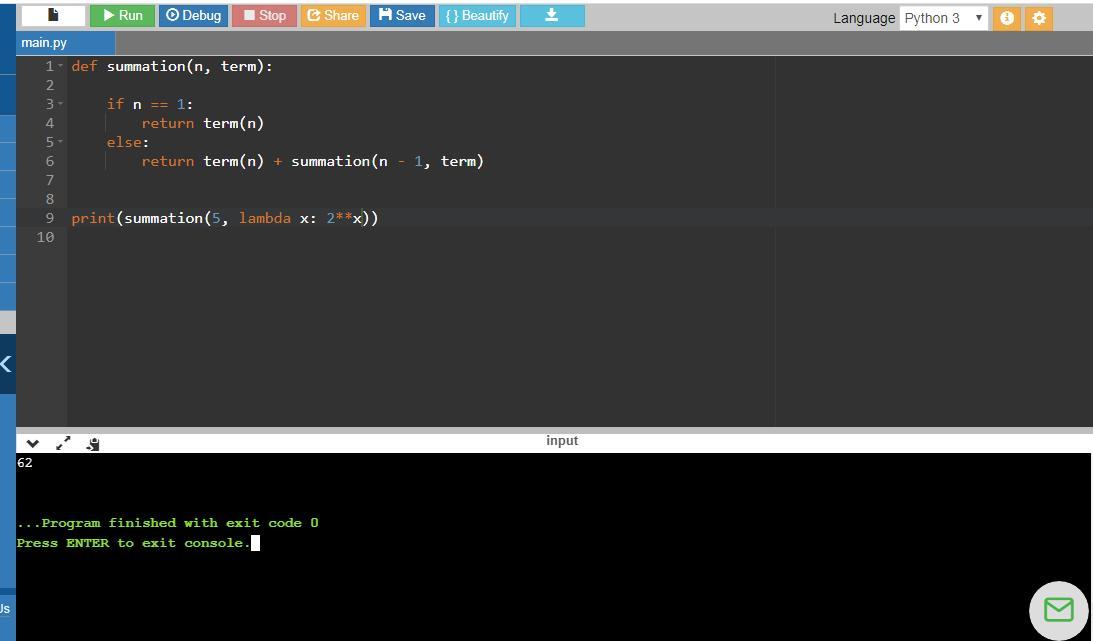
Q3: Summation Write a recursive implementation of summation, which takes a positive integer n and a function term. It applies te
harina [27]

Answer:

Here is the recursive function summation:

def summation(n, term):      

   if n == 1:  

       return term(n)

   else:

       return term(n) + summation(n - 1, term)

Explanation:

The function summation() has two arguments where n is a positive integer and term is a function term. term has the lambda function which is a small function having an argument and an expression e.g lambda b: b+20

So the summation() function is a recursive function which returns sum of the first n terms in the sequence defined by term ( a lambda function).

If you want to check if this function works, you can call this function by passing values to it like given in the question.

summation(5, lambda x: 2**x)

Here the value of n is 5 and the term is a lambda function x: 2**x

If you want to see the results of this function on output screen then use:

print(summation(5, lambda x: 2**x))

The print() function will print the results on screen.

This returns the sum of first 5 terms in sequence defined in the function x: 2**x

In recursive methods there are two cases: base case and recursive case. Base case is the stopping case which means that the recursion will stop when the base case/ base condition evaluates to true. The recursive case is when the function keeps calling itself so the recursive function keepsexecuting until the base case becomes true.

Here the base case is if n == 1:  So the recursive function calling itself until the value of n becomes 1.  

Recursive case is:

       return term(n) + summation(n - 1, term)

For the above example with n= 5 and term = x:2**x the recursions starts from n and adds all the terms of the series one by one and the value of n keeps decrementing by 1 at every recursive call.

When the value of n is equal to 1 the base case gets true and the recursion ends and the result of the sum is displayed in output.

This is how the summation() function works for the above function call:

2^1 + 2^2 + 2^3 + 2^4 + 2^5

n is 5 So this term function is called recursively 5 times and at every recursive call its value decreases by 1. Here the term function is used to compute 2 raise to power n. So in first recursive call the 2 raise to the power 5 is computed, then 5 is decremented and then in second recursive call to summation(), 2 raise to the power 4 is calculated, in third recursive call  to summation(), 2 raise to the power 3 is calculated, in fourth recursive call  to summation(), 2 raise to the power 2 is calculated, in fifth recursive call  to summation(), 2 raise to the power 1 is calculated, then the base condition is reached as n==1. So the recursion stops and the sum of the above computed power function results is returned which is 62.

2^1 + 2^2 + 2^3 + 2^4 + 2^5 = 62

The screen shot of recursive function along with the output of explained examples is attached.

6 0
2 years ago
A conical enlargement in a vertical pipeline is 5 ft long and enlarges the pipe diameter from 12 in. to 24 in. diameter. Calcula
makkiz [27]

Answer:

F_y = 151319.01N = 15.132 KN

Explanation:

From the linear momentum equation theory, since flow is steady, the y components would be;

-V1•ρ1•V1•A1 + V2•ρ2•V2•A2 = P1•A1 - P2•A2 - F_y

We are given;

Length; L = 5ft = 1.52.

Initial diameter;d1 = 12in = 0.3m

Exit diameter; d2 = 24 in = 0.6m

Volume flow rate of water; Q2 = 10 ft³/s = 0.28 m³/s

Initial pressure;p1 = 30 psi = 206843 pa

Thus,

initial Area;A1 = π•d1²/4 = π•0.3²/4 = 0.07 m²

Exit area;A2 = π•d2²/4 = π•0.6²/4 = 0.28m²

Now, we know that volume flow rate of water is given by; Q = A•V

Thus,

At exit, Q2 = A2•V2

So, 0.28 = 0.28•V2

So,V2 = 1 m/s

When flow is incompressible, we often say that ;

Initial mass flow rate = exit mass flow rate.

Thus,

ρ1 = ρ2 = 1000 kg/m³

Density of water is 1000 kg/m³

And A1•V1 = A2•V2

So, V1 = A2•V2/A1

So, V1 = 0.28 x 1/0.07

V1 = 4 m/s

So, from initial equation of y components;

-V1•ρ1•V1•A1 + V2•ρ2•V2•A2 = P1•A1 - P2•A2 - F_y

Where F_y is vertical force of enlargement pressure and P2 = 0

Thus, making F_y the subject;

F_y = P1•A1 + V1•ρ1•V1•A1 - V2•ρ2•V2•A2

Plugging in the relevant values to get;

F_y = (206843 x 0.07) + (1² x 1000 x 0.07) - (4² x 1000 x 0.28)

F_y = 151319.01N = 15.132 KN

6 0
2 years ago
Q1. In electronic circuits it is not unusual to encounter currents in the microampere range. Assume a 35 μA current, due to the
Anit [1.1K]

Answer:

2.9*10^14 electrons

Explanation:

An Ampere is the flow of one Coulomb per second, so 35 μA = is 35*10^-6 C per second.

An electron has a charge of 1.6*10^-19 C.

35*10^-6 / 1.6*10^-19 = 2.9*10^14 electrons

So, with a current o 35 μA you have an aevrage of 2.9*10^14 electrons flowing past a fixed reference cross section perpendicular to the direction of flow.

7 0
2 years ago
A 100 kmol/h stream that is 97 mole% carbon tetrachloride (CCL) and 3% carbon disulfide (CS2) is to be recovered from the bottom
Ugo [173]

Answer: oop

Explanation:oop

7 0
2 years ago
A pump with a 400 mm diameter suction pipe and 350 mm diameter discharge pipe is to deliver 20,000 litres per minute of 15.60C w
Svetach [21]

Answer:

pump head is 10.15 m

Explanation:

given data

diameter suction = 400 mm

diameter discharge = 350 mm

discharge = 20000 l/m

to find out

pump head in meters

solution

we know discharge is 20000 l/m

so discharge = \frac{1}{3} m³/min

and

we know suction head hs  is express as

hs = section gauge × specif gravity of Hg

hs = 0.127 × 13.6

hs = 1.7272 m of water

and

delivery head hd is express as

hd = \frac{delivery gauge}{density of water*g}

hd = \frac{75*10^3}{1000*9.81}

hd = 7.6453 m of water

and

we know distance between the gauge is here

Distance D = 0.075 + 0.45 = 0.525 m

so

discharge velocity vd is express as

Vd = \frac{discharge}{area}

Vd = \frac{1}{3*\frac{\pi }{4} * 0.35^2}

Vd = 3.465 m/s

and

suction velocity Vs is express as

Vs = \frac{discharge}{area}

Vs =  \frac{1}{3*\frac{\pi }{4} * 0.4^2}

Vs = 2.653 m/s

so

pump head will be here

pump head = hs + hd + D + \frac{Vd^2 - Vs^2}{2g}

pump head = 1.7272 + 7.6453 + 0.525 +  \frac{3.465^2 - 2.653^2}{2*9.81}

so pump head = 10.15 m

7 0
2 years ago
Other questions:
  • A dielectric material, such as Teflon®, is placed between the plates of a parallel-plate capacitor without altering the structur
    10·1 answer
  • A six- lane freeway ( three lanes in each direction) in a scenic area has a measured free- flow speed of 55 mi/ h. The peak- hou
    15·1 answer
  • Water flows downward through a vertical 10-mm-diameter galvanized iron pipe with an average velocity for 5.0 m/s and exits as a
    5·1 answer
  • Air in tankBis at 200 kPa, 280 K and mass 1 kg. It is connected to an empty piston/cylinder with a float pressure of 400 kPa sim
    6·1 answer
  • The in situ moist unit weight of a soil is 17.3 kN/m3 and the moisture content is 16%. The specific gravity of soil solids is 2.
    12·1 answer
  • Consider the time domain waveforms below on the left. Match waveforms (a) - (e) to their respective frequency spectrum represent
    11·1 answer
  • Toeboards are usually ___ inches high and used on landings and balconies.
    8·1 answer
  • A fuel oil is burned with air in a furnace. The combustion produces 813 kW of thermal energy, of which 65% is transferred as hea
    13·1 answer
  • Find the velocity and rate of flow of water through a rectangular channel of 6m wide and 3m deep when it's running full. The cha
    13·1 answer
  • What term describes a guardrail system
    13·2 answers
Add answer
Login
Not registered? Fast signup
Signup
Login Signup
Ask question!