answer.
Ask question
Login Signup
Ask question
All categories
  • English
  • Mathematics
  • Social Studies
  • Business
  • History
  • Health
  • Geography
  • Biology
  • Physics
  • Chemistry
  • Computers and Technology
  • Arts
  • World Languages
  • Spanish
  • French
  • German
  • Advanced Placement (AP)
  • SAT
  • Medicine
  • Law
  • Engineering
Serjik [45]
2 years ago
11

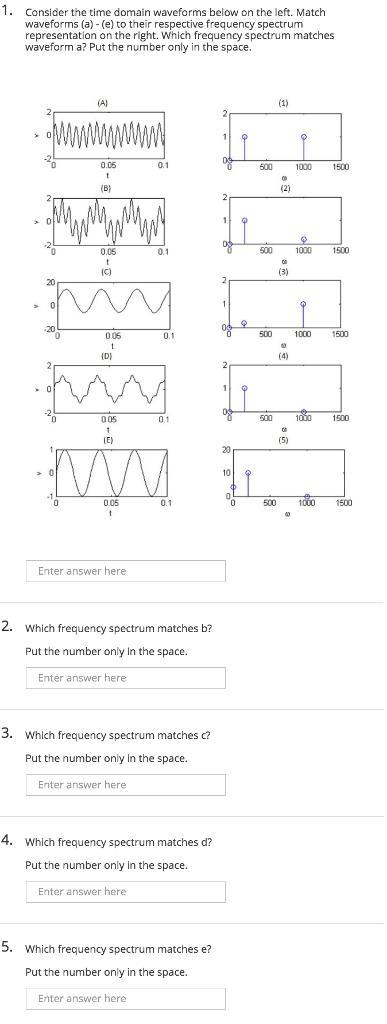
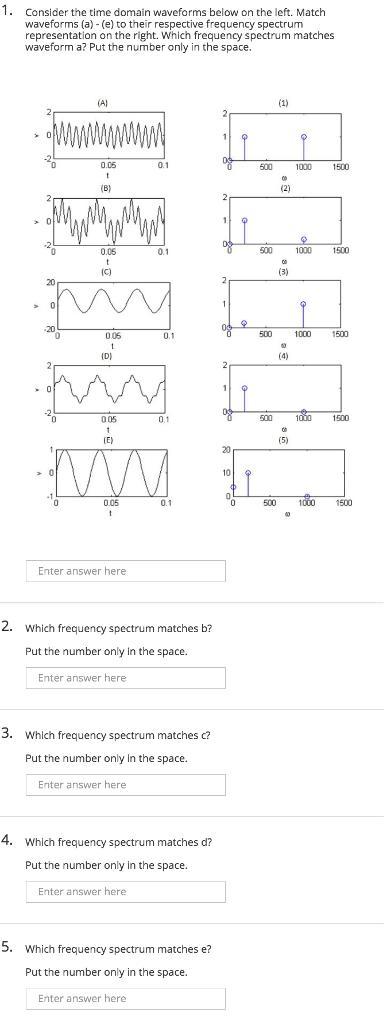
Consider the time domain waveforms below on the left. Match waveforms (a) - (e) to their respective frequency spectrum represent

ation on the right. Which frequency spectrum matches waveform a? Put the number only in the space. _____
Which frequency spectrum matches b? Put the number only in the space. _____
Which frequency spectrum matches c? Put the number only in the space. _____
Which frequency spectrum matches d? Put the number only in the space. _____
Which frequency spectrum matches e? Put the number only in the space. _____

Engineering
1 answer:
lozanna [386]2 years ago
3 0

Answer:

(a) ------(3). (b)------(1) (c)-----(5) (d)------(2) ------ (e) -----4

Note: Kindly find an attached copy of the diagram associated with the solution to the question below.

Sources: the diagram to this question was researched from Quizlet

Explanation:

Solution

(1) Part (a)a waveform has a high frequency components compared to another waveform. the corresponding frequency components should be high.

So for the wave form a  the corresponding frequency spectrum is (3)

(2) For part (b), waveform has three harmonics, the corresponding frequency spectrum is (1)

(3) The time domain waveform plot (c) is a sine wave but there exists a dc component.

Thus x[0] ≠0

For (c) the corresponding frequency spectrum is (5)

(4) For part (d) the corresponding frequency spectrum is (2)

(5) A sine wave is made of a single frequency only and its spectrum is a single point

For (e) the corresponding frequency spectrum is (4)

You might be interested in
A thin, flat plate that is 0.2 m × 0.2 m on a side is oriented parallel to an atmospheric airstream having a velocity of 40 m/s.
Leto [7]

Answer:

The rate of heat transfer from both sides of the plate to the air is 240 W

Explanation:

Given;

area of the flat plate = 0.2 m × 0.2 m = 0.04 m²

velocity of atmospheric air stream, v = 40 m/s

drag force, F =  0.075 N

The rate of heat transfer from both sides of the plate to the air:

q = 2 [h'(A)(Ts -T∞)]

where;

h' is heat transfer coefficient obtained from Chilton-Colburn analogy

h' = \frac{C_f}{2} \rho u C_p P_r^{-2/3}\\\\\frac{C_f}{2} = \frac{\tau'_s}{2*\rho u^2/2}

Properties of air at 70°C and 1 atm:

ρ = 1.018 kg/m³, cp = 1009 J/kg.K, Pr = 0.7, v = 20.22 x 10⁻⁶ m²/s

\frac{C_f}{2} = \frac{(0.075/2)/(0.2)^2}{2*(1.018)(40)^2/2} = 5.756*10^{-4}\\\\Thus,\\h' = 5.756*10^{-4} (1.018*40*1009)*(0.7)^{-2/3}\\\\h' = 30 \ W/m^2.K

Finally;

q = 2 [ 30(0.04)(120 - 20) ]

q = 240 W

Therefore, the rate of heat transfer from both sides of the plate to the air is 240 W

4 0
2 years ago
Read 2 more answers
A curve in a speed track has a radius of 1000 ft and a rated speed of 120 mi/h. (From Sample Prob. 12.7 is the definition of rat
forsale [732]

Answer:

tan \theta = \frac{(176ft/s)^2}{1000 ft 32.2 ft/s^2}= 0.962

\theta = tan^{-1} (0.962) = 43.89

Explanation:

If the question is: Determine the banking angle θ

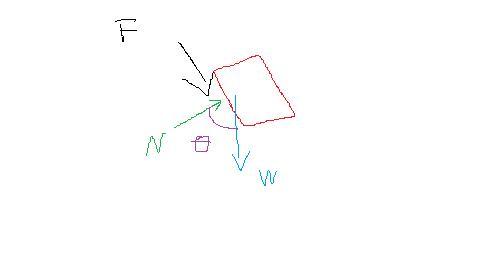
We have the forces involved on the figure attached.

For this case we know that the weight is given by:

W = mg

And for this case the centripetal acceleration would be given by:

a=\frac{v^2}{r}

If we analyze the sum of forces on x and y we have:

\sum F_x = m a_x

F + W sin \theta = ma cos theta

And if we solve for the force we got:

F = ma cos \theta - mg sin \theta = \frac{mv^2}{r} cos \theta - mg sin \theta

\sum F_y = m a_y

N - W cos \theta = ma sin \theta

If we solve for the normal force we got:

N =W cos \theta + ma sin \theta = \frac{mv^2}{r} sin \theta + mg cos \theta

In order to find the banking angle we use the fact that F =0

0 = \frac{mv^2}{r} cos \theta - mg sin \theta

tan \theta= \frac{v^2}{rg}

The velocity on this case is 120 mi/h if we convert this into ft/ s we got:

120 mi/h * \frac{5280 ft}{1mi} *\frac{1hr}{3600 s}= 176 ft/s

And then we have this:

tan \theta = \frac{(176ft/s)^2}{1000 ft 32.2 ft/s^2}= 0.962

\theta = tan^{-1} (0.962) = 43.89

5 0
2 years ago
Write a method printShampooInstructions(), with int parameter numCycles, and void return type. If numCycles is less than 1, prin
kirill [66]

Answer:

// The method is defined with a void return type

// It takes a parameter of integer called numCycles

// It is declared static so that it can be called from a static method

public static void printShampooInstructions(int numCycles){

// if numCycles is less than 1, it display "Too few"

   if (numCycles < 1){

       System.out.println("Too few.");

   }

// else if numCycles is less than 1, it display "Too many"

    else if (numCycles > 4){

       System.out.println("Too many.");

   }

// else it uses for loop to print the number of times to display

// Lather and rinse

  else {

       for(int i = 1; i <= numCycles; i++){

           System.out.println(i + ": Lather and rinse.");

       }

       System.out.println("Done");


   }

}

Explanation:

The code snippet is written in Java. The method is declared static so that it can be called from another static method. It has a return type of void. It takes an integer as parameter.

It display "Too few" if the passed integer is less than 1. Or it display "Too much" if the passed integer is more than 4. Else it uses for loop to display "Lather and rinse" based on the passed integer.

8 0
2 years ago
Laminar flow normally persists on a smooth flat plate until a critical Reynolds number value is reached. However, the flow can b
grandymaker [24]

Answer:

At L = 0.1 m

h⁻_lam = 11.004K   W/m^1.5

h⁻_turb = 7.8848K   W/m^1.8

At L = 1 m

h⁻_lam = 3.48K   W/m^1.5

h⁻_turb = 4.975K   W/m^1.8
Explanation:

Given that;

h_lam(x)= 1.74 W/m^1.5. Kx^-0.5

h_turb(x)= 3.98 W/m^1.8 Kx^-0.2

conditions for plates of length L = 0.1 m and 1 m

Now

Average heat transfer coefficient is expressed as;

h⁻ = 1/L ₀∫^L hxdx

so for Laminar flow

h_lam(x)= 1.74 . Kx^-0.5  W/m^1.5

from the expression

h⁻_lam = 1/L ₀∫^L 1.74 . Kx^-0.5   dx

= 1.74k / L { [x^(-0.5+1)] / [-0.5 + 1 ]}₀^L

= 1.74k/L = [ (x^0.5)/0.5)]⁰^L

= 1.74K × L^0.5 / L × 0.5

h⁻_lam= 3.48KL^-0.5

For turbulent flow

h_turb(x)= 3.98. Kx^-0.2 W/m^1.8

form the expression

1/L ₀∫^L 3.98 . Kx^-0.2   dx

= 3.98k / L { [x^(-0.2+1)] / [-0.2 + 1 ]}₀^L

= (3.98K/L) × (L^0.8 / 0.8)

h⁻_turb = 4.975KL^-0.2

Now at L = 0.1 m

h⁻_lam = 3.48KL^-0.5  =  3.48K(0.1)^-0.5  W/m^1.5

h⁻_lam = 11.004K   W/m^1.5

h⁻_turb = 4.975KL^-0.2 = 4.975K(0.1)^-0.2

h⁻_turb = 7.8848K   W/m^1.8

At L = 1 m

h⁻_lam = 3.48KL^-0.5  =  3.48K(1)^-0.5  W/m^1.5

h⁻_lam = 3.48K   W/m^1.5

h⁻_turb = 4.975KL^-0.2 = 4.975K(1)^-0.2

h⁻_turb = 4.975K   W/m^1.8

Therefore

At L = 0.1 m

h⁻_lam = 11.004K   W/m^1.5

h⁻_turb = 7.8848K   W/m^1.8

At L = 1 m

h⁻_lam = 3.48K   W/m^1.5

h⁻_turb = 4.975K   W/m^1.8
3 0
2 years ago
The solid aluminum shaft has a diameter of 50 mm. Determine the absolute maximum shear stress in the shaft and sketch the shear-
jarptica [38.1K]

Answer:

Max shear = 8.15 x 10^7 N/m2

Explanation:

In order to find the maximum stress for a solid shaft having radius r, we will be applying the Torsion formula which can be written as;

Allowable Shear Stress = Torque x Radius / pi/2 x radius^4

Putting the values we have;

T = 2000 N/m

Radius = Diameter/2 = 0.05 / 2 = 0.025 m

Putting values in formula;

Max shear = 2000 x 0.025 / 3.14/2 x (0.025)^4

Max shear = 8.15 x 10^7 N/m2

5 0
2 years ago
Other questions:
  • A hydrogen-filled balloon to be used in high altitude atmosphere studies will eventually be 100 ft in diameter. At 150,000 ft, t
    7·1 answer
  • As shown, a load of mass 10 kg is situated on a piston of diameter D1 = 140 mm. The piston rides on a reservoir of oil of depth
    9·1 answer
  • A circular ceramic plate that can be modeled as a blackbody is being heated by an electrical heater. The plate is 30 cm in diame
    15·1 answer
  • A long aluminum wire of diameter 3 mm is extruded at a temperature of 280°C. The wire is subjected to cross air flow at 20°C at
    9·1 answer
  • Reconsider Couette flow between two parallel plates as derived in class, but with the top plate moving with a known velocity +i
    13·1 answer
  • An inventor claims to have developed an engine that does not use fuel but operates as a power cycle at steady state while receiv
    10·2 answers
  • An airplane in level flight at an altitude h and a uniform speed v passes directly over a radar tracking station A. Calculate th
    5·1 answer
  • Which of the following types of protective equipment protects workers who are passing by from stray sparks or metal while anothe
    8·1 answer
  • Draw an ERD for each of the following situations. (If you believe that you need to make additional assumptions, clearly state th
    15·1 answer
  • What should always be done before beginning any diagnosis?
    9·1 answer
Add answer
Login
Not registered? Fast signup
Signup
Login Signup
Ask question!