answer.
Ask question
Login Signup
Ask question
All categories
  • English
  • Mathematics
  • Social Studies
  • Business
  • History
  • Health
  • Geography
  • Biology
  • Physics
  • Chemistry
  • Computers and Technology
  • Arts
  • World Languages
  • Spanish
  • French
  • German
  • Advanced Placement (AP)
  • SAT
  • Medicine
  • Law
  • Engineering
Wewaii [24]
2 years ago
12

The in situ moist unit weight of a soil is 17.3 kN/m3 and the moisture content is 16%. The specific gravity of soil solids is 2.

72. This soil is to be excavated and transported to a construction site for use in a compacted fill. If the specification calls for the soil to be compacted to a minimum dry unit weight of 18.1 kN/m3 at the same moisture content of 16%, how many cubic meters of soil from the excavation site are needed to produce 2000 m3 of compacted fill?
Engineering
1 answer:
Temka [501]2 years ago
3 0

Answer:

Explanation:

Given that,

Moist content w = 16%

The in situ moist unit weight of the soil : γ(in situ) = 17.3 kN/m³

Specific gravity of the soil

G(s) = 2.72

Minimum dry unit weight of the soil

γd(compacted) = 18.1 kN/m³

Moist content is same as above

w = 16%

Question

how many cubic meters of soil from the excavation site are needed to produce 2000 m³ of compacted fill?

Let determine the in situ dry unit weight γd(in-situ) using the relation

γd(in-situ) = γ(in-situ) / [1 + (w/100)]

γd(in-situ) = 17.3/ [1 + (18/100)]

γd(in-situ) = 17.3 / ( 1 + 0.18)

γd(in-situ) = 17.3 / 1.18

γd(in-situ) = 14.66 kN/m³

To determine the Volume of the soil to be excavated (Vex)

Let the Volume to be excavated = V

We can use the relation

V=V(fill) × γd(compacted) / γd(in situ)

Given that, V(fill) = 2000m³

V(fill) is the volume of the compacted fill

Therefore,

V=V(fill) × γd(compacted) / γd(in situ)

Vex = 2000 × 18.1 / 14.66

Vex = 2469.13 m³

So, the excavated volume of the soil is 2469.13 m³

You might be interested in
Refrigerant-134a enters a diffuser steadily as saturated vapor at 600 kPa with a velocity of 160 m/s, and it leaves at 700 kPa a
Zina [86]

Answer:

a) V_2 = 82.1 m/s

b) m = 0.298 Kg/s

Explanation:

from A-11 to A-13 we have the following data

P_1 = 600 kpa

V_1 = 0.033925 m^3/kg

h_1 = 262.52 kJ/kg

P_2 = 700 kpa

V_2 = 0.0313 m^3/kg

T_2 = 40°C = 313K

h_2 = 278.66 kJ/kg

Now, from the conversation of mass,

A_2*V_2/u_2 = A_1*V_1/u_1

V_2 = A_1/A_2*u_2/u_1*V_1

V_2 = A_1/1.8*A_1 * 0.0313 /0.033925*160

V_2 = 82.1 m/s

now from the energy balance equation

E_in = E_out

Q_in + m(h_1 + V_1^2/2) =  m(h_2 + V_2^2/2)

m = 0.298 Kg/s

4 0
2 years ago
Read 2 more answers
A woodcutter wishes to cause the tree trunk to fall uphill, even though the trunk is leaning downhill. With the aid of the winch
Sedbober [7]

Answer:

The correct answer will be "400.4 N". The further explanation is given below.

Explanation:

The given values are:

Mass of truck,

m = 600 kg

g = 9.8 m/s²

On equating torques at the point O,

⇒  T\times Cos(10+5)\times (1.3+4)=mg\times Sin(5)\times 4

So that,

On putting the values, we get

⇒  T\times Cos(15^{\circ})\times 5.3=600\times 9.8\times Sin(5^{\circ})\times 4

⇒                             T=400.4 \ N

8 0
2 years ago
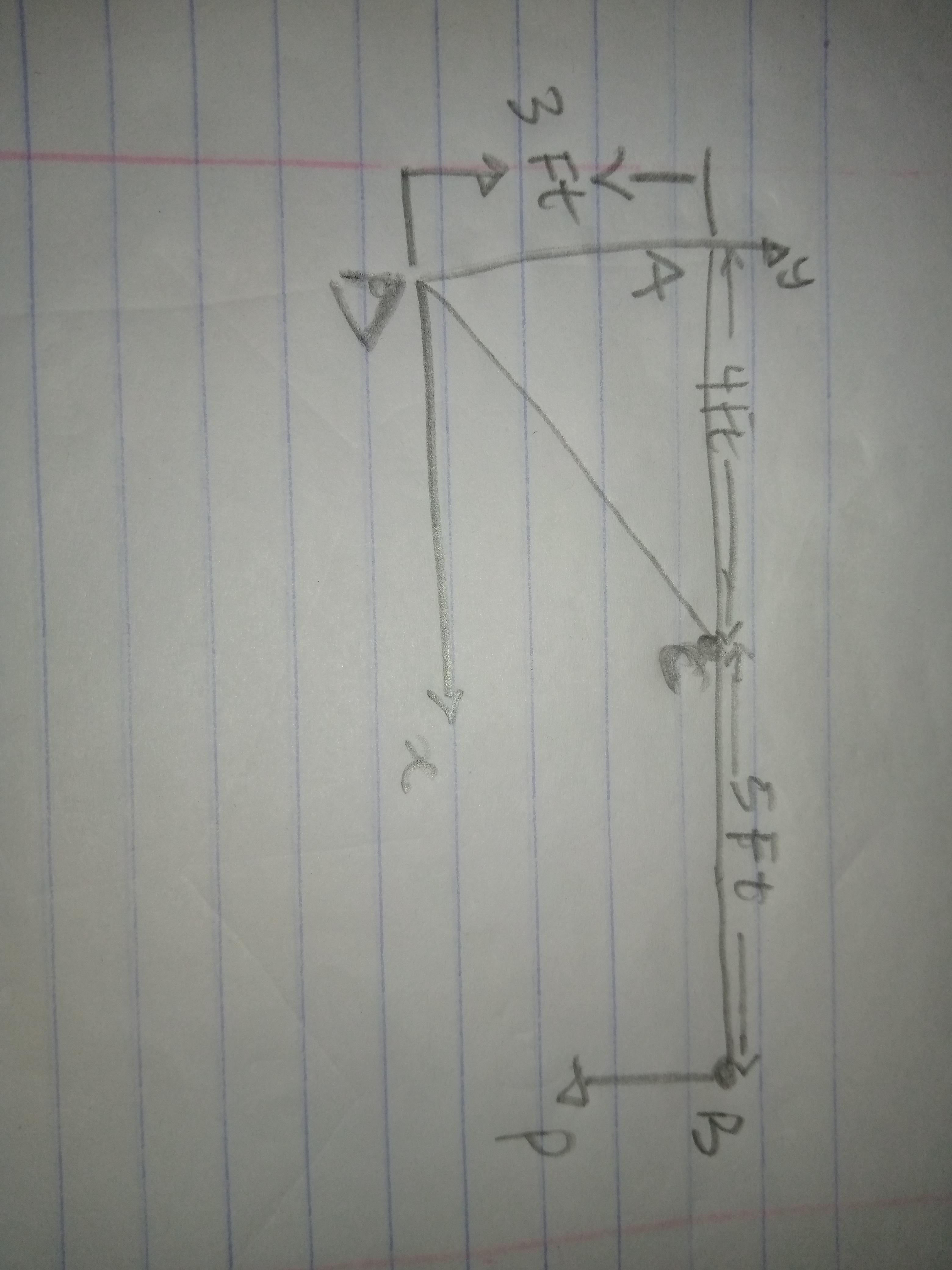
Rigid bar ACB is supported by an elastic cir-cular strut DC having an outer diameter of 15 in. and inner diameter of 14.4 in. Th
Ne4ueva [31]

Answer:

The change in length of the circular strut DC = 0.0028 in.

The vertical displacement of the rigid bar at point B = 0.00378 in.

Explanation:

We have the following parameters or information in the question given above:

=> The outer diameter = 15 in., the inner diameter = 14.4 in., the modulus elasticity of E = 29,000 ksi, and the Point load P = 5kips.

The diagram showing the rigid bar ACB is supported by an elastic cir-cular strut DC  is given in  the attached picture below.

According to Newton's law of motion, it can be seen that the force on CD, that is FCD is equal and opposite to ACD. Hence, FCD = ACD.

Where FCD = p × [4 + 5] ÷ [sin Ф × 4].

kindly note that from the diagram sin Ф = 3/5, cos Ф = 4/5 and tan Ф = 3/4. Also p =5.

Hence, FCD =[ 5 × 9] ÷ [3/5 × 4] = 18.75 kip. So FCD = ACD.

The next thing here is to determine the area and length of CD, say the area of CD is G, thus, G = π/4 × [ 15² - 14.4²] = 13.854 in².

The lenght of CD is = √[4² + 3²] = √[16 + 9] = 5ft. Thus, 5 × 12 = 60in.

Hence, the change in length of the circular strut DC = [18.75 × 60] ÷ 13.854 × 29000 = 0.0028 in.

The vertical deflection of CD = 0.0028 × 3/5 = 0.00168 in.

We have that; 4 /CV = 9BV. Hence, BV = 9/4× CV.

(CV = vertical deflection of CD).

The vertical displacement of the rigid bar at point B = 9/ 4 × 0.00168 in = 0.00378 in.  

7 0
2 years ago
The density of a liquid is to be determined by an old 1-cm-diameter cylindrical hydrometer whose division marks are completely w
vodka [1.7K]

Answer:

The density of the unknown liquid is 1.025 kg/m³ (considering the density of the water as 1.000 kg/m³)

Explanation:

The hydrometer works by the Archimedes principle. The cylinder floats in the liquid because the hydrostatic thrust is equal to the weight force. This means:

Tr-W=0N\\Tr=W\\\delta_{fl} \cdot Vol \cdot g =W_{hydr}

If we measure 2 fluids, the weight of the hydrometer is the same, so:

\delta_{fl1} \cdot Vol_1 \cdot g =W_{hydr}=\delta_{fl2} \cdot Vol_2 \cdot g\\\delta_{fl1} \cdot Vol_1 =\delta_{fl2} \cdot Vol_2\\\delta_{fl1} H_1 \pi R^2 =\delta_{fl2} H_2 \pi R^2\\\delta_{fl1}\frac{H_1}{H_2}=\delta_{fl2}

If the original watermark height is 12.3cm (H₁) and the mark for water has risen 0.3 cm above the unknown liquid–air interface, the height of the unknown liquid mark is 12cm (H₂). Therefore:

delta_{fl1}\frac{H_1}{H_2}=\delta_{fl2}\\1.000\frac{kg}{m^3} \frac{12.3cm}{12cm}=\delta_{fl2}=1.025\frac{kg}{m^3}

8 0
2 years ago
What kind of datatype is being input for Number1, Number2, Number3?
Contact [7]

Answer: integer

Explanation:

Its python code.

The datatype for number1, number2 and number3 it will be integer and even the output will be integer.

the programmer will decide whether to convert integer to float or not.

The program want a user to inputting a value number1, number2 and number3, then the interpreter will add the numbers and get the total and then the average will be total of numbers / 3.

so it will print number1, number3, number3, the sum and average.

6 0
2 years ago
Other questions:
  • True or False: Drag and tailwind are examples of a contact force.<br> tyy guyss
    14·1 answer
  • The rigid bar CDE is attached to a pin support at E and rests on the 30 mm diameter brass cylinder BD. A 22 mm diameter steel ro
    8·1 answer
  • Carbon dioxide gas enters a pipe at 3 MPa and 500 K at a rate of 2 kg/s. CO2 is cooled at constant pressure as it flows in the p
    10·1 answer
  • You work in Madison, Wisconsin. It is January and the area has been hit with bad weather. Another weather front is expected to a
    9·1 answer
  • A negative pressure respirator brings fresh air to you through a hose<br>A) True<br>B)False​
    15·2 answers
  • In a heat-treating process, a 1-kg metal part, initially at 1075 K, is quenched in a closed tank containing 100 kg of water, ini
    10·1 answer
  • Benzene vapor at 480°C is cooled and converted to a liquid at 25°C in a continuous condenser. The condensate is drained into 1.7
    15·1 answer
  • The rectangular frame is composed of four perimeter two-force members and two cables AC and BD which are incapable of supporting
    9·1 answer
  • In which of the following branches of engineering is the practice not restricted?
    7·2 answers
  • All of these are true about GMA (MIG) welding EXCEPT that:
    12·1 answer
Add answer
Login
Not registered? Fast signup
Signup
Login Signup
Ask question!