answer.
Ask question
Login Signup
Ask question
All categories
  • English
  • Mathematics
  • Social Studies
  • Business
  • History
  • Health
  • Geography
  • Biology
  • Physics
  • Chemistry
  • Computers and Technology
  • Arts
  • World Languages
  • Spanish
  • French
  • German
  • Advanced Placement (AP)
  • SAT
  • Medicine
  • Law
  • Engineering
Firdavs [7]
2 years ago
11

The density of a liquid is to be determined by an old 1-cm-diameter cylindrical hydrometer whose division marks are completely w

iped out. The hydrometer is first dropped in water, and the water level is marked. The hydrometer is then dropped into the other liquid, and it is observed that the mark for water has risen 0.3 cm above the liquid–air interface (Fig. P11–31). If the height of the original water mark is 12.3 cm, determine the density of the liquid.
Engineering
1 answer:
vodka [1.7K]2 years ago
8 0

Answer:

The density of the unknown liquid is 1.025 kg/m³ (considering the density of the water as 1.000 kg/m³)

Explanation:

The hydrometer works by the Archimedes principle. The cylinder floats in the liquid because the hydrostatic thrust is equal to the weight force. This means:

Tr-W=0N\\Tr=W\\\delta_{fl} \cdot Vol \cdot g =W_{hydr}

If we measure 2 fluids, the weight of the hydrometer is the same, so:

\delta_{fl1} \cdot Vol_1 \cdot g =W_{hydr}=\delta_{fl2} \cdot Vol_2 \cdot g\\\delta_{fl1} \cdot Vol_1 =\delta_{fl2} \cdot Vol_2\\\delta_{fl1} H_1 \pi R^2 =\delta_{fl2} H_2 \pi R^2\\\delta_{fl1}\frac{H_1}{H_2}=\delta_{fl2}

If the original watermark height is 12.3cm (H₁) and the mark for water has risen 0.3 cm above the unknown liquid–air interface, the height of the unknown liquid mark is 12cm (H₂). Therefore:

delta_{fl1}\frac{H_1}{H_2}=\delta_{fl2}\\1.000\frac{kg}{m^3} \frac{12.3cm}{12cm}=\delta_{fl2}=1.025\frac{kg}{m^3}

You might be interested in
A converging-diverging nozzle is designed to operate with an exit Mach number of 1.75 . The nozzle is supplied from an air reser
Flura [38]

Answer:

a. 4.279 MPa

b. 3.198 MPa to 4.279 MPa

c. 0.939 MPa

d. Below 3.198 MPa

Explanation:

From the given parameters

M_{exit} = 1.75 MPa  

M at 1.6 MPa gives A_{exit}/A* = 1.2502

M at 1.8 MPa gives  A_{exit}/A* = 1.4390

Therefore, by interpolation, we have M_{exit} = 1.75 MPa  gives A

However, we shall use M_{exit} = 1.75 MPa and A

Similarly,

P_{exit}/P₀ = 0.1878

a) Where the nozzle is choked at the throat there is subsonic flow in the following diverging part of the nozzle. From tables, we have

A_{exit}/A* = 1.387. by interpolation M

Therefore P_{exit} = P₀ × P

Which shows that the nozzle is choked for back pressures lower than 4.279 MPa

b) Where there is a normal shock at the exit of the nozzle, we have;

M₁ = 1.75 MPa, P₁ = 0.1878 × 5 = 0.939 MPa

Where the normal shock is at M₁ = 1.75 MPa, P₂/P₁ = 3.406

Where the normal shock occurs at the nozzle exit, we have

P_b = 3.406\times 0.939 = 3.198 MPa

Where the shock occurs t the section prior to the nozzle exit from the throat, the back pressure was derived as P_b = 4.279 MPa

Therefore the back pressure value ranges from 3.198 MPa to 4.279 MPa

c) At M_{exit} = 1.75 MPa  and P

d) Where the back pressure is less than 3.198 MPa according to isentropic flow relations supersonic flow will exist at the exit plane    

8 0
2 years ago
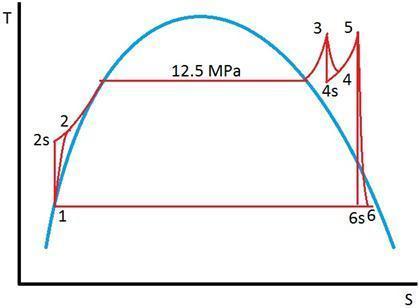
A steam power plant operates on the reheat Rankine cycle. Steam enters the highpressure turbine at 12.5 MPa and 550°C at a rate
gayaneshka [121]

Answer:

A) condenser pressure = 9.73 kPa,

B) 10242 kw

C) 36.9%

Explanation:

given data

entrance pressure of steam = 12.5 MPa

temperature of steam = 550⁰c

flow rate of steam = 7.7 kg/s

outer pressure = 2 MPa

reheated steam temperature = 450⁰c

isentropic efficiency of turbine( nt ) = 85% = 0.85

isentropic efficiency of pump = 90% = 0.90

From steam tables

at 12.5 MPa and 550⁰c ; h3 = 3476.5 kJ/kg,  S3 = 6.6317 kJ/kgK

also for an Isentropic expansion

S4s = S3 .

therefore when S4s = 6.6317 kJ/kg and P4 = 2 MPa

h4s = 2948.1 kJ/kg

nt = 0.85

nt (0.85) = \frac{h3-h4}{h3-h4s} = \frac{3476.5 - h4}{3476.5 - 2948.1}

making h4 subject of the equation

h4 = 3476.5 - 0.85 (3476.5 - 2948.1)

h4 = 3027.3 kj/kg

at P5 = 2 MPa and T5 = 450⁰c

h5 = 3358.2 kj/kg,  s5 = 7.2815 kj/kgk

at P6 , x6 = 0.95  and s5 = s6

using nt = 0.85 we can calculate for h6 and h6s

from the chart attached below we can see that

p6 = 9.73 kPa, h6 = 2463.3 kj/kg

B) the net power output

solution is attached below

c) thermal efficiency

thermal efficiency = 1 - \frac{qout}{qin} = 1 - ( 2273.7/ 3603.8) = 36.9% ≈ 37%

8 0
2 years ago
A six- lane freeway ( three lanes in each direction) in a scenic area has a measured free- flow speed of 55 mi/ h. The peak- hou
Novosadov [1.4K]

Answer:

0.867

Explanation:

The driver population factor (f_{p})can be estimated using the equation below:

f_{p} = \frac{V}{PHF*N*f_{HV}*v_{p}}

The value of the heavy vehicle factor (f_{HV}) is determined below:

The values of the E_{T} = 2 and E_{R} = 3 are gotten from the tables for the RVs, trucks and buses upgrades for passenger-car equivalents. Therefore:

f_{HV} = 1/[1+0.08(2-1)+0.06(3-1)] = 1/[1+0.08+0.12] = 1/1.2 = 0.833

Furthermore, the vp is taken as 2250 pc/(h*In) from the table of LOS criteria for lane freeway using the 15 minutes flow rate. Therefore:

f_{p} = 3900/[0.8*3*0.833*2250] = 3900/4498.2 = 0.867

6 0
2 years ago
A fatigue test was conducted in which the mean stress was 46.2 MPa and the stress amplitude was 219 MPa.
sleet_krkn [62]

Answer:

a)σ₁ = 265.2 MPa

b)σ₂ = -172.8 MPa

c)Stress\ ratio =-0.65

d)Range = 438 MPa

Explanation:

Given that

Mean stress ,σm= 46.2 MPa

Stress amplitude ,σa= 219 MPa

Lets take

Maximum stress level = σ₁

Minimum stress level =σ₂

The mean stress given as

\sigma_m=\dfrac{\sigma_1+\sigma_2}{2}

2\sigma_m={\sigma_1+\sigma_2}

2 x 46.2 =  σ₁ +  σ₂

 σ₁ +  σ₂ = 92.4 MPa    --------1

The amplitude stress given as

\sigma_a=\dfrac{\sigma_1-\sigma_2}{2}

2\sigma_a={\sigma_1-\sigma_2}

2 x 219 =  σ₁ -  σ₂

 σ₁ -  σ₂ = 438 MPa    --------2

By adding the above equation

2  σ₁ = 530.4

σ₁ = 265.2 MPa

-σ₂ = 438 -265.2 MPa

σ₂ = -172.8 MPa

Stress ratio

Stress\ ratio =\dfrac{\sigma_{min}}{\sigma_{max}}

Stress\ ratio =\dfrac{-172.8}{265.2}

Stress\ ratio =-0.65

Range = 265.2 MPa - ( -172.8 MPa)

Range = 438 MPa

8 0
2 years ago
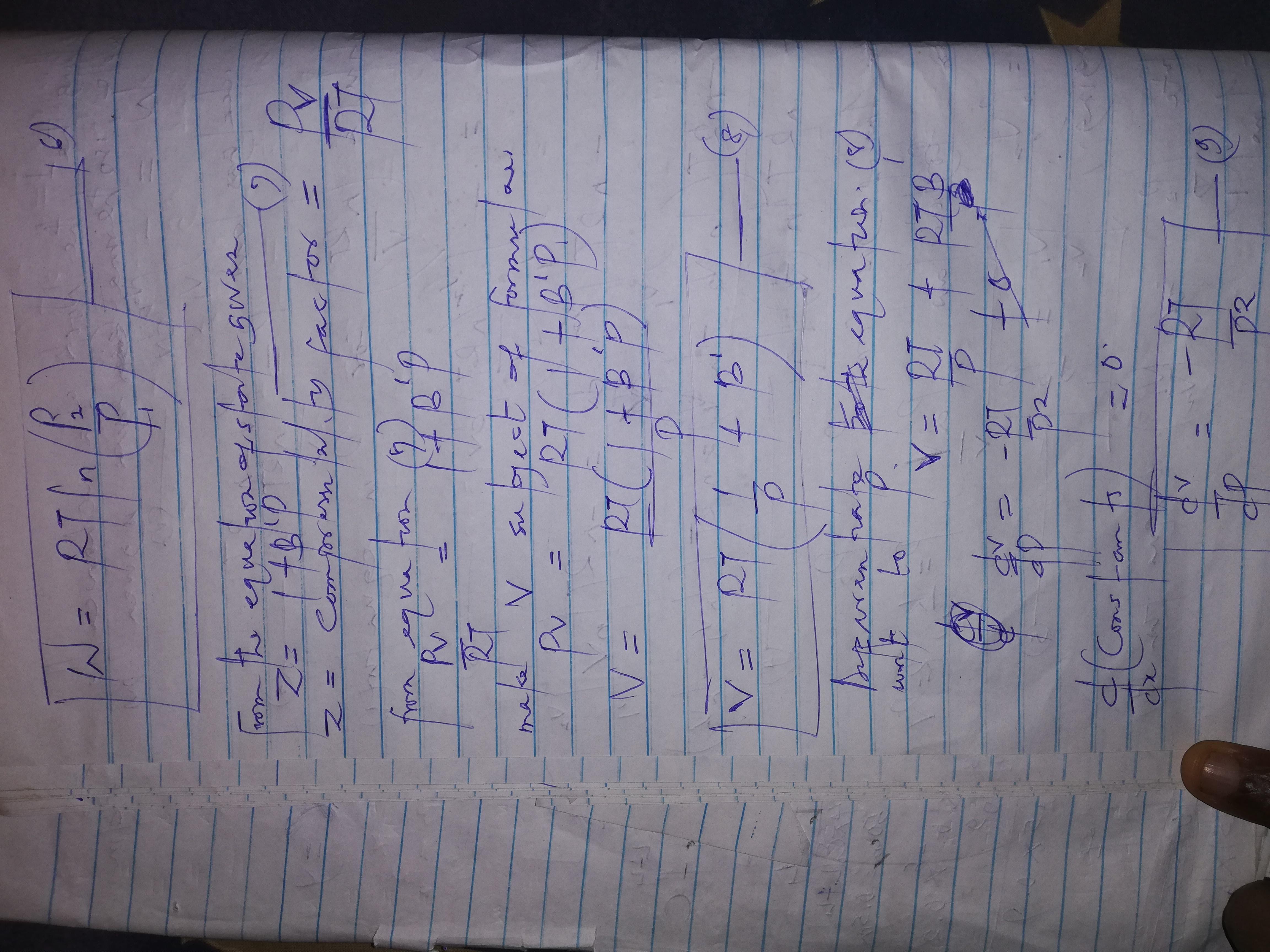
Derive an equation for the work of a mechanically reversible, isothermal compression of 1 mol of a gas from an initial pressure
Lyrx [107]

Answer:

The long derivation for work of a mechanically reversible, isothermal compression was done with detailed steps as shown in the attachment.

Explanation:

what is applied here is a long derivation from Work done in an isobaric process, the expression for the compressibility factor (Z) and the equation of state that was given. The requisite knowledge of Differentiation and Integration was used.

The detailed derivation from firs principle is as shown in the attachment.

5 0
2 years ago
Other questions:
  • Oil with a density of 800 kg/m3 is pumped from a pressure of 0.6 bar to a pressure of 1.4 bar, and the outlet is 3 m above the i
    9·1 answer
  • A 1020 CD steel shaft is to transmit 15 kW while rotating at 1750 rpm. Determine the minimum diameter for the shaft to provide a
    10·1 answer
  • A particle has an initial velocity of v0 = 14 ft/s to the right, at s0 = 0, and a = 2 ft/s2 to the left. determine its position
    5·1 answer
  • The rigid bar CDE is attached to a pin support at E and rests on the 30 mm diameter brass cylinder BD. A 22 mm diameter steel ro
    8·1 answer
  • The basic barometer can be used to measure the height of a building. If the barometric readings at the top and the bottom of a b
    15·1 answer
  • A railcar with an overall mass of 78,000 kg traveling with a speed vi is approaching a barrier equipped with a bumper consisting
    15·1 answer
  • The velocity of a particle which moves along the s-axis is given by v = 2-4t+5t^(3/2), where t is in seconds and v is in meters
    11·2 answers
  • With thermodynamics, one cannot determine ________.
    14·1 answer
  • Who play 1v1 lol unblocked games 76
    8·2 answers
  • The BARO sensor informs the PCM about changes in weather and ____________________.
    14·1 answer
Add answer
Login
Not registered? Fast signup
Signup
Login Signup
Ask question!