answer.
Ask question
Login Signup
Ask question
All categories
  • English
  • Mathematics
  • Social Studies
  • Business
  • History
  • Health
  • Geography
  • Biology
  • Physics
  • Chemistry
  • Computers and Technology
  • Arts
  • World Languages
  • Spanish
  • French
  • German
  • Advanced Placement (AP)
  • SAT
  • Medicine
  • Law
  • Engineering
RSB [31]
2 years ago
11

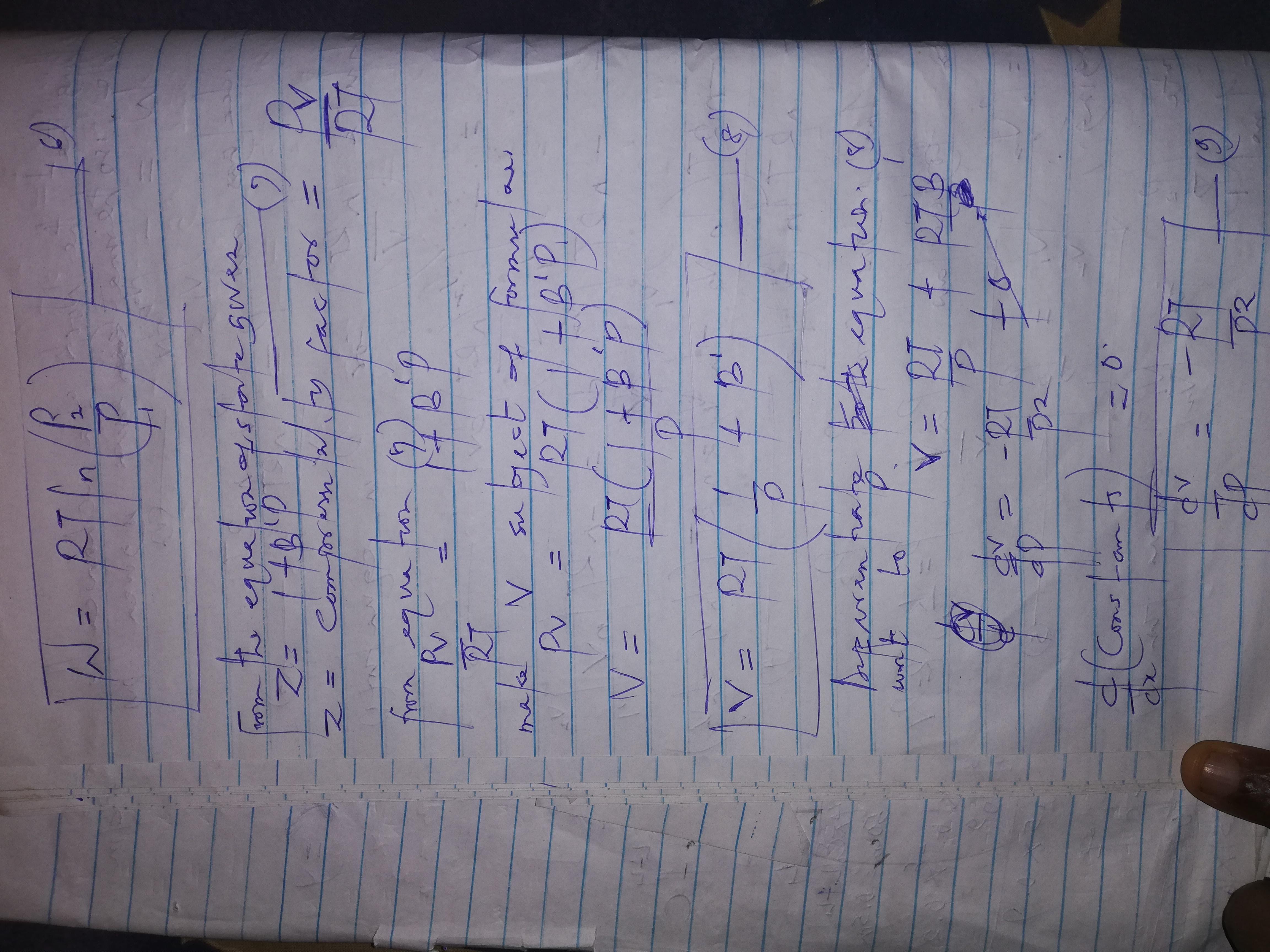
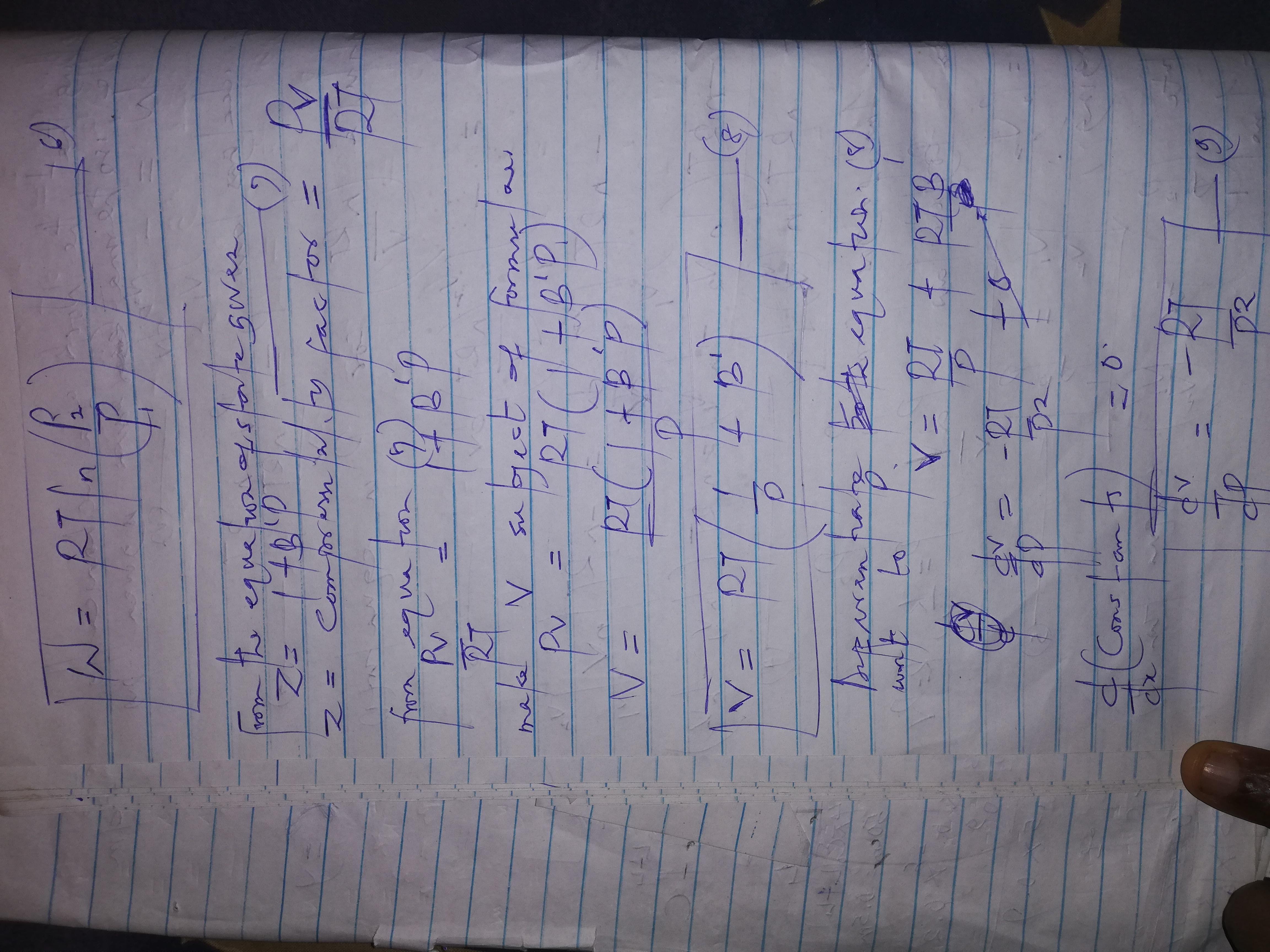
Derive an equation for the work of a mechanically reversible, isothermal compression of 1 mol of a gas from an initial pressure

PI to a final temperature P2 using the equation of state: Z = 1 + B'P How does this result compare with the work found with the corresponding equation for an ideal gas?

Engineering
1 answer:
Lyrx [107]2 years ago
5 0

Answer:

The long derivation for work of a mechanically reversible, isothermal compression was done with detailed steps as shown in the attachment.

Explanation:

what is applied here is a long derivation from Work done in an isobaric process, the expression for the compressibility factor (Z) and the equation of state that was given. The requisite knowledge of Differentiation and Integration was used.

The detailed derivation from firs principle is as shown in the attachment.

You might be interested in
A thermal energy storage unit consists of a large rectangular channel, which is well insulated on its outer surface and encloses
yaroslaw [1]

Answer:

the temperature of the aluminum at this time is 456.25° C

Explanation:

Given that:

width w of the aluminium slab = 0.05 m

the initial temperature T_1 = 25° C

T{\infty} =600^0C

h = 100 W/m²

The properties of Aluminium at temperature of 600° C by considering the conditions for which the storage unit is charged; we have ;

density ρ = 2702 kg/m³

thermal conductivity k = 231 W/m.K

Specific heat c = 1033 J/Kg.K

Let's first find the Biot Number Bi which can be expressed by the equation:

Bi = \dfrac{hL_c}{k} \\ \\ Bi = \dfrac{h \dfrac{w}{2}}{k}

Bi = \dfrac{hL_c}{k} \\ \\ Bi = \dfrac{100 \times \dfrac{0.05}{2}}{231}

Bi = \dfrac{2.5}{231}

Bi = 0.0108

The time constant value \tau_t is :

\tau_t = \dfrac{pL_cc}{h} \\ \\ \tau_t = \dfrac{p \dfrac{w}{2}c}{h}

\tau_t = \dfrac{2702* \dfrac{0.05}{2}*1033}{100}

\tau_t = \dfrac{2702* 0.025*1033}{100}

\tau_t = 697.79

Considering Lumped capacitance analysis since value for Bi is less than 1

Then;

Q= (pVc)\theta_1 [1-e^{\dfrac {-t}{ \tau_1}}]

where;

Q = -\Delta E _{st} which correlates with the change in the internal energy of the solid.

So;

Q= (pVc)\theta_1 [1-e^{\dfrac {-t}{ \tau_1}}]= -\Delta E _{st}

The maximum value for the change in the internal energy of the solid  is :

(pVc)\theta_1 = -\Delta E _{st}max

By equating the two previous equation together ; we have:

\dfrac{-\Delta E _{st}}{\Delta E _{st}{max}}= \dfrac{  (pVc)\theta_1 [1-e^{\dfrac {-t}{ \tau_1}}]} { (pVc)\theta_1}

Similarly; we need to understand that the ratio of the energy storage to the maximum possible energy storage = 0.75

Thus;

0.75=  [1-e^{\dfrac {-t}{ \tau_1}}]}

So;

0.75=  [1-e^{\dfrac {-t}{ 697.79}}]}

1-0.75=  [e^{\dfrac {-t}{ 697.79}}]}

0.25 =  e^{\dfrac {-t}{ 697.79}}

In(0.25) =  {\dfrac {-t}{ 697.79}}

-1.386294361= \dfrac{-t}{697.79}

t = 1.386294361 × 697.79

t = 967.34 s

Finally; the temperature of Aluminium is determined as follows;

\dfrac{T - T _{\infty}}{T_1-T_{\infty}}= e ^ {\dfrac{-t}{\tau_t}}

\dfrac{T - 600}{25-600}= e ^ {\dfrac{-967.34}{697.79}

\dfrac{T - 600}{25-600}= 0.25

\dfrac{T - 600}{-575}= 0.25

T - 600 = -575 × 0.25

T - 600 = -143.75

T = -143.75 + 600

T = 456.25° C

Hence; the temperature of the aluminum at this time is 456.25° C
3 0
2 years ago
Which of these is true about airbag charts?
Arlecino [84]
A should be it or b
4 0
2 years ago
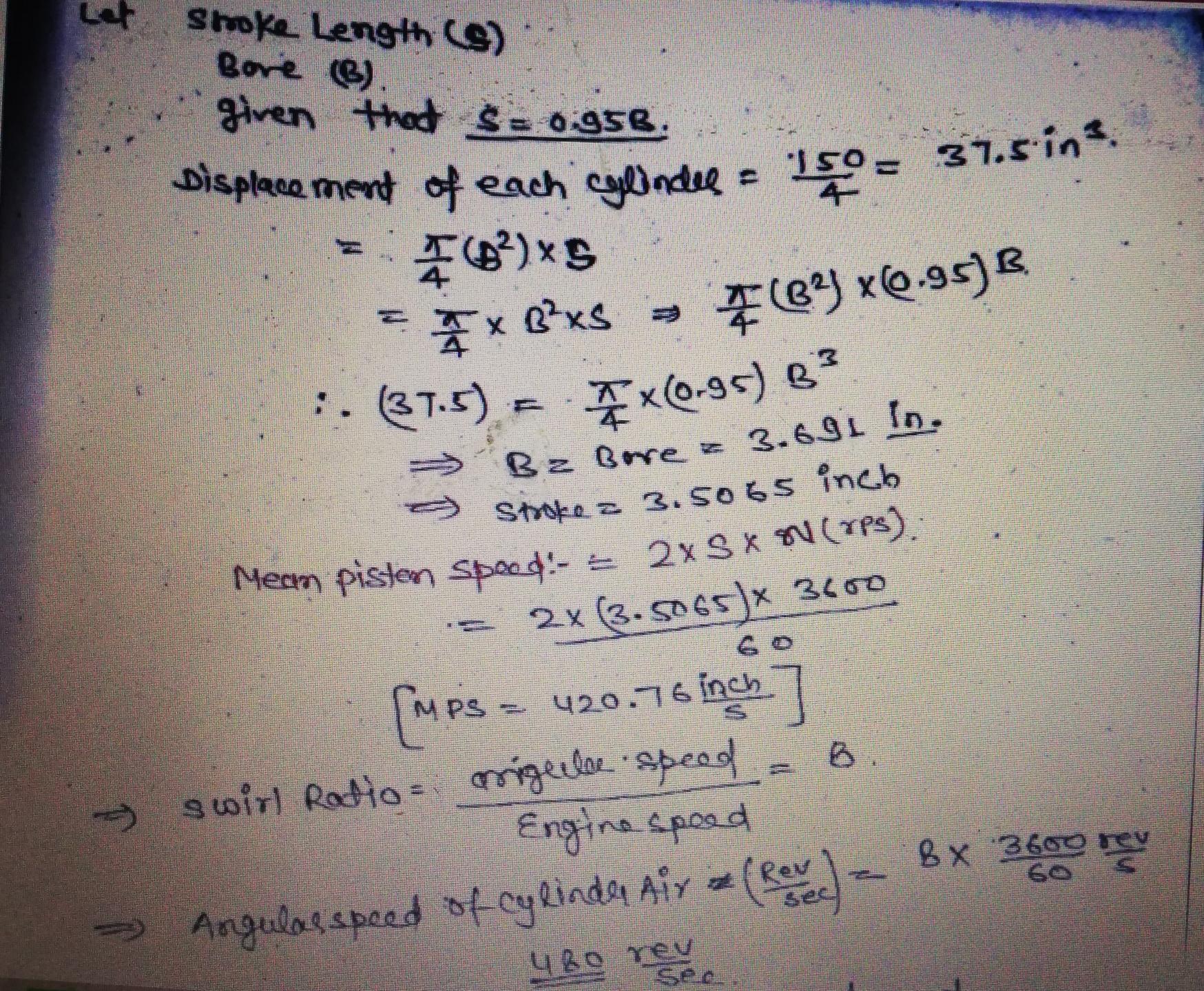
A 150-in.3, four-cylinder, four-stroke cycle, high-swirl CI engine is running at 3600 RPM. Bore and stroke are related by S = 0.
Free_Kalibri [48]

Answer:

Explanation:

(a) Swirl tangential speed = 3 x MPS ( mean piston speed)

= 3 x 420.76 inch/sec = 280.51  [ft/sec]

The other detailed steps is as shown in the attached file

6 0
2 years ago
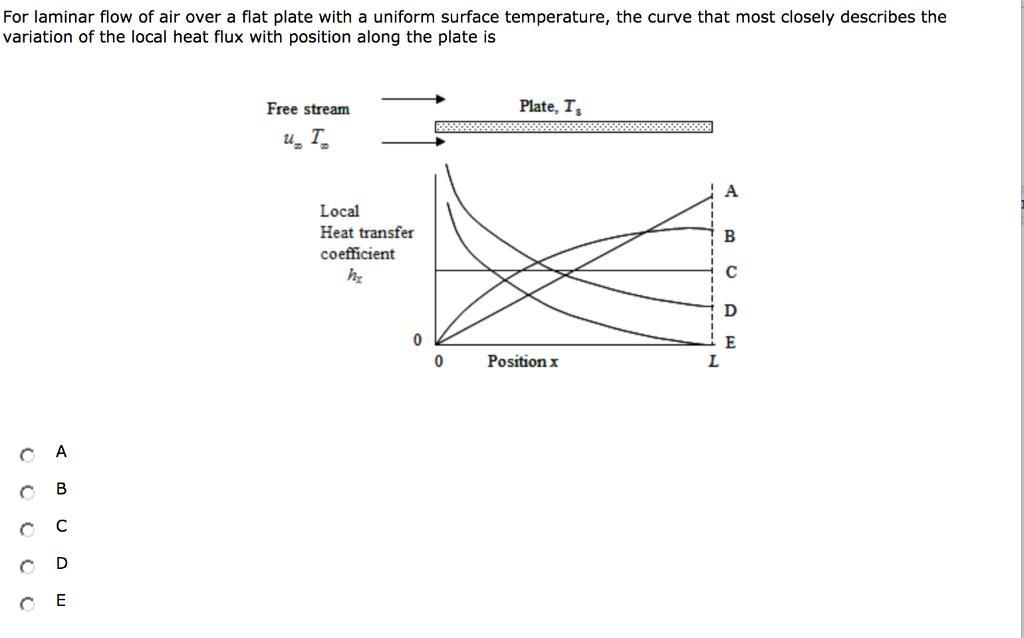
For laminar flow of air over a flat plate that has a uniform surface temperature, the curve that most closely describes the vari
Aliun [14]

This question is incomplete, the missing diagram is uploaded along this answer below;

Answer:

from the diagram, the curve that most closely describes the variation of the local heat transfer coefficient with position along the plate is Option D

Explanation:

Given the data in the question;

We write the expression for the local Nusselt number for Laminar flow over the flat plate;

Nu = C(Re_x)^{0.5 (Pr)^{1/3

Nu = C(\frac{Vx}{v})^{0.5} (Pr)^{1/3

\frac{h_xx}{k} = C(\frac{V}{v})^{0.5}  (Pr)^{1/3  (x)^{0.5

h_x = \frac{1}{x^{1/2}}

Next we write down the expression for the local heat flux from the plate with  uniform surface temperature;

q = h_xA( T_s - T∞ )

q ∝ h_x

∴

q ∝  \frac{1}{x^{1/2}}

The local heat flux decreases with the position as it is inversely proportional to the square root of the position from the leading edge and it will not be zero at the end of the plate.

Therefore, from the diagram, the curve that most closely describes the variation of the local heat transfer coefficient with position along the plate is Option D

3 0
2 years ago
A can of engine oil with a length of 150 mm and a diameter of 100 mm is placed vertically in the trunk of a car. On a hot summer
igomit [66]

Answer:

6.6516 W

Explanation:

The film temperature is given as the average of the two temperatures, hence (43 + 17)/2 = 30°C.

8 0
2 years ago
Other questions:
  • referring to either the CMS file or code book index, what is the cross reference for reduction of a dislocation?
    10·1 answer
  • Water has a density of 1.94 slug/ft^3. What is the density expressed in SI units? Express the answer to three significant figure
    8·1 answer
  • A square loop of wire surrounds a solenoid. The side of the square is 0.1 m, while the radius of the solenoid is 0.025 m. The sq
    6·1 answer
  • Some states have osha programs, but you should always defer to the federal program.
    8·2 answers
  • Use Lagrange multiplier techniques to find the local extreme values of the given function subject to the stated constraint. If a
    15·1 answer
  • Which statement concerning symbols used on plans is true?
    10·1 answer
  • Technician A says that the most efficient method of EVAP system leak detection is introducing smoke under low pressure from a ma
    7·1 answer
  • The mass fractions of a mixture of gases are 15 percent nitrogen, 5 percent helium, 60 percent methane, and 20 percent ethane. T
    9·1 answer
  • The extruder head in a fused- deposition modeling setup has a diameter of 1.25 mm (0.05 in) and produces layers that are 0.25mm
    8·1 answer
  • How does Accenture generate value for clients through Agile and DevOps?
    15·2 answers
Add answer
Login
Not registered? Fast signup
Signup
Login Signup
Ask question!