answer.
Ask question
Login Signup
Ask question
All categories
  • English
  • Mathematics
  • Social Studies
  • Business
  • History
  • Health
  • Geography
  • Biology
  • Physics
  • Chemistry
  • Computers and Technology
  • Arts
  • World Languages
  • Spanish
  • French
  • German
  • Advanced Placement (AP)
  • SAT
  • Medicine
  • Law
  • Engineering
andrezito [222]
2 years ago
15

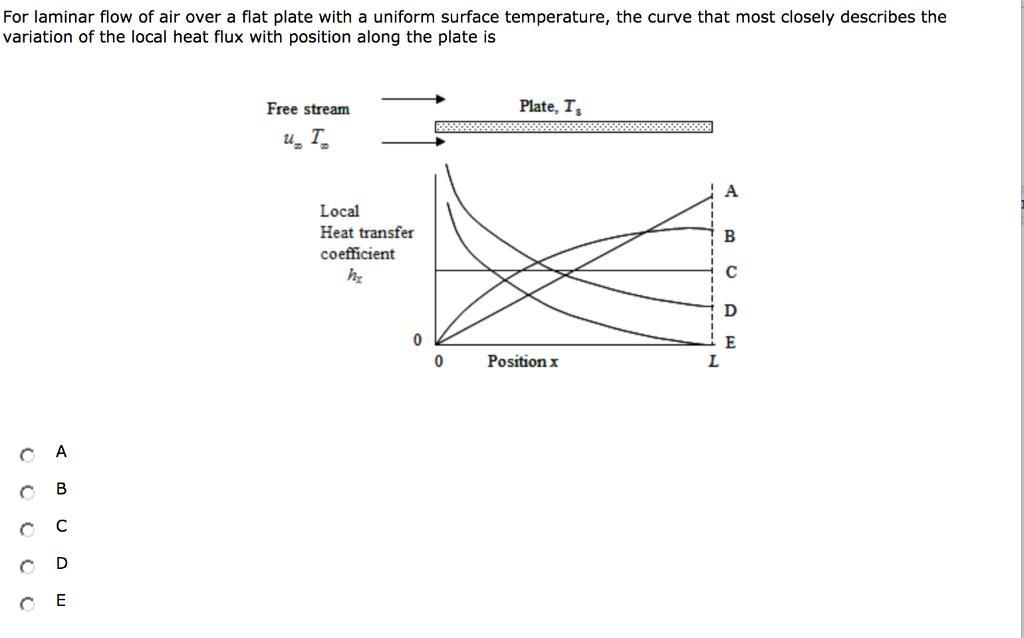
For laminar flow of air over a flat plate that has a uniform surface temperature, the curve that most closely describes the vari

ation of the local heat transfer coefficient with position along the plate is
Engineering
1 answer:
Aliun [14]2 years ago
3 0

This question is incomplete, the missing diagram is uploaded along this answer below;

Answer:

from the diagram, the curve that most closely describes the variation of the local heat transfer coefficient with position along the plate is Option D

Explanation:

Given the data in the question;

We write the expression for the local Nusselt number for Laminar flow over the flat plate;

Nu = C(Re_x)^{0.5 (Pr)^{1/3

Nu = C(\frac{Vx}{v})^{0.5} (Pr)^{1/3

\frac{h_xx}{k} = C(\frac{V}{v})^{0.5}  (Pr)^{1/3  (x)^{0.5

h_x = \frac{1}{x^{1/2}}

Next we write down the expression for the local heat flux from the plate with  uniform surface temperature;

q = h_xA( T_s - T∞ )

q ∝ h_x

∴

q ∝  \frac{1}{x^{1/2}}

The local heat flux decreases with the position as it is inversely proportional to the square root of the position from the leading edge and it will not be zero at the end of the plate.

Therefore, from the diagram, the curve that most closely describes the variation of the local heat transfer coefficient with position along the plate is Option D

You might be interested in
Problem 5) Water is pumped through a 60 m long, 0.3 m diameter pipe from a lower reservoir to a higher reservoir whose surface i
kap26 [50]

Answer:

\epsilon = 0.028*0.3 = 0.0084

Explanation:

\frac{P_1}{\rho} + \frac{v_1^2}{2g} +z_1 +h_p - h_l =\frac{P_2}{\rho} + \frac{v_2^2}{2g} +z_2

where P_1 = P_2 = 0

V1 AND V2  =0

Z1 =0

h_P = \frac{w_p}{\rho Q}

=\frac{40}{9.8*10^3*0.2} = 20.4 m

20.4 - (f [\frac{l}{d}] +kl) \frac{v_1^2}{2g} = 10

we know thaTV  =\frac{Q}{A}

V = \frac{0.2}{\pi \frac{0.3^2}{4}} =2.82 m/sec

20.4 - (f \frac{60}{0.3} +14.5) \frac{2.82^2}{2*9.81} = 10

f  = 0.0560

Re =\frac{\rho v D}{\mu}

Re =\frac{10^2*2.82*0.3}{1.12*10^{-3}} =7.53*10^5

fro Re = 7.53*10^5 and f = 0.0560

\frac{\epsilon}{D] = 0.028

\epsilon = 0.028*0.3 = 0.0084

4 0
2 years ago
The pressure drop across a valve through which air flows is expected to be 10 kPa. If this differential were applied to the two
ozzi

Answer:hit that soulja boy

Explanation:

6 0
2 years ago
1. Add:<br>(i) 5xy, -2xy, -11xy, 8xy<br>(iv) 3a - 2b + c, 5a + 8b -70​
Cerrena [4.2K]

Answer:

(i) 0

(iv) 8a+6b+c-70

Explanation:

Hope this helps you

8 0
1 year ago
A 10-m long steel linkage is to be designed so that it can transmit 2 kN of force without stretching more than 5 mm nor having a
Fed [463]

Answer:

<em>minimum required diameter of the steel linkage is 3.57 mm</em>

<em></em>

Explanation:

original length of linkage l = 10 m

force to be transmitted  f = 2 kN = 2000 N

extension e = 5 mm= 0.005 m

maximum stress σ = 200 N/mm^2 = 2*10^{8}  N/m^{2}

maximum stress allowed on material σ = force/area

imputing values,

200 = 2000/area

area = 2000/(2*10^{8}) = 10^{-5} m^2

recall that area = \pi d^{2} /4

10^{-5} = \frac{3.142*d^{2} }{4} = 0.7855d^{2}

d^{2} = \frac{10^{-5} }{0.7855} = 1.273*10^{-5}

d = \sqrt{1.273*10^{-5}  } = 3.57*10^{-3} m = 3.57 mm

<em>maximum diameter of  the steel linkage d = 3.57 mm</em>

4 0
2 years ago
A platinum resistance temperature sensor has a resistance of 120 Ω at 0℃ and forms one arm of a Wheatstone bridge. At this tempe
oksian1 [2.3K]

Answer : 9.36ohms/ temperature

Explanation:

Expression for the variation of resistance of platinum with temperature

Rt= Ro(1+*t)

Rt= resistance @ t°C

Ro= resistance @ 0°C

*= temperature coefficient of resistance

Calculate the change in resistance by putting 120ohms for Ro,

0.0039/K for *

20°C for t

Using this formula:

Rt = Ro(1+*t)

Rt- Ro = Ro*t

= (120ohms)(0.0039/K)(20°C)

= 9.36ohms/K
8 0
2 years ago
Other questions:
  • generally compound curves are not filtered recommended for A. Road B. water way C. underground road D. rail way​
    12·1 answer
  • A particle has an initial velocity of v0 = 14 ft/s to the right, at s0 = 0, and a = 2 ft/s2 to the left. determine its position
    5·1 answer
  • Air at 40°C flows over a long, 25-mm-diameter cylinder with an embedded electrical heater. In a series of tests, measurements we
    11·1 answer
  • The 2-Mg concrete pipe has a center of mass at point G. If it is suspended from cables AB and AC, determine the diameter of cabl
    12·1 answer
  • A binary star system consists of two stars of masses m1m1m_1 and m2m2m_2. The stars, which gravitationally attract each other, r
    9·1 answer
  • The components of an electronic system dissipating 90 W are located in a 1-m-long circular horizontal duct of 15-cm diameter. Th
    11·1 answer
  • An inventor claims to have developed an engine that does not use fuel but operates as a power cycle at steady state while receiv
    10·2 answers
  • Define initial set and final set. Briefly discuss one method used to determine them. The following laboratory tests are performe
    12·1 answer
  • ) A given system has four sensors that can produce an output of 0 or 1. The system operates properly when exactly one of the sen
    9·1 answer
  • Find the velocity and rate of flow of water through a rectangular channel of 6m wide and 3m deep when it's running full. The cha
    13·1 answer
Add answer
Login
Not registered? Fast signup
Signup
Login Signup
Ask question!
