answer.
Ask question
Login Signup
Ask question
All categories
  • English
  • Mathematics
  • Social Studies
  • Business
  • History
  • Health
  • Geography
  • Biology
  • Physics
  • Chemistry
  • Computers and Technology
  • Arts
  • World Languages
  • Spanish
  • French
  • German
  • Advanced Placement (AP)
  • SAT
  • Medicine
  • Law
  • Engineering
Art [367]
2 years ago
15

Consider water at 27°C in parallel flow over an isothermal, 1‐m‐long flat plate with a velocity of 2 m/s. a) Plot the variation

(in MATLAB or Excel) of the local heat transfer coefficient, hx(x), with distance along the plate for three flow conditions corresponding to critical (transition) Reynolds numbers of (i) 5 × 10^5, (ii) 3 × 10^5, and (iii) 0 (the flow is fully turbulent). b) Calculate the average heat transfer coefficients for the entire plate for the three flow conditions of part (a)?

Engineering
1 answer:
yulyashka [42]2 years ago
6 0

Answer:

i) h-bar-L = 4110 W/m^2K

ii ) h-bar-L = 4490 W/m^2K

iii) h-bar-L = 5072 W/m^2K

Explanation:

Given:-

- The temperature of water, T = 27°C

- The velocity of fluid flow, U∞ = 2m/s

- The length of the flat place, L = 1 m

Solution:-

- Using table A-6, to determine the properties of water:

                   Density ρ = 997 kg/m^3

                   Dynamic viscosity ν = 0.858*10^-6 m^2/s

                   Pr = 583 , k = 0.613 W/m.K

- The reynold's number for full length (L = 1m):

                   Re = U∞*L / ν

                   Re = (2)*(1) / (0.858*10^-6)

                  Re = 2.33*10^6

- The boundary layer is mixed with Rex,c = 5*10^5. Evaluate the critical length (xc):

                 xc = L* ( Rex,c / Re )

                      = (5*10^5 / 2.33*10^6 )

                      = 0.215 m

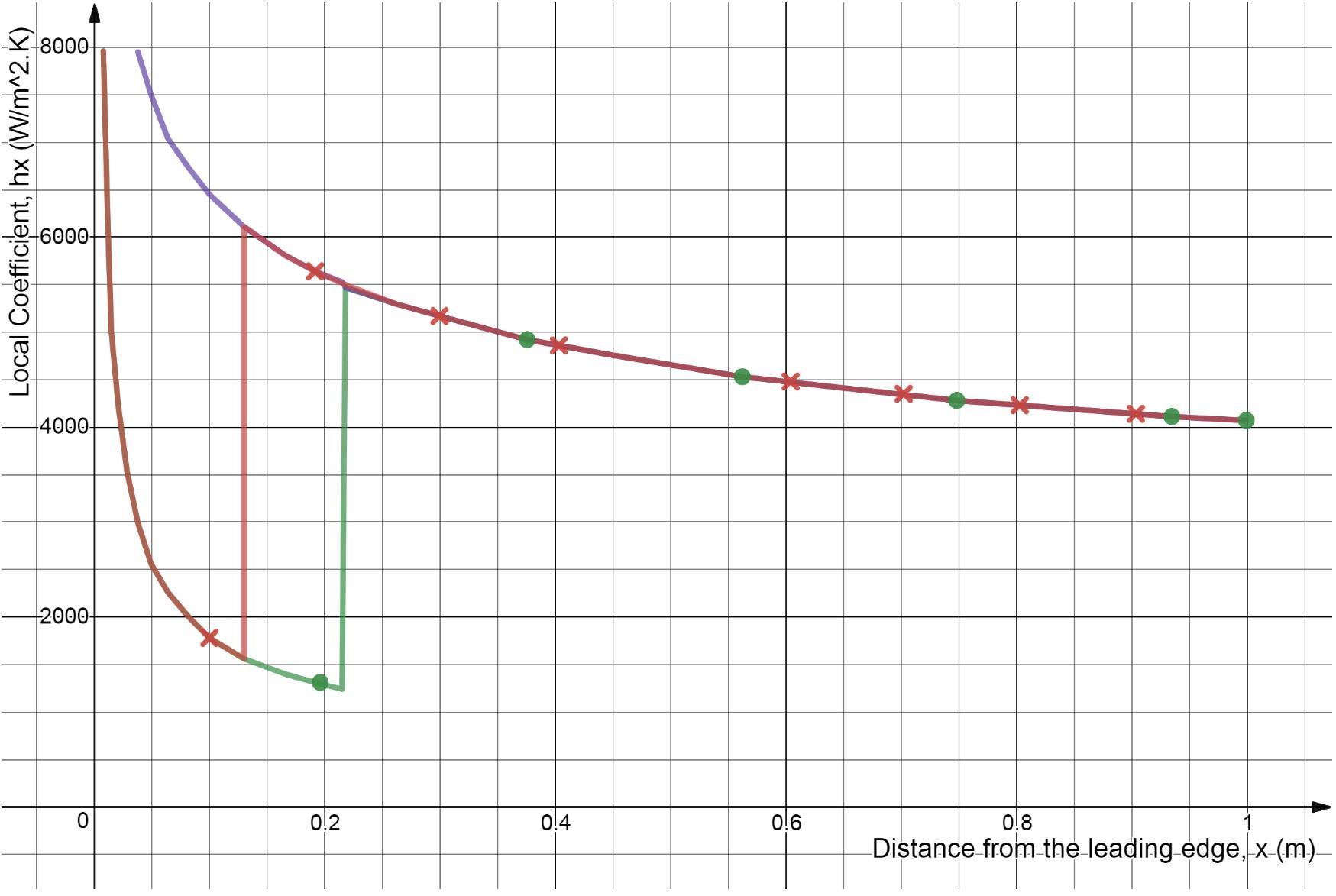
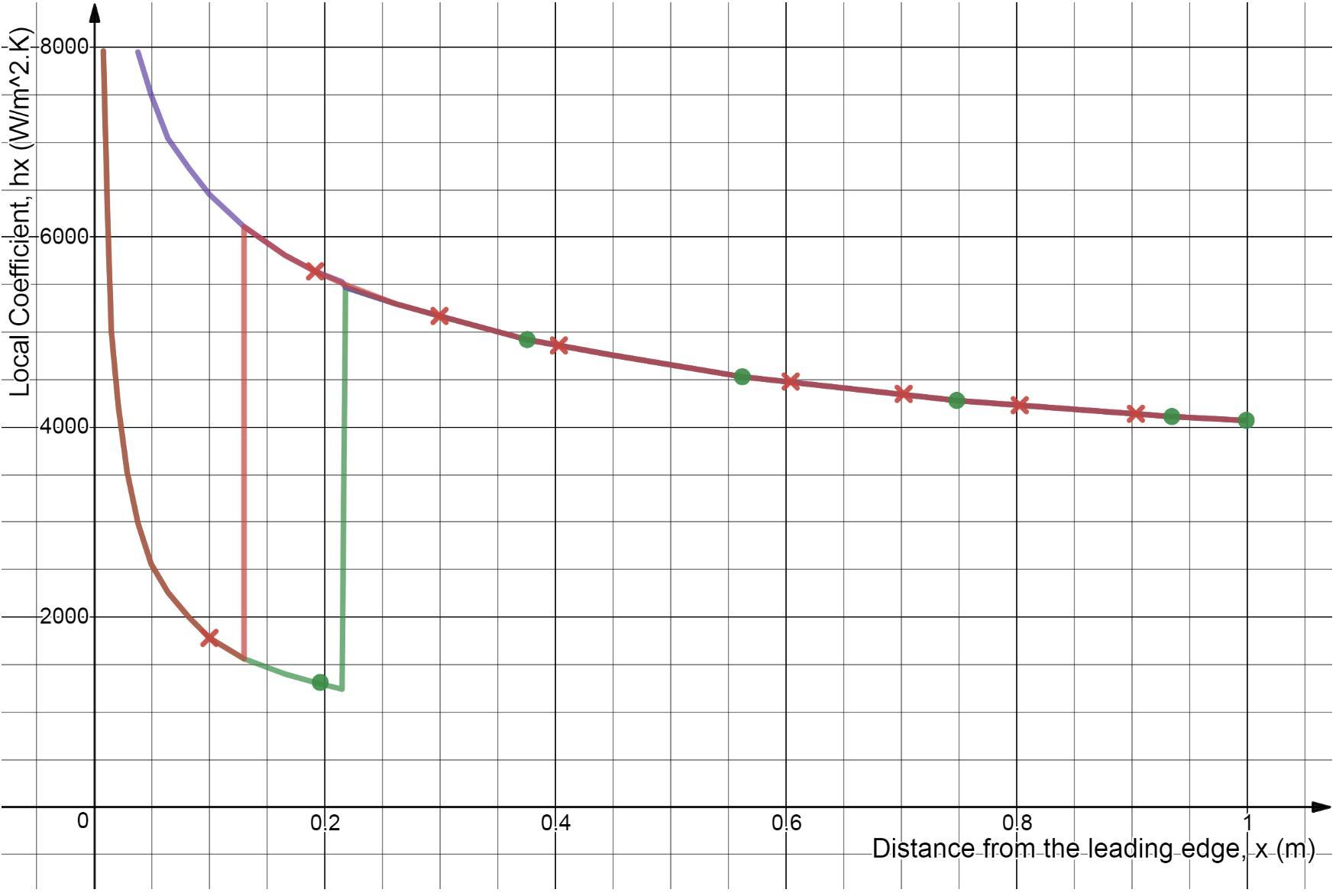
a) Using "IHT correlation tool, External Flow, Local coefficients for laminar or Turbulent flows", h (x) was evaluated and plotted with critical Reynolds number for all 3 cases: (i) 5 × 10^5, (ii) 3 × 10^5, and (iii) 0 (the flow is fully turbulent). - (See attachment 1)

b) Using "IHT correlation tool, External Flow, Average coefficients for laminar or Mixed flows", h - bar- (x) was evaluated and plotted with critical Reynolds number for all 3 cases: (i) 5 × 10^5, (ii) 3 × 10^5, and (iii) 0 (the flow is fully turbulent). - (See attachment 2)

c) The average convection coefficient for the plate can be determined from the graphs presented in (Attachments 1 and 2). Since,

                                    h-bar-L = h-bar-x(L)

The values for the flow conditions are:

             ( i) h-bar-L = 4110,  ii ) h-bar-L = 4490 , iii) h-bar-L = 5072 ) W/m^2K
                   

You might be interested in
Consider an infinitely thin flat plate of chord c at an angle of attack α in a supersonic flow. The pressure on the upper and lo
amm1812

Answer:

X_cp = c/2

Explanation:

We are given;

Chord = c

Angle of attack = α

p u (s) = c 1

​p1(s)=c2,

and c2 > c1

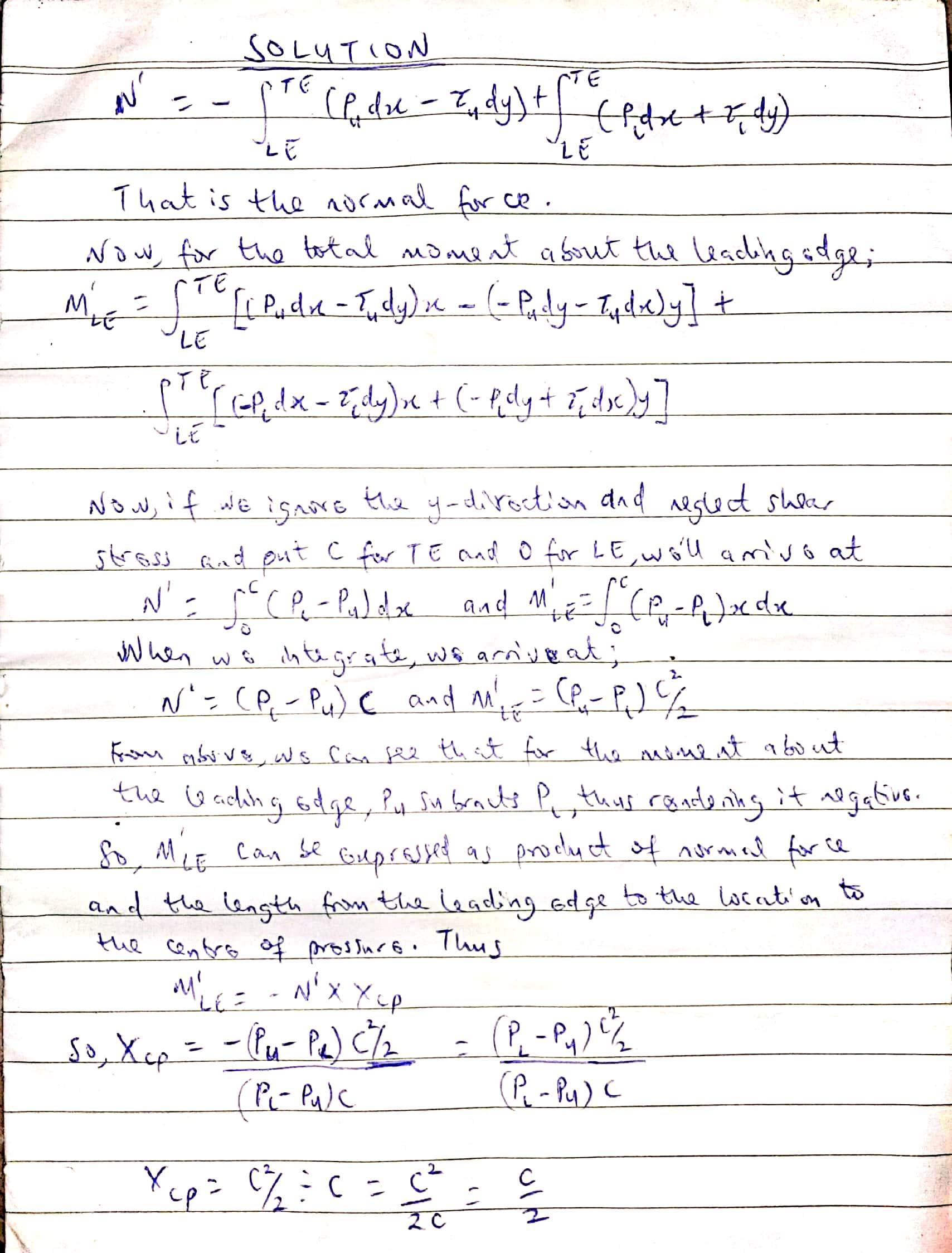
First of all, we need to find the resultant normal force on the plate and the total moment about leading edge.

I've attached the solution

4 0
2 years ago
3/63 A 2‐kg sphere S is being moved in a vertical plane by a robotic arm. When the angle θ is 30°, the angular velocity of the a
miss Akunina [59]

Answer:

Ps=19.62N

Explanation:

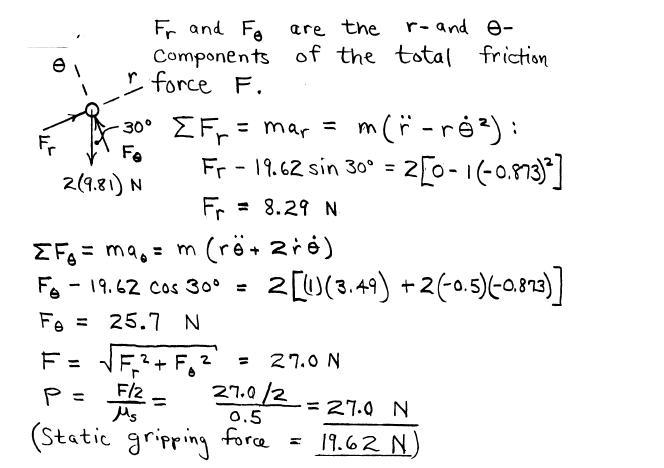
The detailed explanation of answer is given in attached files.

5 0
2 years ago
The wires each have a diameter of 12 mm, length of 0.6 m, and are made from 304 stainless steel. Determine the magnitude of forc
Sonbull [250]

Answer:

Magnitude of force P = 25715.1517 N

Explanation:

Given - The wires each have a diameter of 12 mm, length of 0.6 m, and are made from 304 stainless steel.

To find - Determine the magnitude of force P so that the rigid beam tilts 0.015∘.

Proof -

Given that,

Diameter = 12 mm = 0.012 m

Length = 0.6 m

\theta = 0.015°

Youngs modulus of elasticity of 34 stainless steel is 193 GPa

Now,

By applying the conditions of equilibrium, we have

∑fₓ = 0, ∑f_{y} = 0, ∑M = 0

If ∑M_{A} = 0

⇒F_{BC}×0.9 - P × 0.6 = 0

⇒F_{BC}×3 - P × 2 = 0

⇒F_{BC} = \frac{2P}{3}

If ∑M_{B} = 0

⇒F_{AD}×0.9 = P × 0.3

⇒F_{AD} ×3 = P

⇒F_{AD} = \frac{P}{3}

Now,

Area, A = \frac{\pi }{4} X (0.012)^{2} = 1.3097 × 10⁻⁴ m²

We know that,

Change in Length , \delta = \frac{P l}{A E}

Now,

\delta_{AD} = \frac{P(0.6)}{3(1.3097)(10^{-4}) (193)(10^{9}  } = 9.1626 × 10⁻⁹ P

\delta_{BC} = \frac{2P(0.6)}{3(1.3097)(10^{-4}) (193)(10^{9}  } = 1.83253 × 10⁻⁸ P

Given that,

\theta = 0.015°

⇒\theta = 2.618 × 10⁻⁴ rad

So,

\theta =  \frac{\delta_{BC} - \delta_{AD}}{0.9}

⇒2.618 × 10⁻⁴ = (  1.83253 × 10⁻⁸ P - 9.1626 × 10⁻⁹ P) / 0.9

⇒P = 25715.1517 N

∴ we get

Magnitude of force P = 25715.1517 N

6 0
2 years ago
2An oil pump is drawing 44 kW of electric power while pumping oil withrho=860kg/m3at a rate of 0.1m3/s.The inlet and outlet diam
Natasha2012 [34]

Answer:

\eta = 91.7%

Explanation:

Determine the initial velocity

v_1 = \frac{\dot v}{A_1}

    = \frac{0.1}{\pi}{4} 0.08^2

     = 19.89 m/s

final velocity

v_2 =\frac{\dot v}{A_2}

      = \frac{0.1}{\frac{\pi}{4} 0.12^2}

      =8.84 m/s

total mechanical energy is given as

E_{mech} = \dot m (P_2v_2 -P_1v_1) + \dot m \frac{v_2^2 - v_1^2}{2}

\dot v = \dot m v                       ( v =v_1 =v_2)

E_{mech} = \dot mv (P_2 -P_1) + \dot m \frac{v_2^2 - v_1^2}{2}

                = mv\Delta P + \dot m  \frac{v_2^2 -v_1^2}{2}

                 = \dot v \Delta P  + \dot v \rho \frac{v_2^2 -v_1^2}{2}

              = 0.1\times 500 + 0.1\times 860\frac{8.84^2 -19.89^2}{2}\times \frac{1}{1000}

E_{mech} = 36.34 W

Shaft power

W = \eta_[motar} W_{elec}

    =0.9\times 44 =39.6

mechanical efficiency

\eta{pump} =\frac{ E_{mech}}{W}

=\frac{36.34}{39.6} = 0.917  = 91.7%

8 0
2 years ago
During an experiment conducted in a room at 25°C, a laboratory assistant measures that a refrigerator that draws 2 kW of power h
zvonat [6]

Answer:

Not reasonable.

Explanation:

To solve this problem it is necessary to take into account the concepts related to the performance of a reversible refrigerator. The coefficient of performance is basically defined as the ratio between the heating or cooling provided and the electricity consumed. The higher coefficients are equivalent to lower operating costs. The coefficient can be greater than 1, because it is a percentage of the output: losses, other than the thermal efficiency ratio: input energy. For a reversible refrigerator the coefficient is given by

COP_{R,rev} = \frac{1}{\frac{T_1}{T_2}-1}

Where,

T_1 =High temperature

T_2 =Low Temperature

With our values previous given we can find it:

T_2 = -30\°C = (-30+273)

T_2 = 243K

T_1 = 25\°C = (25+273)

T_1 = 298K

With these values we can now calculate the coefficient of performance:

COP_{R,rev} = \frac{1}{\frac{298}{243}-1}

COP_{R,rev} = 4.42

At the same time we can calculate the work consumption of the refrigerator, this is

W = \dot{W}\Delta t

Where,

\dot{W} = Required power input

t = time to remove heat from a cool to water medium

W = 2kJ/s * 20 min

W = 2kJ/s * 1200s

W = 2400kJ

In this way we can calculate the coefficient of the refrigerator directly:

COP_R = \frac{Q_L}{W}

Where,

Q = Amoun of heat rejected

COP_R = \frac{30000}{2400}

COP_R = 12.5

Comparing the values of both coefficients we have that the experiments are NOT reasonable, because the coefficient of a refrigerator is high compared to  coefficient of reversible refrigerator.

5 0
2 years ago
Other questions:
  • A charge of 2.0 × 10⁻¹⁰ C is to be stored on each plate of a parallel-plate capacitor having an area of 650 mm2 (1.0 in.2 ) and
    14·1 answer
  • A particle has an initial velocity of v0 = 14 ft/s to the right, at s0 = 0, and a = 2 ft/s2 to the left. determine its position
    5·1 answer
  • ) A shaft encoder is to be used with a 50 mm radius tracking wheel to monitor linear displacement. If the encoder produces 256 p
    15·1 answer
  • In a parallel one-dimensional flow in the positive x direction, the velocity varies linearly from zero at y = 0 to 32 m/s at y =
    8·1 answer
  • Suppose that a class CalendarDate has been defined for storing a calendar date with month, day and year components. (In our sect
    6·1 answer
  • Determine F12 and F21 for the following configurations: (a) A long semicircular duct with diameter of 0.1 meters: (b) A hemisphe
    10·1 answer
  • 15. A cold-chamber die-casting machine operates automatically, supported by two industrial robots.The machine produces two zinc
    9·2 answers
  • An ideal Diesel cycle has a compression ratio of 18 and a cutoff ratio of 1.5. Determine the maximum air temperature and the rat
    9·1 answer
  • what is the advantage of decreasing the field current of a separately excited dc motor below its nominal value
    7·1 answer
  • Which of the following types of protective equipment protects workers who are passing by from stray sparks or metal while anothe
    8·1 answer
Add answer
Login
Not registered? Fast signup
Signup
Login Signup
Ask question!