answer.
Ask question
Login Signup
Ask question
All categories
  • English
  • Mathematics
  • Social Studies
  • Business
  • History
  • Health
  • Geography
  • Biology
  • Physics
  • Chemistry
  • Computers and Technology
  • Arts
  • World Languages
  • Spanish
  • French
  • German
  • Advanced Placement (AP)
  • SAT
  • Medicine
  • Law
  • Engineering
xxMikexx [17]
2 years ago
10

Determine F12 and F21 for the following configurations: (a) A long semicircular duct with diameter of 0.1 meters: (b) A hemisphe

re-disk arrangement, with hemisphere diameter of 0.1 meters:
Engineering
1 answer:
uysha [10]2 years ago
6 0

Answer:

long duct: 1.0 and 0.424

Hemisphere 1.0 ; 0.125; 0.5

Explanation:

For a long duct:

By inspection, F_{12} = 1.0

Calculating by reciprocity, F_{21} = \frac{A_{1} }{A_{2}F_{12}  }  = \frac{2RL}{\frac{3}{4}*2\pi RL  }* 1.0\\                                                         = 0.424

Hemisphere:

By reciprocity gives = 0.125

using the summation rule: F_{21} + F_{22} + F_{23} = 1

However, because this is a hemisphere, the value will be= 0.5 * 1

                                                                                               = 0.5

You might be interested in
Who want to play "1v1 lol unblocked games 76"
kotegsom [21]

Answer:I want to play what game?

Explanation:

3 0
2 years ago
Read 2 more answers
The ingredient weights for making 1 yd (cyd) of concrete by assuming aggregates in SSD state are given below. The volume of air
Pachacha [2.7K]

Answer:

Explanation:

Ans) Given batch weight of each component :

Cement = 700 lb

Water = 315 lb

Coarse aggregate = 1575 lb

Fine aggregate = 1100 lb

Part 1) Amount of water = 328.5 lb

Amount of water is needed to be increased if the aggregates has absorption capacity, To maintain constant water cement ratio, the mixing water is increased because some of the water is absorbed by aggregates.

Amount of water absorbed = 328.5 lb - 315 lb = 13.5 lb

Total amount of aggregates = 1575 + 1100 = 2675 lb

=> % Absorption capacity = 13.5 x 100 / 2675 = 0.5 %

Hence, new amount of Coarse aggregate = (1 - 0.005) x 1575 lb = 1567.125 lb

New amount of fine aggregate = (1 - 0.005) x 1100 = 1094.5 lb

Since, water cement ratio is maintained constant , amount of cement remains unchanged

=> Volume of water = 328.5 / 62.4 = 5.26 ft3

=> Volume of cement = 700 / (3.15 x 62.4) = 3.56 ft3

=> Volume of coarse aggregate = 1567.125 / (2.4 x 62.4) = 10.46 ft3

=> Volume of fine aggregate = 1100 / (2.4 x 62.4) = 7.34 ft3

Volume of air = 2% = 0.02 x 27 = 0.54 ft3

Total concrete volume = 5.26 + 3.56 + 10.46 + 7.34 + 0.54 \approx 27 ft3 = 1 yd3

Hence, calculated amount of each component is correct

Part 2) We know, minus sign indicated that the aggregate will absorb some moisture from concrete, hence mixing water amount needed to be corrected .

=> Amount of water absorbed by coarse aggregate = 0.01 x 1567.125 lb = 15.67 lb

=> Amount of water absorbed by fine aggregate = 0.02 x 1094.50 lb = 21.89 lb

Total amount of water absorbed = 15.67 + 21.89 = 37.56 lb

To maintain same water cement ratio, amount of mixing water is needed to be increased

=> Corrected amount of mixing water = 328.5 lb + 37.56 lb = 366 lb

=> Corrected amount of coarse aggregate = (1 - 0.01) x 1567.125 = 1551.45 lb

=> Corrected amount of fine aggregate = (1 - 0.02) x 1094.5 = 1072.6 lb

Part 3) We know,

Unit weight = Sum of weight of each material / Total volume

=> Sum of weight = 366 + 700 + 1551.45 + 1072.6 = 3690.05 lb

Total volume = 1 yd3 or 27 ft3

=> Expected Unit Weight = 3690.05 lb / 27 ft3 = 136.67 lb/ft3

Also, Concrete Yield = Weight of all components / Unit weight of concrete

=> Yield = 3690.05 / 136.67 = 27 ft3 or 1 yd3

4 0
2 years ago
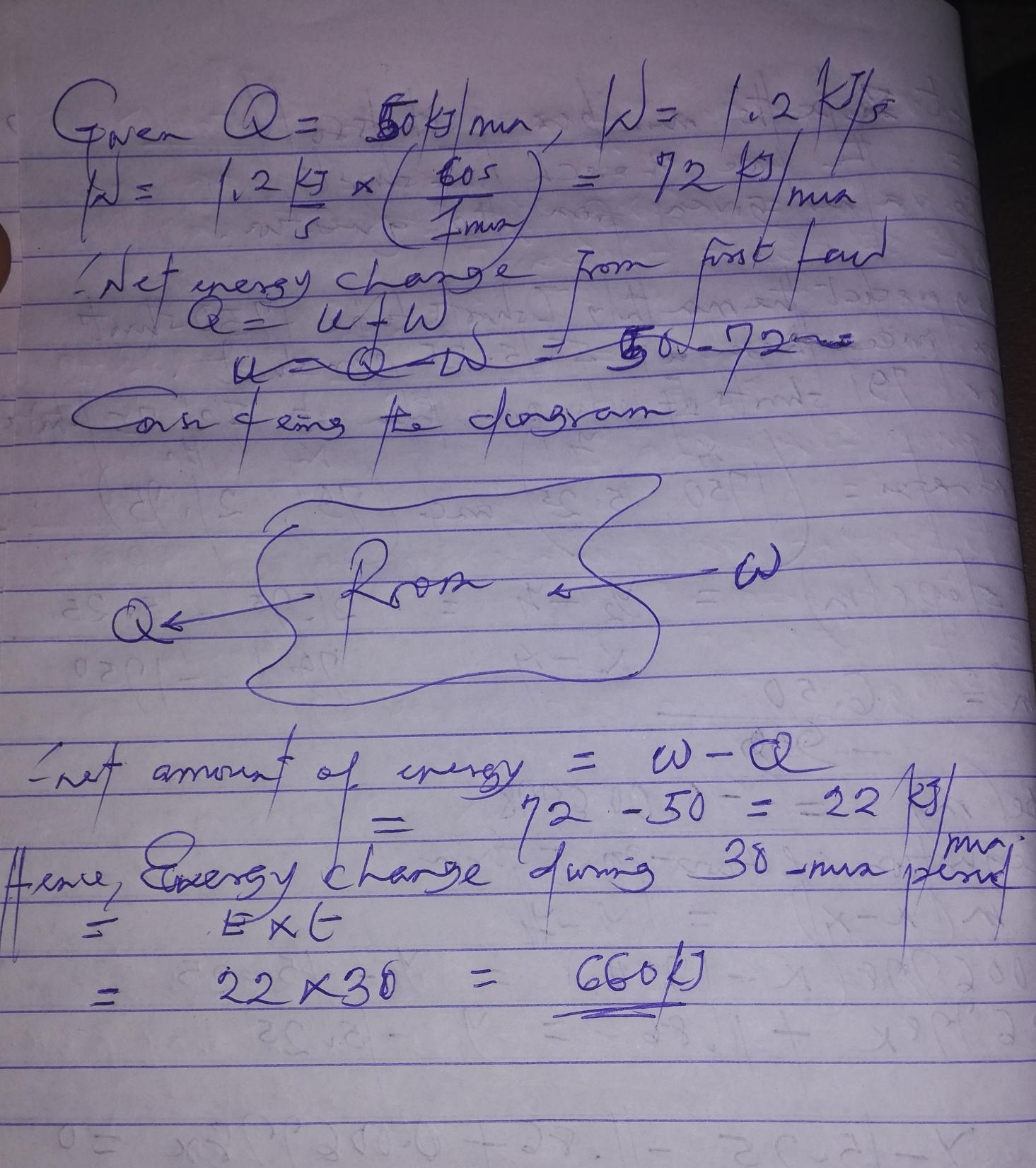
The air contained in a room loses heat to the surroundings at a rate of 50 kJ/min while work is supplied to the room by computer
Artemon [7]

Answer:

net amount of energy change of the air in the room during a 30-min period = 660KJ

Explanation:

The detailed calculation is as shown in the attached file.

4 0
2 years ago
Read 2 more answers
A six- lane freeway ( three lanes in each direction) in a scenic area has a measured free- flow speed of 55 mi/ h. The peak- hou
Novosadov [1.4K]

Answer:

0.867

Explanation:

The driver population factor (f_{p})can be estimated using the equation below:

f_{p} = \frac{V}{PHF*N*f_{HV}*v_{p}}

The value of the heavy vehicle factor (f_{HV}) is determined below:

The values of the E_{T} = 2 and E_{R} = 3 are gotten from the tables for the RVs, trucks and buses upgrades for passenger-car equivalents. Therefore:

f_{HV} = 1/[1+0.08(2-1)+0.06(3-1)] = 1/[1+0.08+0.12] = 1/1.2 = 0.833

Furthermore, the vp is taken as 2250 pc/(h*In) from the table of LOS criteria for lane freeway using the 15 minutes flow rate. Therefore:

f_{p} = 3900/[0.8*3*0.833*2250] = 3900/4498.2 = 0.867

6 0
2 years ago
A thermal energy storage unit consists of a large rectangular channel, which is well insulated on its outer surface and encloses
yaroslaw [1]

Answer:

the temperature of the aluminum at this time is 456.25° C

Explanation:

Given that:

width w of the aluminium slab = 0.05 m

the initial temperature T_1 = 25° C

T{\infty} =600^0C

h = 100 W/m²

The properties of Aluminium at temperature of 600° C by considering the conditions for which the storage unit is charged; we have ;

density ρ = 2702 kg/m³

thermal conductivity k = 231 W/m.K

Specific heat c = 1033 J/Kg.K

Let's first find the Biot Number Bi which can be expressed by the equation:

Bi = \dfrac{hL_c}{k} \\ \\ Bi = \dfrac{h \dfrac{w}{2}}{k}

Bi = \dfrac{hL_c}{k} \\ \\ Bi = \dfrac{100 \times \dfrac{0.05}{2}}{231}

Bi = \dfrac{2.5}{231}

Bi = 0.0108

The time constant value \tau_t is :

\tau_t = \dfrac{pL_cc}{h} \\ \\ \tau_t = \dfrac{p \dfrac{w}{2}c}{h}

\tau_t = \dfrac{2702* \dfrac{0.05}{2}*1033}{100}

\tau_t = \dfrac{2702* 0.025*1033}{100}

\tau_t = 697.79

Considering Lumped capacitance analysis since value for Bi is less than 1

Then;

Q= (pVc)\theta_1 [1-e^{\dfrac {-t}{ \tau_1}}]

where;

Q = -\Delta E _{st} which correlates with the change in the internal energy of the solid.

So;

Q= (pVc)\theta_1 [1-e^{\dfrac {-t}{ \tau_1}}]= -\Delta E _{st}

The maximum value for the change in the internal energy of the solid  is :

(pVc)\theta_1 = -\Delta E _{st}max

By equating the two previous equation together ; we have:

\dfrac{-\Delta E _{st}}{\Delta E _{st}{max}}= \dfrac{  (pVc)\theta_1 [1-e^{\dfrac {-t}{ \tau_1}}]} { (pVc)\theta_1}

Similarly; we need to understand that the ratio of the energy storage to the maximum possible energy storage = 0.75

Thus;

0.75=  [1-e^{\dfrac {-t}{ \tau_1}}]}

So;

0.75=  [1-e^{\dfrac {-t}{ 697.79}}]}

1-0.75=  [e^{\dfrac {-t}{ 697.79}}]}

0.25 =  e^{\dfrac {-t}{ 697.79}}

In(0.25) =  {\dfrac {-t}{ 697.79}}

-1.386294361= \dfrac{-t}{697.79}

t = 1.386294361 × 697.79

t = 967.34 s

Finally; the temperature of Aluminium is determined as follows;

\dfrac{T - T _{\infty}}{T_1-T_{\infty}}= e ^ {\dfrac{-t}{\tau_t}}

\dfrac{T - 600}{25-600}= e ^ {\dfrac{-967.34}{697.79}

\dfrac{T - 600}{25-600}= 0.25

\dfrac{T - 600}{-575}= 0.25

T - 600 = -575 × 0.25

T - 600 = -143.75

T = -143.75 + 600

T = 456.25° C

Hence; the temperature of the aluminum at this time is 456.25° C

3 0
2 years ago
Other questions:
  • A system consisting of 3 lb of water vapor in a piston–cylinder assembly, initially at 350°F and a volume of 71.7 ft3, is expand
    11·1 answer
  • Evan notices a small fire in his workplace. Since the fire is small and the atmosphere is not smoky he decides to fight the fire
    10·1 answer
  • Your roommate wants to learn about organizational chart. You can tell her that these charts can tell you all of these about an o
    10·1 answer
  • Consider a very long rectangular fin attached to a flat surface such that the temperature at the end of the fin is essentially t
    9·1 answer
  • A negative pressure respirator brings fresh air to you through a hose<br>A) True<br>B)False​
    15·2 answers
  • You are an electrician on the job. The electrical blueprint shows that eight 500-W lamps are to be installed on the same circuit
    11·1 answer
  • Suppose that a class CalendarDate has been defined for storing a calendar date with month, day and year components. (In our sect
    6·1 answer
  • 6.8.1: Function pass by pointer: Transforming coordinates. Define a function CoordTransform() that transforms its first two inpu
    9·1 answer
  • Air ows steadily in a thermally insulated pipe with a constant diameter of 6.35 cm, and an average friction factor of 0.005. At
    5·1 answer
  • What are some goals of NYFEA? Select three options.
    9·2 answers
Add answer
Login
Not registered? Fast signup
Signup
Login Signup
Ask question!