answer.
Ask question
Login Signup
Ask question
All categories
  • English
  • Mathematics
  • Social Studies
  • Business
  • History
  • Health
  • Geography
  • Biology
  • Physics
  • Chemistry
  • Computers and Technology
  • Arts
  • World Languages
  • Spanish
  • French
  • German
  • Advanced Placement (AP)
  • SAT
  • Medicine
  • Law
  • Engineering
kiruha [24]
2 years ago
6

The outer surface of an engine is situated in a place where oil leakage can occur. When leaked oil comes in contact with ahot su

rface that has a temperature above its autoignition temperature. the oil can ignite spontaneously. Consider anengine cover that is made of a stainless steel plate with a thickness of 1 cm and a thermal conductivity of 14 W/m-K Theinner surface of the engine cover is exposed to hot air with a convection heat transfer coefficient of 7 W/m2-K at 333°C.The outer surface is exposed to an environment where the ambient air is 69‘C with a convection heat transfer coefficientof 7 W/mZ-K To prevent fire hazard in the event of oil leak on the engine cover, a layer of thermal barrier coating (T BC)with a thermal conductivity of 11 W/m-K is applied on the engine cover outer surface. Would a TBC layer of 4 mm inthickness be sufficient to keep the engine cover surface below autoignition temperature of 200T to prevent fire hazard?

Engineering
1 answer:
VladimirAG [237]2 years ago
3 0

Answer:

TBC thickness of 4 mm is insufficient to prevent fire hazard

Explanation:

Given:

- Temperature of hot-fluid inner surface T_i = 333°C

- The convection coefficient hot-fluid h_i = 7 W/m^2K

- The thermal conductivity of engine cover k_1 = 14 W/mK

- The thickness of engine cover L_1 = 0.01 m

- The thermal conductivity of TBC layer k_2 = 1.1 W/mK  ... (Typing error)

- The thickness of TBC layer L_2 = 0.004 m

- Temperature of ambient air outer surface T_o = 69°C

- The convection coefficient ambient air h_o = 7 W/m^2K

Find:

Would a TBC layer of 4 mm thickness be sufficient to keep the engine cover surface below autoignition temperature of 200°C to prevent fire hazard?

Solution:

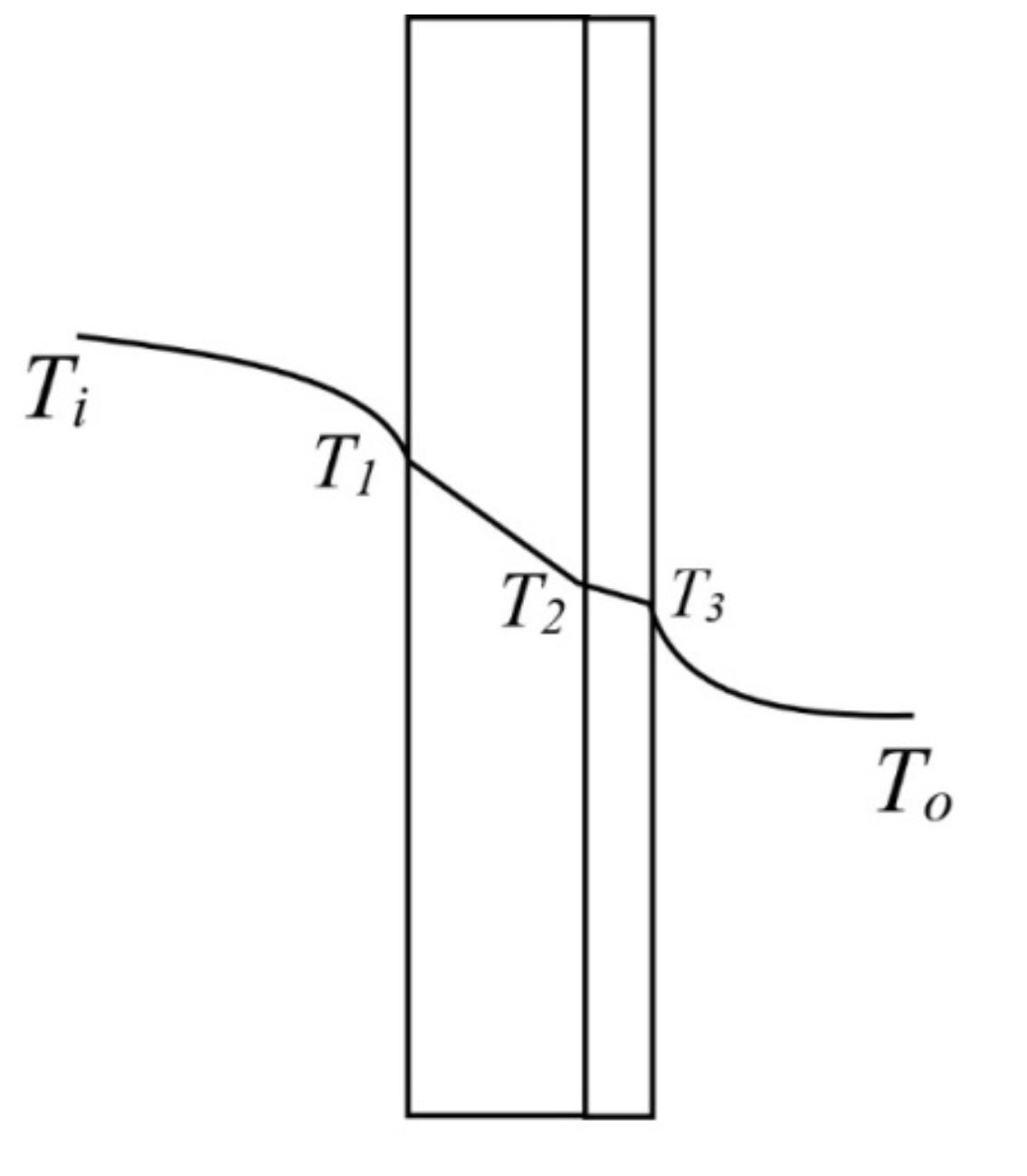
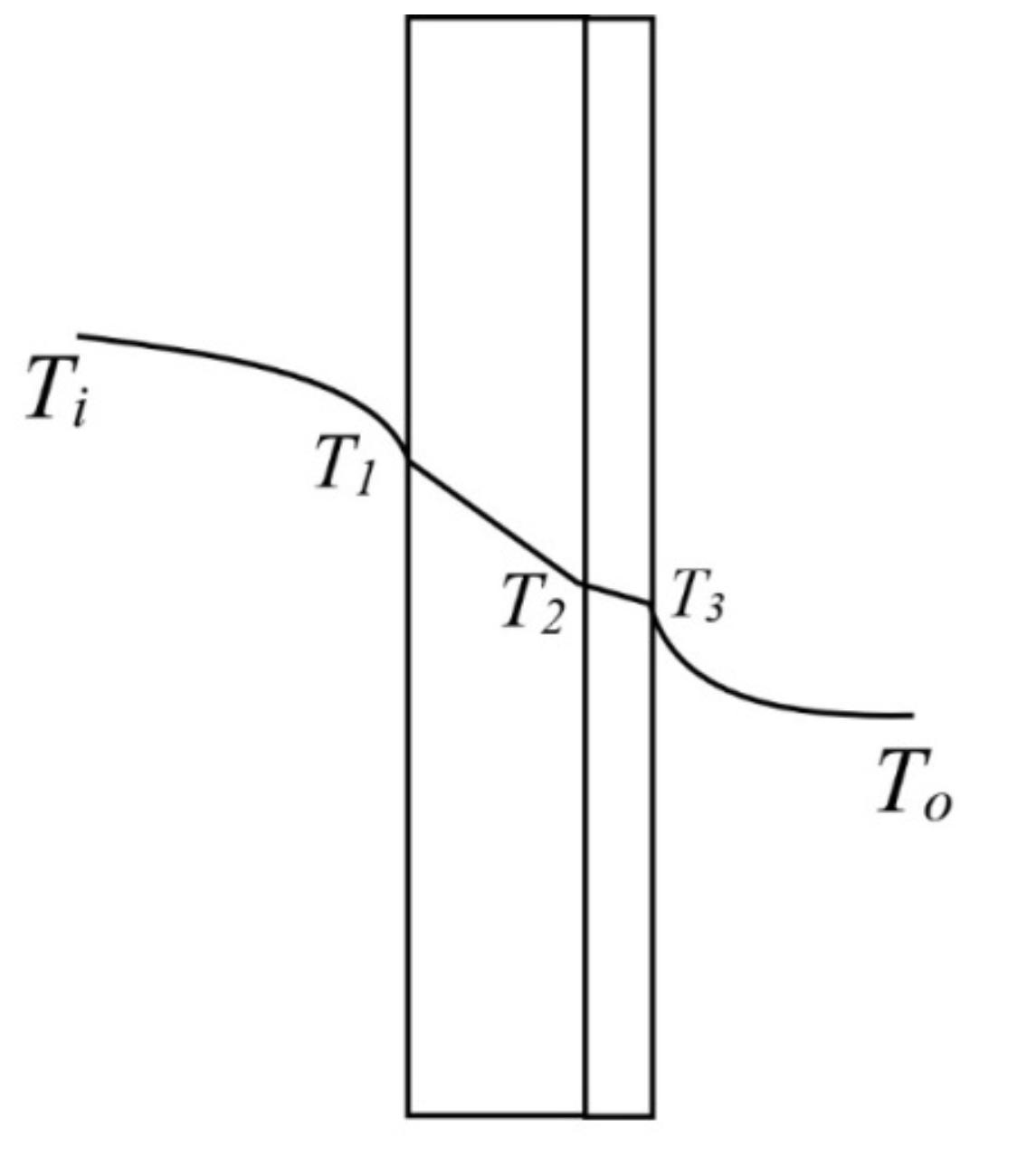
- We will use thermal circuit analogy for the 1-D problem and steady state conduction with no heat generation in the cover or TBC layer.

 The temperature at each medium interface and the Thermal resistance for each medium is given in the attachment schematic and circuit analogy.

 - We will calculate the total heat flux for the entire system q:

                       q = ( T_i - T_o ) / R_total

- R_total is the equivalent thermal resistance of the entire circuit. Since all resistances are in series we have:

                       R_total = 1 / h_i + L_1 / k_1 + L_2 / k_2 + 1 / h_o

- Plug in the values and compute:

                       R_total = 1 / 7 + 0.01 / 14 + 0.004 / 1.1 + 1 / 7

                       R_total = 0.2900649351 T-m^2 / W

- Calculate the Total heat flux q:

                       q = ( 333 - 69 ) / 0.2900649351

                       q = 910.141 W / m^2

- Just like the total current in a circuit remains same, the total heat flux remains same. We will use the total heat flux q to calculate the temperature of outer engine surface T_2 as follows:

                      q = ( T_i - T_2 ) / R_i2

Where,

                      R_i2 = 1 / h_i + L_1 / k_1

                      R_i2 = 1 / 7 + 0.01 / 14 = 0.14357 T-m^2 / W

Hence,

                      ( T_i - T_2 ) = q*R_i2

                        T_2 = T_i - q*R_i2

Plug the values in:

                        T_2 = 333 - 910.141*0.14357

                        T_2 = 202.33°C

- The outer surface of the engine cover has a temperature above T_ignition = 200°C. Hence, the TBC thickness of 4 mm is insufficient to prevent fire hazard
You might be interested in
When comparing solids to fluids, the following is true: for elastic solids, the stress must be normal. For Newtonian fluids, the
Nat2105 [25]

Answer: D

Find the answer in the explanation

Explanation:

Elastic solid will obey Hooke's law which state that the force applied is proportional to the extension provided the elastic limit is not exceeded.

Examples of Newtonian fluid are water, glycerol, honey and all organic solvents

When comparing solids to fluids, the below statement is true

We can therefore conclude that

For elastic solids, stress is linearly related to strain, and for Newtonian fluids, stress is linearly related to strain rate

4 0
2 years ago
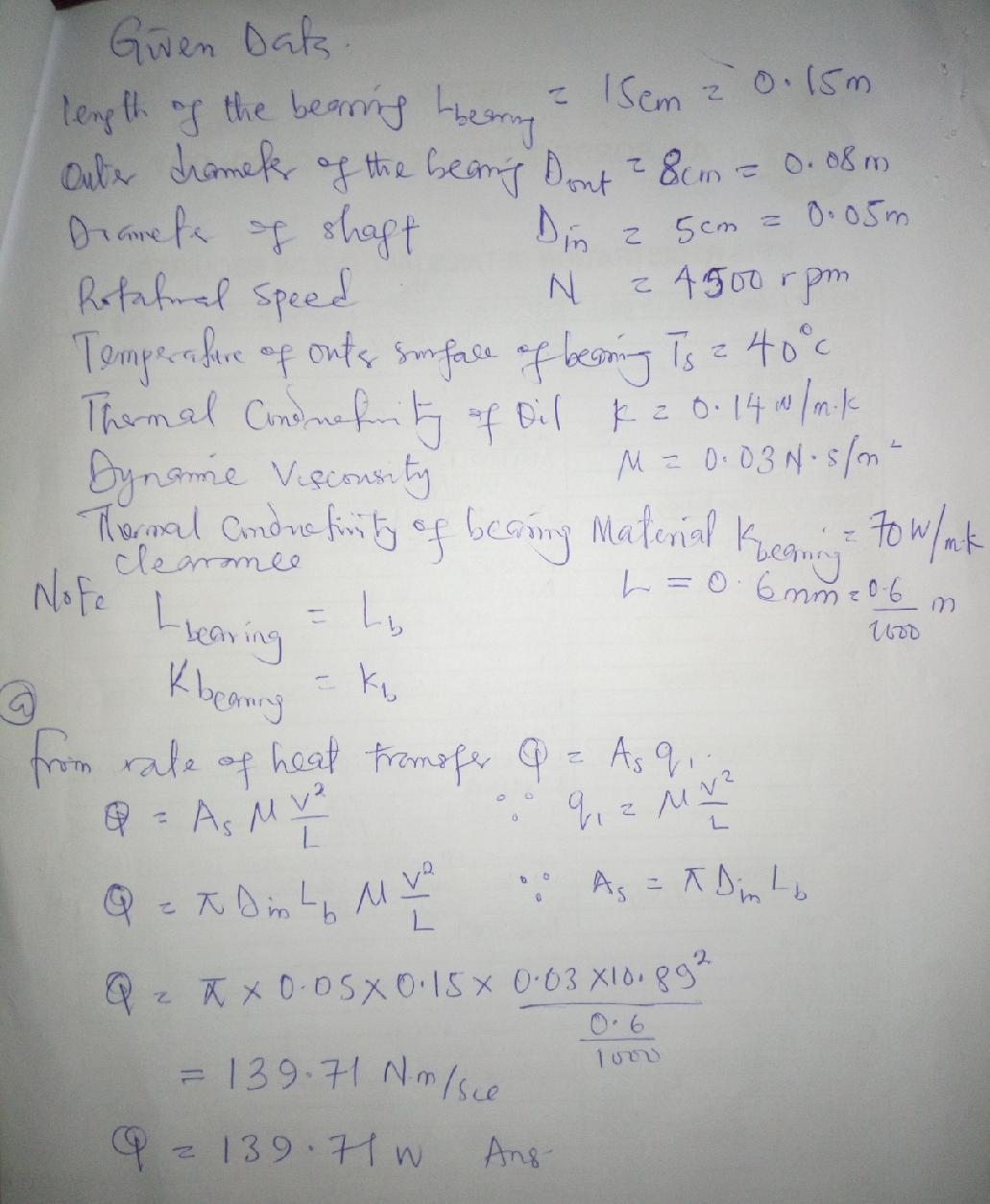
A 5-cm-diameter shaft rotates at 4500 rpm in a 15-cmlong, 8-cm-outer-diameter cast iron bearing (k = 70 W/m·K) with a uniform cl
-BARSIC- [3]

Answer:

(a) the rate of heat transfer to the coolant is Q = 139.71W

(b) the surface temperature of the shaft T = 40.97°C

(c) the mechanical power wasted by the viscous dissipation in oil 22.2kW

Explanation:

See explanation in the attached files

5 0
2 years ago
three balls each have a mass m if a has a speed v just before a direct collision with B determine the speed of C after collision
ratelena [41]

Answer:

Vc2= V(l+e) ^2/4

Vg2= V(l-e^2)/4

Explanation:

Conservation momentum, when ball A strikes Ball B

Where,

M= Mass

V= Velocity

Ma(VA)1+ Mg(Vg)2= Ma(Va)2+ Ma(Vg)2

MV + 0= MVg2

Coefficient of restitution =

e= (Vg)2- (Va)2/(Va)1- (Vg)1

e= (Vg)2- (Va)2/ V-0

Solving equation 1 and 2 yield

(Va)2= V(l-e) /2

(Vg)2= V(l+e)/2

Conservative momentum when ball b strikes c

Mg(Vg)2+Mc(Vc)1 = Mg(Vg)3+Mc(Vc)2

=> M[V(l+e) /2] + 0 = M(Vg)3 + M(Vc) 2

Coefficient of Restitution,

e= (Vc)2 - (Vg)2/(Vg)2- (Vc)1

=> e= (Vc)2 - (Vg)2/V(l+e) /2

Solving equation 3 and 4,

Vc2= V(l+e) ^2/4

Vg2= V(l-e^2)/4

8 0
2 years ago
Read 2 more answers
Explain why failure of this garden hose occurred near its end and why the tear occurred along its length. Use numerical values t
alukav5142 [94]

Answer:

  • hoop stress
  • longitudinal stress
  • material used

all this could led to the failure of the garden hose and the tear along the length

Explanation:

For the flow of water to occur in any equipment, water has to flow from a high pressure to a low pressure. considering the pipe, water is flowing at a constant pressure of 30 psi inside the pipe which is assumed to be higher than the allowable operating pressure of the pipe. but the greatest change in pressure will occur at the end of the hose because at that point the water is trying to leave the hose into the atmosphere, therefore the great change in pressure along the length of the hose closest to the end of the hose will cause a tear there. also the other factors that might lead to the failure of the garden hose includes :

hoop stress ( which acts along the circumference of the pipe):

αh = \frac{PD}{2T}     EQUATION 1

and Longitudinal stress ( acting along the length of the pipe )

αl = \frac{PD}{4T}       EQUATION 2

where p = water pressure inside the hose

          d = diameter of hose, T = thickness of hose

we can as well attribute the failure of the hose to the material used in making the hose .

assume for a thin cylindrical pipe material used to be

\frac{D}{T} ≥  20

insert this value into equation 1

αh = \frac{20 *30}{2}  = 60/2 = 30 psi

the allowable hoop stress was developed by the material which could have also led to the failure of the garden hose

8 0
2 years ago
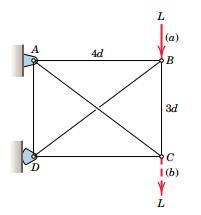
The rectangular frame is composed of four perimeter two-force members and two cables AC and BD which are incapable of supporting
Rama09 [41]

Answer:

Your question is lacking some information attached is the missing part and the solution

A) AB = AD = BD = 0, BC = LC

    AC = \frac{5L}{3}T, CD = \frac{4L}{3} C

B) AB = AD = BC = BD = 0

   AC = \frac{5L}{3} T, CD = \frac{4L}{3} C

Explanation:

A) Forces in all members due to the load L in position A

assuming that BD goes slack from an inspection of Joint B

AB = 0 and BC = LC from Joint D, AD = 0 and CD = 4L/3 C

B) steps to arrive to the answer is attached below

AB = AD = BC = BD = 0

AC = \frac{5L}{3} T,  CD = \frac{4L}{3}C

7 0
2 years ago
Other questions:
  • The wall of drying oven is constructed by sandwiching insulation material of thermal conductivity k = 0.05 W/m°K between thin me
    8·1 answer
  • 5. A typical paper clip weighs 0.59 g and consists of BCC iron. Calculate (a) the number of
    5·1 answer
  • PDAs with two stacks are strictly more powerful than PDAs with one stack. Prove that 2-stack PDAs are not a valid model for CFLs
    12·1 answer
  • Plastic parts produced by an injection-molding operation are checked for conformance to specifications. Each tool contains 11 ca
    12·1 answer
  • Water flows downward through a vertical 10-mm-diameter galvanized iron pipe with an average velocity for 5.0 m/s and exits as a
    5·1 answer
  • A piece of corroded metal alloy plate was found in a submerged ocean vessel. It was estimated that the original area of the plat
    6·1 answer
  • 15. A cold-chamber die-casting machine operates automatically, supported by two industrial robots.The machine produces two zinc
    9·2 answers
  • Solid spherical particles having a diameter of 0.090 mm and a density of 2002 kg/m3 are settling in a solution of water at 26.7C
    8·1 answer
  • Technician A says that weld-through primer can be removed from the immediate weld area to improve weld quality. Technician B say
    7·1 answer
  • You are the scheduler for a large commercial building project. The schedule that you prepared (based on feedback from the projec
    7·1 answer
Add answer
Login
Not registered? Fast signup
Signup
Login Signup
Ask question!