answer.
Ask question
Login Signup
Ask question
All categories
  • English
  • Mathematics
  • Social Studies
  • Business
  • History
  • Health
  • Geography
  • Biology
  • Physics
  • Chemistry
  • Computers and Technology
  • Arts
  • World Languages
  • Spanish
  • French
  • German
  • Advanced Placement (AP)
  • SAT
  • Medicine
  • Law
  • Engineering
Setler79 [48]
2 years ago
6

A piece of corroded metal alloy plate was found in a submerged ocean vessel. It was estimated that the original area of the plat

e was 800 cm2 and that approximately 7.6 kg had corroded away during the submersion. Assuming a corrosion penetration rate of 4 mm/yr for this alloy in seawater, estimate the time of submersion in years. The density of the alloy is 4.5 g/cm3.
Engineering
1 answer:
loris [4]2 years ago
8 0

Answer:

t = 5.27 years

Explanation:

First of all, the formula for corrosion penetration rate is given as;

CPR = (KW)/(ρAt)

Where;

K = Constant dependent on exposed area A.

W - weight lost after time

t- time

ρ - density

A - exposed area

From the question;

W = 7.6kg or 7.6 x 10^(6) mg

CPR = 4 mm/yr

ρ = 4.5 g/cm³

Area = 800 cm²

K is a constant of 87.6cm

Making t the subject of the formula from the CPR equation, we obtain;

t = KW/(ρA(CPR))

t = (87.6 x 7.6 x 10^(6))/(4.5 x 800 x 4) = 46233.3 hours

The question wants the time in years.

So let's convert;

There are 8760 hours in a year.

Thus;

t = 46233.3/8760 = 5.27 years.

You might be interested in
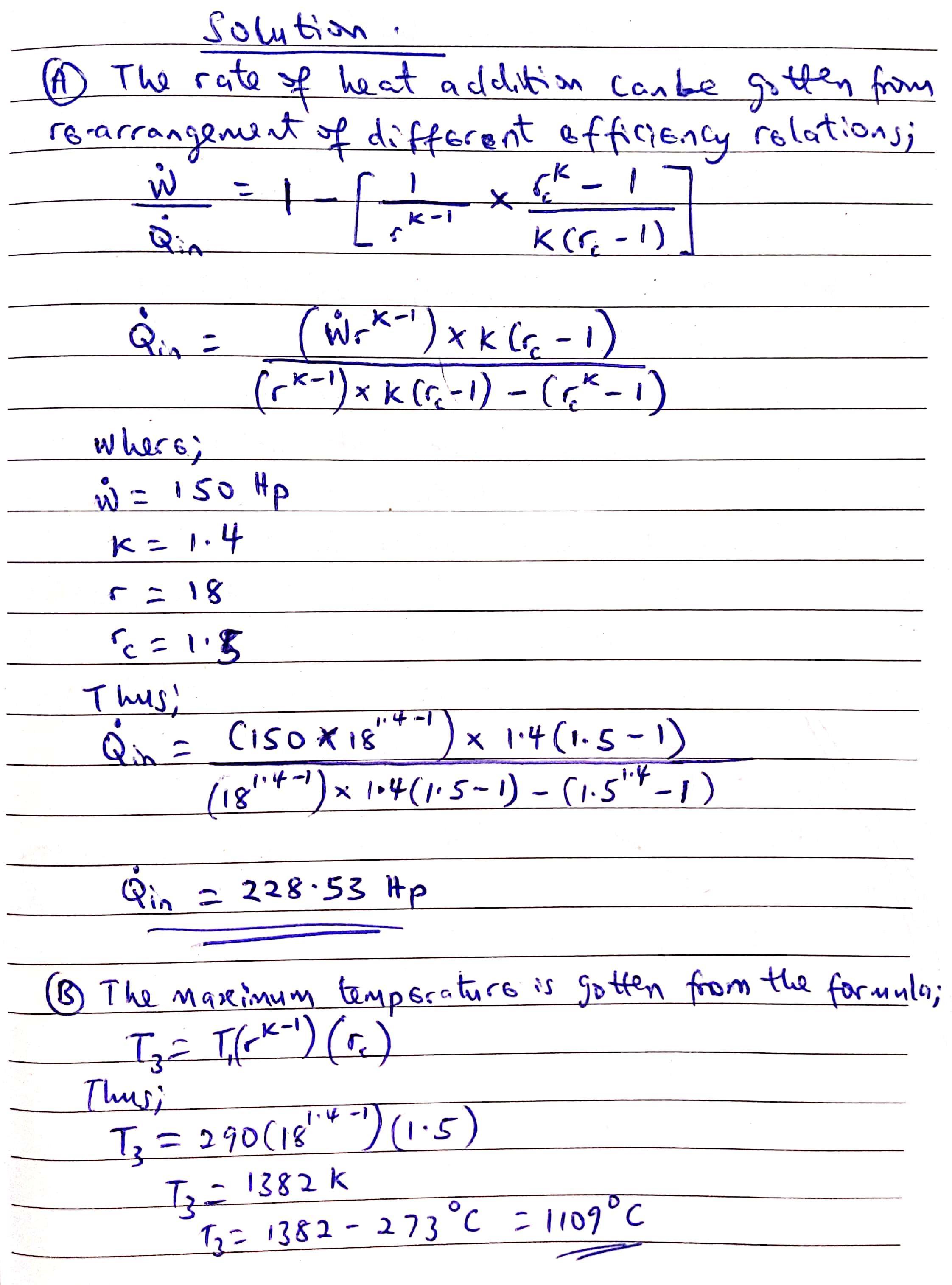
An ideal Diesel cycle has a compression ratio of 18 and a cutoff ratio of 1.5. Determine the maximum air temperature and the rat
defon

Answer:

A) Rate of heat addition = 228.53 Hp

B) Maximum Air temperature = 1109 °C

Explanation:

We are given;

Cut off ratio; r_c = 1.5

Compression ratio; r = 18

Power produced; W` = 150 Hp

cp = 1.005 kJ/kg·K

cv = 0.718 kJ/kg·K

R = 0.287 kJ/kg·K

k = 1.4

Temperature;T1 = 17°C = 17 + 273 K = 290K

I've attached the rest of the explanation below.

8 0
2 years ago
Air whose density is 0.082 lbm/ft3 enters the duct of an air-conditioning system at a volume flow rate of 450 ft3/min. If the di
Akimi4 [234]

Answer:

Given:\\V_{flow} =450 ft^3/min\\P=0.082lbm/ft^3\\A=16In

where P is density of air and v flow is volume flow rate, so in order to find velocity of air and mass flow rate formula is given by :

M_{flow} =V_{flow} *P\\\\M_{flow} =450*0.082=36.9ib/min

so velocity is:

v=V_{flow} /A=339.03m/min

4 0
2 years ago
Read 2 more answers
Determine the angular acceleration of the uniform disk if (a) the rotational inertia of the disk is ignored and (b) the inertia
lukranit [14]

Answer:

α = 7.848 rad/s^2  ... Without disk inertia

α = 6.278 rad/s^2  .... With disk inertia

Explanation:

Given:-

- The mass of the disk, M = 5 kg

- The right hanging mass, mb = 4 kg

- The left hanging mass, ma = 6 kg

- The radius of the disk, r = 0.25 m

Find:-

Determine the angular acceleration of the uniform disk without and with considering the inertia of disk

Solution:-

- Assuming the inertia of the disk is negligible. The two masses ( A & B )  are hung over the disk in a pulley system. The disk is supported by a fixed support with hinge at the center of the disk.

- We will make a Free body diagram for each end of the rope/string ties to the masses A and B.

- The tension in the left and right string is considered to be ( T ).

- Apply newton's second law of motion for mass A and mass B.

                      ma*g - T = ma*a

                      T - mb*g = mb*a

Where,

* The tangential linear acceleration ( a ) with which the system of two masses assumed to be particles move with combined constant acceleration.

- g: The gravitational acceleration constant = 9.81 m/s^2

- Sum the two equations for both masses A and B:

                      g* ( ma - mb ) = ( ma + mb )*a

                      a =  g* ( ma - mb ) / ( ma + mb )

                      a = 9.81* ( 6 - 4 ) / ( 6 + 4 ) = 9.81 * ( 2 / 10 )

                      a = 1.962 m/s^2  

- The rope/string moves with linear acceleration of ( a ) which rotates the disk counter-clockwise in the direction of massive object A.

- The linear acceleration always acts tangent to the disk at a distance radius ( r ).

- For no slip conditions, the linear acceleration can be equated to tangential acceleration ( at ). The correlation between linear-rotational kinematics is given below :

                     a = at = 1.962 m/s^2

                     at = r*α      

Where,

           α: The angular acceleration of the object ( disk )

                    α = at / r

                    α = 1.962 / 0.25

                    α = 7.848 rad/s^2                                

- Take moments about the pivot O of the disk. Apply rotational dynamics conditions:


                Sum of moments ∑M = Iα

                 ( Ta - Tb )*r = Iα

- The moment about the pivots are due to masses A and B.


               Ta: The force in string due to mass A

               Tb: The force in string due to mass B

                I: The moment of inertia of disk = 0.5*M*r^2

                   ( ma*a - mb*a )*r = 0.5*M*r^2*α

                   α = ( ma*a - mb*a ) / ( 0.5*M*r )

                   α = ( 6*1.962 - 4*1.962 ) / ( 0.5*5*0.25 )

                   α = ( 3.924 ) / ( 0.625 )

                   α = 6.278 rad/s^2

6 0
2 years ago
6.28 A six-lane freeway (three lanes in each direction) in rolling terrain has 10-ft lanes and obstructions 4 ft from the right
dimulka [17.4K]

Answer:

Assume Base free flow speed (BFFS) = 70 mph

Lane width = 10 ft

Reduction in speed corresponding to lane width, fLW = 6.6 mph

Lateral Clearance = 4 ft

Reduction in speed corresponding to lateral clearance, fLC = 0.8 mph

Interchanges/Ramps = 9/ 6 miles = 1.5 /mile

Reduction in speed corresponding to Interchanges/ramps, fID = 5 mph

No. of lanes = 3

Reduction in speed corresponding to number of lanes, fN = 3 mph

Free Flow Speed (FFS) = BFFS – fLW – fLC – fN – fID = 70 – 6.6 – 0.8 – 3 – 5 = 54.6 mph

Peak Flow, V = 2000 veh/hr

Peak 15-min flow = 600 veh

Peak-hour factor = 2000/ (4*600) = 0.83

Trucks and Buses = 12 %

RVs = 6 %

Rolling Terrain

fHV = 1/ (1 + 0.12 (2.5-1) + 0.06 (2.0-1)) = 1/1.24 = 0.806

fP = 1.0

Peak Flow Rate, Vp = V / (PHV*n*fHV*fP) = 2000/ (0.83*3*0.806*1.0) = 996.54 ~ 997 veh/hr/ln

Vp < (3400 – 30 FFS)

S = FFS

S = 54.6 mph

Density = Vp/S = (997) / (54.6) = 18.26 veh/mi/ln

7 0
2 years ago
The 8-mm-thick bottom of a 220-mm-diameter pan may be made from aluminum (k = 240 W/m ⋅ K) or copper (k = 390 W/m ⋅ K). When use
Artemon [7]

Answer:

For aluminum 110.53 C

For copper 110.32 C

Explanation:

Heat transmission through a plate (considering it as an infinite plate, as in omitting the effects at the borders) follows this equation:

q = \frac{k * A * (th - tc)}{d}

Where

q: heat transferred

k: conduction coeficient

A: surface area

th: hot temperature

tc: cold temperature

d: thickness of the plate

Rearranging the terms:

d * q = k * A * (th - tc)

\frac{d * q}{k * A} = th - tc

th = \frac{d * q}{k * A} + tc

The surface area is:

A = \frac{\pi * d^2}{4}

A = \frac{\pi * 0.22^2}{4} = 0.038 m^2

If the pan is aluminum:

th = \frac{0.008 * 600}{240 * 0.038} + 110 = 110.53 C

If the pan is copper:

th = \frac{0.008 * 600}{390 * 0.038} + 110 = 110.32 C

7 0
2 years ago
Other questions:
  • A rod is 2m long at temperature of 10oC. Find the expansion of the rod, when the temperature is raised to 80oC. If this expansio
    7·1 answer
  • A long aluminum wire of diameter 3 mm is extruded at a temperature of 280°C. The wire is subjected to cross air flow at 20°C at
    9·1 answer
  • A pitfall cited in Section 1.10 is expecting to improve the overall performance of a computer by improving only one aspect of th
    6·1 answer
  • Some states have osha programs, but you should always defer to the federal program.
    8·2 answers
  • 10. Aluminum-lithium (Al-Li) alloys have been developed by the aircraft industry to reduce the weight and improve the performanc
    7·1 answer
  • - Consider a 2024-T4 aluminum material with ultimate tensile strength of 70 ksi. In a given application, a component of this mat
    7·1 answer
  • Madison and Oxford are the same distance from the equator and they are both near the ocean. Use the information on the map to an
    11·1 answer
  • The u velocity component of a steady, two-dimensional, incompressible flow field is u = 3 ax 2 - 2 bxy, where a and b are consta
    6·1 answer
  • Who can work on a fixed ladder that extends more than 24 feet?
    11·1 answer
  • Air ows steadily in a thermally insulated pipe with a constant diameter of 6.35 cm, and an average friction factor of 0.005. At
    5·1 answer
Add answer
Login
Not registered? Fast signup
Signup
Login Signup
Ask question!