answer.
Ask question
Login Signup
Ask question
All categories
  • English
  • Mathematics
  • Social Studies
  • Business
  • History
  • Health
  • Geography
  • Biology
  • Physics
  • Chemistry
  • Computers and Technology
  • Arts
  • World Languages
  • Spanish
  • French
  • German
  • Advanced Placement (AP)
  • SAT
  • Medicine
  • Law
  • Engineering
sukhopar [10]
2 years ago
15

One type of illumination system consists of rows of strip fluorescents and a ceiling that will transmit light. For this system t

o be efficient, the surfaces above the luminous ceiling must be ____.
Engineering
1 answer:
marshall27 [118]2 years ago
3 0

Answer:

For this system to be efficient, the surfaces above the luminous ceiling must be white, so that all the light been transmitted is reflected.

Explanation:

White surfaces reflect light at almost 100% efficiency, this ensures that non of the light been transmitted is absorbed.

Thus, if one type of illumination system consists of rows of strip fluorescents and a ceiling that will transmit light. For this system to be efficient, the surfaces above the luminous ceiling must be white so that all the light been transmitted is reflected.

You might be interested in
Which one of the following activities is not an example of incident coordination
Lady bird [3.3K]
Directing, ordering, or controlling
7 0
2 years ago
Two metallic terminals protrude from a device. The terminal on the left is the positive reference for a voltage called vx (the o
tresset_1 [31]

Answer:

Vx = 6.242 x 10raised to power 15

Vy = -6.242 x 10raised to power 15

Explanation:

from E = IVt

but V = IR from ohm's law and Q = It from faraday's first law

I = Q/t

E = Q/t x V x t = QV

hence, E =QV

V = E/Q

3 0
2 years ago
Read 2 more answers
A curve in a speed track has a radius of 1000 ft and a rated speed of 120 mi/h. (From Sample Prob. 12.7 is the definition of rat
forsale [732]

Answer:

tan \theta = \frac{(176ft/s)^2}{1000 ft 32.2 ft/s^2}= 0.962

\theta = tan^{-1} (0.962) = 43.89

Explanation:

If the question is: Determine the banking angle θ

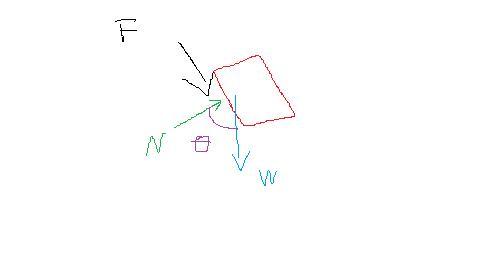
We have the forces involved on the figure attached.

For this case we know that the weight is given by:

W = mg

And for this case the centripetal acceleration would be given by:

a=\frac{v^2}{r}

If we analyze the sum of forces on x and y we have:

\sum F_x = m a_x

F + W sin \theta = ma cos theta

And if we solve for the force we got:

F = ma cos \theta - mg sin \theta = \frac{mv^2}{r} cos \theta - mg sin \theta

\sum F_y = m a_y

N - W cos \theta = ma sin \theta

If we solve for the normal force we got:

N =W cos \theta + ma sin \theta = \frac{mv^2}{r} sin \theta + mg cos \theta

In order to find the banking angle we use the fact that F =0

0 = \frac{mv^2}{r} cos \theta - mg sin \theta

tan \theta= \frac{v^2}{rg}

The velocity on this case is 120 mi/h if we convert this into ft/ s we got:

120 mi/h * \frac{5280 ft}{1mi} *\frac{1hr}{3600 s}= 176 ft/s

And then we have this:

tan \theta = \frac{(176ft/s)^2}{1000 ft 32.2 ft/s^2}= 0.962

\theta = tan^{-1} (0.962) = 43.89

5 0
2 years ago
The 10-kg block slides down 2 m on the rough surface with kinetic friction coefficient μk = 0.2. What is the work done by the fr
Rashid [163]

Answer:

153.2 J

Explanation:

Let's first list our given parameters;

mass (m) of the block = 10 kg

which slides down ( i.e displacement) = 2 m

kinetic coefficient of friction (μk) = 0.2

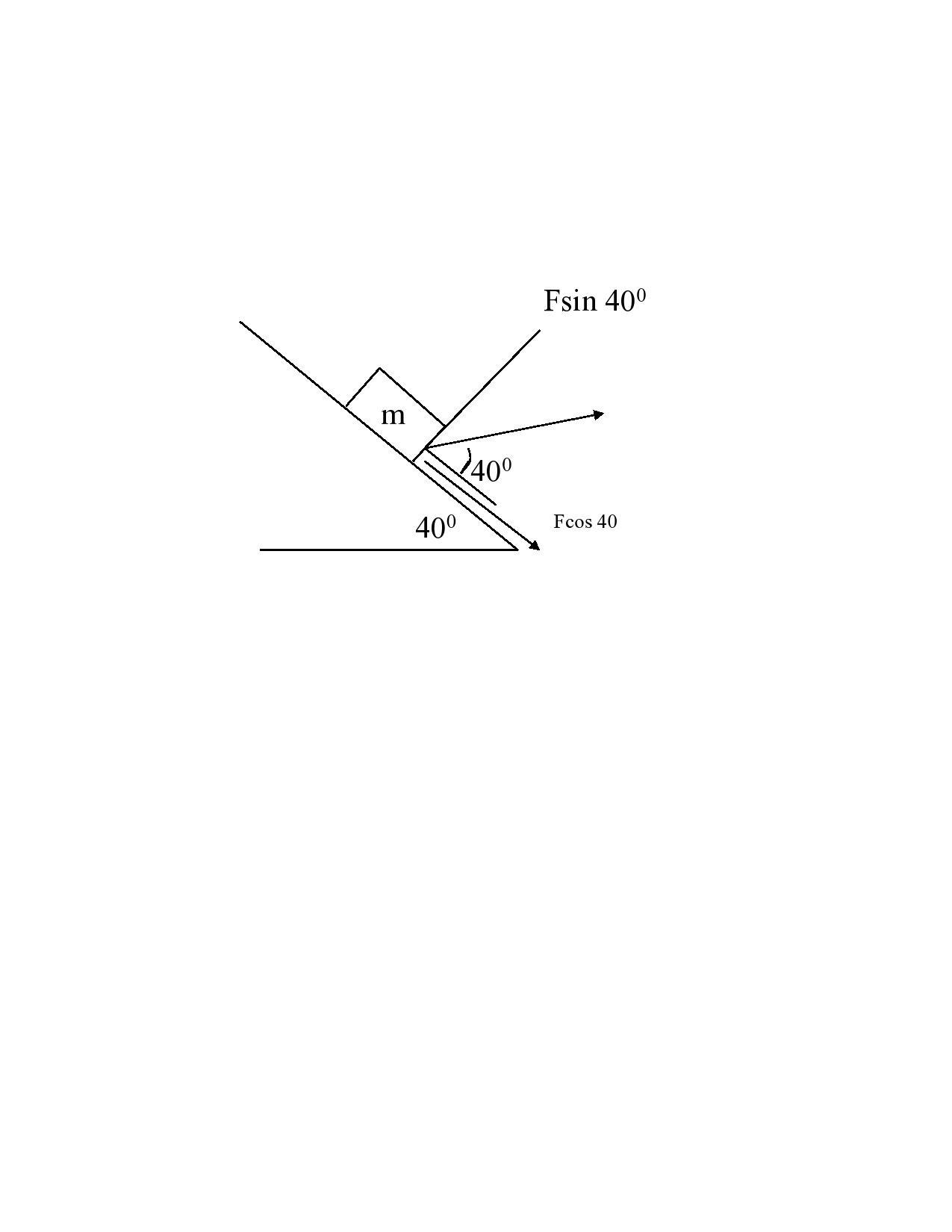
In the diagram shown below;  if we take an integral look at the component of force in the direction of the displacement; we have

F_x= Fcos 40°

F_x= 100 (cos 40°)

F_x= 76.60 N

Workdone by the friction force can now be determined as:

W = F_x × displacement

W = 76.60 × 2

W = 153.2 J

∴  the work done by the friction force = 153.2 J

7 0
2 years ago
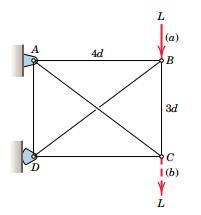
The rectangular frame is composed of four perimeter two-force members and two cables AC and BD which are incapable of supporting
Rama09 [41]

Answer:

Your question is lacking some information attached is the missing part and the solution

A) AB = AD = BD = 0, BC = LC

    AC = \frac{5L}{3}T, CD = \frac{4L}{3} C

B) AB = AD = BC = BD = 0

   AC = \frac{5L}{3} T, CD = \frac{4L}{3} C

Explanation:

A) Forces in all members due to the load L in position A

assuming that BD goes slack from an inspection of Joint B

AB = 0 and BC = LC from Joint D, AD = 0 and CD = 4L/3 C

B) steps to arrive to the answer is attached below

AB = AD = BC = BD = 0

AC = \frac{5L}{3} T,  CD = \frac{4L}{3}C

7 0
2 years ago
Other questions:
  • What can your employer do to protect you from overhead power lines?
    8·1 answer
  • Prompt the user to enter five numbers, being five people's weights. Store the numbers in an array of doubles. Output the array's
    11·2 answers
  • Consider a very long rectangular fin attached to a flat surface such that the temperature at the end of the fin is essentially t
    9·1 answer
  • Flow and Pressure Drop of Gases in Packed Bed. Air at 394.3 K flows through a packed bed of cylinders having a diameter of 0.012
    8·1 answer
  • 2.31 LAB: Simple statistics Part 1 Given 4 integers, output their product and their average, using integer arithmetic. Ex: If th
    5·2 answers
  • 4-6. A vertical cylindrical storage vessel is 10 m high and 2 m in diameter. The vessel contains liquid cyclohexane currently at
    10·1 answer
  • The Gill Art Gallery wishes to maintain data on their customers, artists and paintings. They may have several paintings by each
    7·1 answer
  • Oil enters a counterflow heat exchanger at 600 K with a mass flow rate of 10 kg/s and exits at 200 K. A separate stream of liqui
    12·1 answer
  • A commercial refrigerator with refrigerant-134a as the working fluid is used to keep the refrigerated space at -30C by rejecting
    13·1 answer
  • Consider the time domain waveforms below on the left. Match waveforms (a) - (e) to their respective frequency spectrum represent
    11·1 answer
Add answer
Login
Not registered? Fast signup
Signup
Login Signup
Ask question!