answer.
Ask question
Login Signup
Ask question
All categories
  • English
  • Mathematics
  • Social Studies
  • Business
  • History
  • Health
  • Geography
  • Biology
  • Physics
  • Chemistry
  • Computers and Technology
  • Arts
  • World Languages
  • Spanish
  • French
  • German
  • Advanced Placement (AP)
  • SAT
  • Medicine
  • Law
  • Engineering
gladu [14]
2 years ago
15

Which one of the following activities is not an example of incident coordination

Engineering
1 answer:
Lady bird [3.3K]2 years ago
7 0
Directing, ordering, or controlling
You might be interested in
The in situ moist unit weight of a soil is 17.3 kN/m3 and the moisture content is 16%. The specific gravity of soil solids is 2.
Temka [501]

Answer:

Explanation:

Given that,

Moist content w = 16%

The in situ moist unit weight of the soil : γ(in situ) = 17.3 kN/m³

Specific gravity of the soil

G(s) = 2.72

Minimum dry unit weight of the soil

γd(compacted) = 18.1 kN/m³

Moist content is same as above

w = 16%

Question

how many cubic meters of soil from the excavation site are needed to produce 2000 m³ of compacted fill?

Let determine the in situ dry unit weight γd(in-situ) using the relation

γd(in-situ) = γ(in-situ) / [1 + (w/100)]

γd(in-situ) = 17.3/ [1 + (18/100)]

γd(in-situ) = 17.3 / ( 1 + 0.18)

γd(in-situ) = 17.3 / 1.18

γd(in-situ) = 14.66 kN/m³

To determine the Volume of the soil to be excavated (Vex)

Let the Volume to be excavated = V

We can use the relation

V=V(fill) × γd(compacted) / γd(in situ)

Given that, V(fill) = 2000m³

V(fill) is the volume of the compacted fill

Therefore,

V=V(fill) × γd(compacted) / γd(in situ)

Vex = 2000 × 18.1 / 14.66

Vex = 2469.13 m³

So, the excavated volume of the soil is 2469.13 m³

3 0
2 years ago
Water at 400 kPa with a quality of 75% has its pressure raised 200 kPa (to 600 kPa) in a constant volume process. What is the ne
Zolol [24]

Answer:

T=194.3C

X=1

P=542.5kPa

Explanation:

Through laboratory tests, thermodynamic tables were developed, these allow to know all the thermodynamic properties of a substance (entropy, enthalpy, pressure, specific volume, internal energy etc ..)  

through prior knowledge of two other properties

First we find the specific volume knowing the temperature and quality of state 1

v(p=400kPa, x=0.75)=0.3471m^3/kg

As a constant volume process is presented, it keeps constant in state 2, so we find the temperature and quality with p = 600kPa  and v = 0.3471m ^ 3 / kg

T(P=600kPa, v=0.3471m ^ 3 / kg)=194.3C

x(P=600kPa, v=0.3471m ^ 3 / kg)=1

for the second part we find the pressure, with a quality of 1 and a volume of

v= 0.3471m ^ 3 / kg

p=542.5kPa

4 0
2 years ago
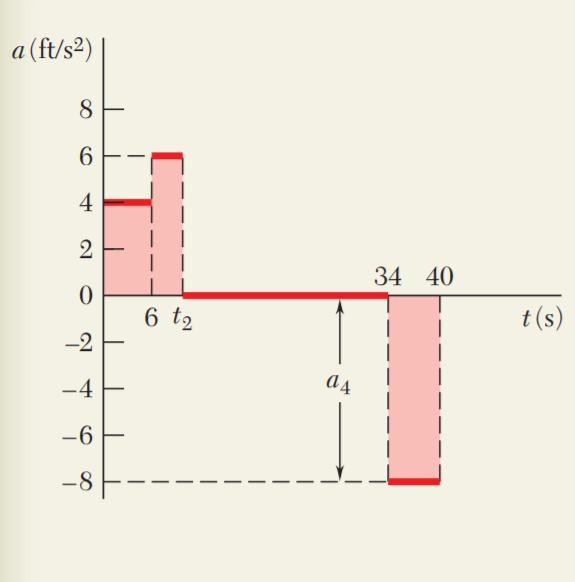
A subway car leaves station A; it gains speed at the rate of 4 ft/s^2 for of until it has reached and then at the rate 6 then th
salantis [7]

Answer:

See attachment

1512 ft

Explanation:

Since the acceleration is either constant or zero,  the a−t curve is made of horizontal straight-line segments. The values of t2  and a4 are determined as follows:

Acceleration - Time

0 < t < 6: Change in v = area under a–t curve

V_6 - 0 =  (6 s)(4 ft/s2 ) = 24 ft/s

6 < t < t2: Since the velocity increases from 24 to 48 ft/s,

Change in v = area under a–t curve

48 - 24 = (t2 - 6) * 6

t2 = 10 s

t2 < t < 34: Since the velocity is constant, the acceleration is zero.

34 < t < 40: Change in v = area under a–t curve

0 - 42 = 6*a4

a4 = - 8 ft / s^2

The acceleration being negative, the corresponding area is below the t axis;  this area represents a decrease in velocity.

Velocity - Time

Since the acceleration is either constant or zero, the  v−t curve is made of straight-line segments connecting the points determined above.

Change in x = area under v−t curve

0 < t < 6:     x6 - 0 = 0.5*6*24 = 72 ft

6 < t < 10:    x10 - x6 = 0.5*4*(24 + 48) = 144 ft

10 < t < 34:     x34 - x10 = 48*24 = 1152 ft

34 < t < 40:     x40 - x34 = 0.5*6*48 = 144 ft

Adding the changes in x, we obtain the distance from A to B:

d = x40 - 0 = 1512 ft

8 0
2 years ago
The wall of drying oven is constructed by sandwiching insulation material of thermal conductivity k = 0.05 W/m°K between thin me
masha68 [24]

Answer:

86 mm

Explanation:

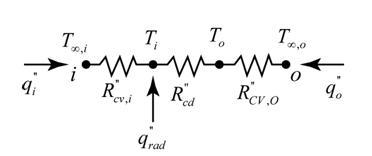
From the attached thermal circuit diagram, equation for i-nodes will be

\frac {T_ \infty, i-T_{i}}{ R^{"}_{cv, i}} + \frac {T_{o}-T_{i}}{ R^{"}_{cd}} + q_{rad} = 0 Equation 1

Similarly, the equation for outer node “o” will be

\frac {T_{ i}-T_{o}}{ R^{"}_{cd}} + \frac {T_{\infty, o} -T_{o}}{ R^{"}_{cv, o}} = 0 Equation 2

The conventive thermal resistance in i-node will be

R^{"}_{cv, i}= \frac {1}{h_{i}}= \frac {1}{30}= 0.033 m^{2}K/w Equation 3

The conventive hermal resistance per unit area is

R^{"}_{cv, o}= \frac {1}{h_{o}}= \frac {1}{10}= 0.100 m^{2}K/w Equation 4

The conductive thermal resistance per unit area is

R^{"}_{cd}= \frac {L}{K}= \frac {L}{0.05} m^{2}K/w Equation 5

Since q_{rad}  is given as 100, T_{o}  is 40 T_ \infty  is 300 T_{\infty, o}  is 25  

Substituting the values in equations 3,4 and 5 into equations 1 and 2 we obtain

\frac {300-T_{i}}{0.033} +\frac {40-T_{i}}{L/0.05} +100=0  Equation 6

\frac {T_{ i}-40}{L/0.05}+ \frac {25-40}{0.100}=0

T_{i}-40= \frac {L}{0.05}*150

T_{i}-40=3000L

T_{i}=3000L+40 Equation 7

From equation 6 we can substitute wherever there’s T_{i} with 3000L+40 as seen in equation 7 hence we obtain

\frac {300- (3000L+40)}{0.033} + \frac {40- (3000L+40)}{L/0.05}+100=0

The above can be simplified to be

\frac {260-3000L}{0.033}+ \frac {(-3000L)}{L/0.05}+100=0

\frac {260-3000L}{0.033}=50

-3000L=1.665-260

L= \frac {-258.33}{-3000}=0.086*10^{-3}m= 86mm

Therefore, insulation thickness is 86mm

8 0
2 years ago
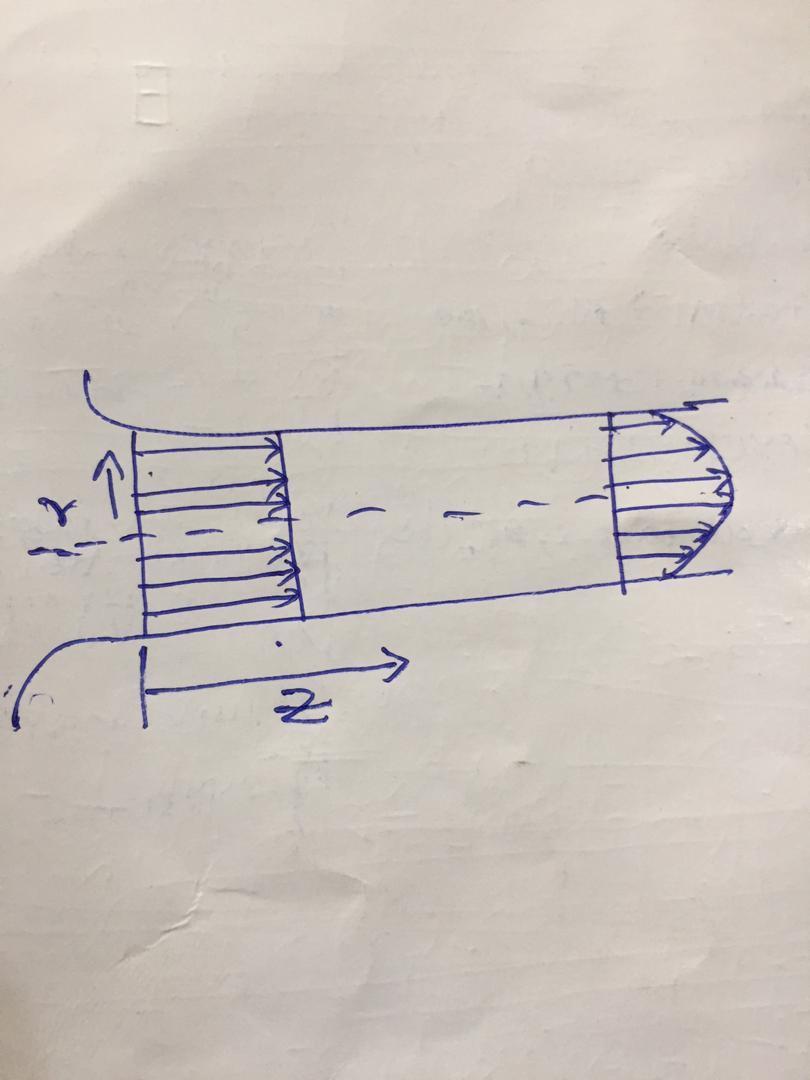
Consider a steady developing laminar flow of water in a constant-diameter horizontal discharge pipe attached to a tank. The flui
dalvyx [7]

Answer:

hello attached is the free body diagram of the missing figure

Fr = \frac{\pi }{4} D^2 [ ( P1 - P2) - pV^2 ]

Explanation:

Average velocity is constant i.e V1 = V2 = V

The momentum equation for the flow in the Z - direction can be expressed as

-Fr + P1 Ac - P2 Ac = mB2V2 - mB1V1 ------- equation 1

Fr = horizontal force on the bolts

P1 = pressure of fluid at entrance

V1 = velocity of fluid at entrance

Ac = cross section area of the pipe

P2 and V2 = pressure and velocity of fluid at some distance

m = mass flow rate of fluid

B1 = momentum flux at entrance , B2 = momentum flux correction factor

Note; average velocity is constant hence substitute V for V1 and V2

equation 1 becomes

Fr = ( P1 - P2 ) Ac + mV ( 1 - 2 )

Fr = ( P1 - P2 ) Ac - mV ---------------- equation 2

equation for mass flow rate

m = <em>p</em>AcV  

<em>p</em> = density of the fluid

insert this into equation 2 EQUATION 2 BECOMES

Fr = ( P1 - P2) Ac - <em>p</em>AcV^2

    = Ac [ (P1 - P2) - pV^2 ]  ---------- equation 3

Note Ac = \frac{\pi }{4} D^2

Equation 3 becomes

Fr = \frac{\pi }{4} D^2 [ (P1 -P2 ) - pV^2 ] ------- relation for the horizontal force acting on the bolts      

6 0
2 years ago
Other questions:
  • Oil in an engine is being cooled by air in a cross-flow heat exchanger, where both fluids are unmixed. Oil (cp = 2000 J/kg. K) f
    12·1 answer
  • Some states have osha programs, but you should always defer to the federal program.
    8·2 answers
  • At a certain college, 30% of the students major in engineering, 20% play club sports, and 10% both major in engineering and play
    14·1 answer
  • Your assignment is to write a menu driven program. The menu will be responded to using a switch statement. The menu options (cas
    6·1 answer
  • A fireboat is to fight fires at coastal areas by drawing seawater with a density of 1030 kg/m through a 20-cm-diameter pipe at a
    13·1 answer
  • The Gill Art Gallery wishes to maintain data on their customers, artists and paintings. They may have several paintings by each
    7·1 answer
  • Reconsider Couette flow between two parallel plates as derived in class, but with the top plate moving with a known velocity +i
    13·1 answer
  • 7. Implement a function factorial in RISC-V that has a single integer parameter n and returns n!. A stub of this function can be
    9·1 answer
  • An air standard cycle with constant specific heats is executed in a closed pistoncylinder system and is composed of the followin
    10·1 answer
  • Most fatal collisions in Florida happen during
    8·2 answers
Add answer
Login
Not registered? Fast signup
Signup
Login Signup
Ask question!