answer.
Ask question
Login Signup
Ask question
All categories
  • English
  • Mathematics
  • Social Studies
  • Business
  • History
  • Health
  • Geography
  • Biology
  • Physics
  • Chemistry
  • Computers and Technology
  • Arts
  • World Languages
  • Spanish
  • French
  • German
  • Advanced Placement (AP)
  • SAT
  • Medicine
  • Law
  • Engineering
malfutka [58]
2 years ago
14

Create a flow chart to represent and describe the process of urine formation in the kidneys. you can use any flow chart format t

hat you wish but you must include the components below: adh hypothalamus liver nephrons pituitary urea renal tubule glomerulus review this rubric and open this flow chart example for this activity.

Biology
1 answer:
luda_lava [24]2 years ago
6 0

Answer:

The key steps to urine formation have been outlined in the attached file (flow chart diagram). Key components highlighted.

Explanation:

GLOMERULAR FILTERATION

The kidney consists of NEPHRONS, which consist of a network of capillaries (surrounded by the Bowman’s capsule), called GLOMERULUS. Water and solutes are filtered from the blood in the capillaries into the capsule through a filtration membrane.

The HYPOTHALAMUS in the brain secretes VASOPRESSIN A.K.A ANTIDIURETIC HORMONE (ADH). The ADH passes through the PITUITARY GLAND into the bloodstream and serves to regulate the blood pressure and water levels the kidney absorbs.

REABSORB VITAL NUTRIENTS

While larger cells and proteins are retained in the bloodstream, glomerular filtrate (fluids) flows into the RENAL TUBULE where reabsorption of essential substances that may have escaped the membrane, are taken in through the convoluted tubule.

SECRETION AND EXCRETION

Waste ions are also passed into the renal tubule in a process called Secretion. UREA is also released into the blood stream and to the tubes, after being broken down by the LIVER. All waste mixes with the filtrate to form urine.

Urine is collected in a duct, and passed out of the kidney in the ureter and the excreted from the bladder.

You might be interested in
Three complex carbohydrates, the subunits of glucose are bonded together differently. Because they have different structures, th
MrRissso [65]
D because they have the same materials but different structure which mean different functions
4 0
2 years ago
An organism that uses co2 for its carbon needs and sunlight for its energy needs would be called a
yulyashka [42]
HeterotrophA heterotroph is an organism that ingests or absorbs organic carbon in order to be able to produce energy and synthesize compounds to maintain its life
3 0
2 years ago
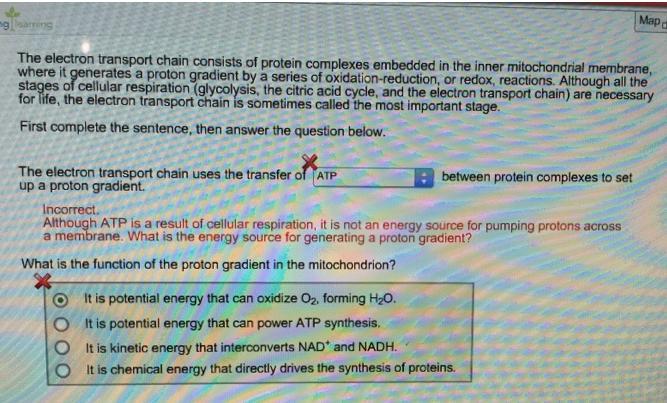
The electron transport chain consists of protein complexes embedded in the inner mitochondrial membrane, where it generates a pr
Maurinko [17]

The question is incomplete as it does not have the option which are provided in the attachment

Answer:

It is potential energy that can power ATP synthesis

Explanation:

Electron transport chain is considered the most important stage of the cellular respiration as it is the only stage during which a high amount of ATP is produced.

The electron transport through various protein complex where electrons lose its energy and are used to drive the outflow of the proton to the outside of the mitochondrial membrane.

When protons accumulate outside the membrane creates a proton gradient as a result of which the proton needs to enter the cell. The protons enter through the ATP synthase where the potential energy of the proton is used to rotate the rotor and thus ATP is formed from the ADP.

Thus, the selected option is correct.

5 0
2 years ago
Beginning at the synapse of a neuron, place the events in neuronal signaling in the correct sequence. 1. Ion channels bind the l
Lana71 [14]

Answer: 5, 1, 4, 3, 6, 2

Explanation:

The synapse is an intercellular approach between neurons or between a neuron and a muscle or glandular effector cell. At the synapse, the transmission of the nerve impulse takes place. This is initiated by a chemical discharge that causes an electrical current in the membrane of the presynaptic cell (sending cell). Then, once this nerve impulse reaches the end of the axon (the connection with the other cell), <u>the neuron secretes a chemical compound called neurotransmitter that is deposited in the cleft or synaptic space</u> (intermediate space between this transmitting neuron and the postsynaptic or receiving neuron). These secreted substances or neurotransmitters (noradrenaline and acetylcholine among others) are responsible for exciting or inhibiting the action of the other cell called postsynaptic cell.

The events are:

  • Acetylcholine is released into the synapse (5): Acetylcholine is a neurotransmitter that is released at synapses in response to a specific stimulus. The secreted neurotransmitter acts on specialized receptor sites on the postsynaptic cell, which causes changes in the metabolism of the postsynaptic cell, modifying its cellular activity.
  • Ion channels bind the ligand and open (1): The channels control the transmission between neurons because they bind neurotransmitters and open in response to a ligand. So the neurotransmitters diffuse across the cleft and bidn to receptors.
  • Na enters the postsynaptic cell, and the membrane potential changes (4): Sodium channels open and allow an inward diffusion of sodium ions (Na+) from the outside to the inside. This causes the membrane potential to become less negative or more positive or to approach the threshold potential. Next, this triggers an excitatory potential (EPSP) so it causes the postsynaptic membrane to depolarize and fire an action potential. which spreads along the membrane of the post-synaptic neuron. This means an impulse is transmitted.
  • Acetylcholinesterase breaks down acetylcholine (3): Acetylcholinesterase is an enzyme that breaks down the neurotransmitter so it causes the inactivation of acetylcholine into acetic acid and choline.
  • Na ion channels close (6):  Na channels open and close according to different signals. The peak voltage causes them to close, and potassium channels open. So sodium ions stay inside the cell while potassium ions move outside of it. When this happens, repolarization (change in membrane potential that retunrs it to a negative value) takes place. Potassium channels remain open after the potential reaches the resting level causing hyperpolarization (the membrane potential becomes more negative) and it alters the ability of certain of ions to enter the cell.  At the end, the cell has more K+ ions on the outside.
  • Na is pumped out of the cell, and the membrane potential is restored (2): The sodium-potassium pump moves sodium ions to the outside and potassium ions to the inside.
3 0
2 years ago
Which one of the following statements holds true for the induced-fit model?
Andrews [41]
The correct answer is...Once the enzyme binds to the specific substrate molecule, subtle structure changes occur in the active site, which are reverted when the reaction is over.

Hope this helps:)
5 0
2 years ago
Other questions:
  • Which of these phenomena cause uneven heating of the Earth?
    15·2 answers
  • Stella wants to test the hypothesis “If carbon dioxide levels increase, the growth rate of sunflowers will increase.” She places
    5·2 answers
  • What chemicals regulate the cell cycle how do they work?
    5·2 answers
  • Damage to which structure will most directly disrupt water balance within a single celled organism?
    14·2 answers
  • Question 2(Multiple Choice Worth 4 points) (03.02 LC) In what layer are convection currents found? Continental crust Inner core
    10·2 answers
  • Click the statement that best describes the role of each element in living organisms.
    12·2 answers
  • Which of the following is an important exception to the central dogma of molecular biology? a) Proteins are responsible for most
    10·1 answer
  • and this experiment you will breed mice to investigate the role of genes when parents pass traits down to their offspring State
    5·1 answer
  • While cleaning out the garage, Duane found his old bicycle. Some of the paint had worn off, exposing the iron frame inside. Duan
    8·2 answers
  • What is an asteroid that is pulled off course by a planet’s gravity and orbits around that planet called?
    8·1 answer
Add answer
Login
Not registered? Fast signup
Signup
Login Signup
Ask question!