answer.
Ask question
Login Signup
Ask question
All categories
  • English
  • Mathematics
  • Social Studies
  • Business
  • History
  • Health
  • Geography
  • Biology
  • Physics
  • Chemistry
  • Computers and Technology
  • Arts
  • World Languages
  • Spanish
  • French
  • German
  • Advanced Placement (AP)
  • SAT
  • Medicine
  • Law
  • Engineering
PolarNik [594]
2 years ago
14

Based in bonding theory, explain why heat capacity increases when you consider metals, ceramics and polymers.

Engineering
1 answer:
Sonbull [250]2 years ago
4 0

Answer:

Metals are good conductors are heat. Many applications of ceramics, such as their use as insulating materials cause higher heating capacity. In the case of polymers, we have to distinguish between the heat capacity of liquid, rubbery and glassy polymers. The heat capacity increases with increasing temperature, therefore, a liquid or rubbery polymer can hold more energy than a solid polymer.  

Explanation:

Valence bond (VB) theory is a chemical bonding theory that explains the chemical bonding between two atoms. Like molecular orbital (MO) theory, it explains bonding using principles of quantum mechanics. According to valence bond theory, bonding is caused by the overlap of half-filled atomic orbitals. The two atoms share each other's unpaired electron to form a filled orbital to form a hybrid orbital and bond together. Sigma and pi bonds are part of valence bond theory.

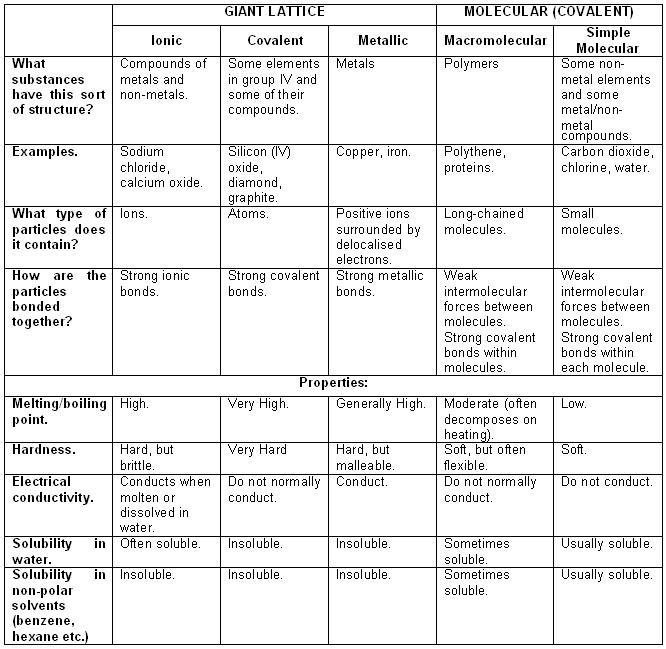
Bonding, Structure and Properties

  1. The bonding and structure of substances determine their properties.
  2. Bonding is the way the atoms are held together.
  3. The structure is the way the atoms are arranged relative to each other.
  4. There are two major types of structure: giant and molecular.
  5. Giant structures go on indefinitely, whereas molecular structures are made up of groups of atoms.

You might be interested in
A steel rotating-beam test specimen has an ultimate strength Sut of 1600 MPa. Estimate the life (N) of the specimen if it is tes
ziro4ka [17]

Answer:

the life (N) of the specimen is 46400 cycles

Explanation:

given data

ultimate strength Su = 1600 MPa

stress amplitude σa = 900 MPa

to find out

life (N) of the specimen

solution

we first calculate the endurance limit of specimen Se i.e

Se = 0.5× Su   .............1

Se = 0.5 × 1600

Se = 800 Mpa

and we know

Se for steel is 700 Mpa for Su ≥ 1400 Mpa

so we take endurance limit Se is = 700 Mpa

and strength of friction f  = 0.77 for 232 ksi

because for Se 0.5 Su at 10^{6} cycle = (1600 × 0.145 ksi ) = 232

so here coefficient value (a) will be

a = \frac{(f*Su)^2}{Se}    

a = \frac{(0.77*1600)^2}{700}  

a = 2168.3 Mpa

so

coefficient value (b) will be

a = -\frac{1}{3}log\frac{(f*Su)}{Se}

b =  -\frac{1}{3}log\frac{(0.77*1600)}{700}

b = -0.0818

so no of cycle N is

N =  (\frac{ \sigma a}{a})^{1/b}

put here value

N =  (\frac{ 900}{2168.3})^{1/-0.0818}

N = 46400

the life (N) of the specimen is 46400 cycles

5 0
2 years ago
Dust, dirt, or metal chips can pose a potential ____ injury risk in a shop.
pantera1 [17]

Answer:

Eye.

Explanation:

Dust, dirt, and metal chips are most unpleasant to get in your eyes. Just experience it and you'll know what I mean.

;)

3 0
2 years ago
CHALLENGE ACTIVITY 1.4.1: Basic syntax errors. Type the statements. Then, correct the one syntax error in each statement. Hints:
Lunna [17]

Answer:

Lets check each statement for the errors.

Explanation:

System.out.println("Predictions are hard.");

This statement has no syntax errors. When this statement is executed the following line will be displayed:

Predictions are hard.

System.out.print("Especially ');

This statement is missing the closing quotation mark. A single quotation mark is placed instead of double quotation mark in the statement.

The following error message will be displayed when this program statement will be compiled:

Main.java:15: error: unclosed string literal

String literals use double quotes. So to correct this syntax error, the statement should be changed as follows:

System.out.print("Especially");

The output of this corrected line is as following:

Especially

System.out.println("about the future.").

In this line a period . is placed at the end of the statement instead of a semicolon ; but according to the syntax rules statements should end in semicolons.

The error message displayed when this line is compiled is as following:

Main.java:15: error: ; expected

Main.java:15: error: not a statement

So in order to correct this syntax error the statement should be changed as following:

System.out.println("about the future.");    

The output of this corrected line is as following:

about the future

System.out.println("Num is: " - userName);

There is a syntax error in this statement because of - symbol used instead of +

+ symbol is used to join together a variable and a value a variable and another variable in a single print statement.

The error message displayed when this line is compiled is as following:

Main.java:13: error: bad operand types for binary operator '-'

So in order to correct this syntax error the statement should be changed as following:

System.out.println("Num is: " + userName);

This line will print two things one is the string Num is and the other is the value stored in userName variable.

So let userName= 5 then the output of this corrected line is as following:

Num is: 5
8 0
2 years ago
4. Two technicians are discussing the evaporative emission monitor. Technician A says that serious monitor faults cause a blinki
snow_lady [41]

Answer:

The correct option is;

Neither Technician A nor B

Explanation:

The evaporative emission monitor or Evaporaive Emission Control System EVAP System monitors enables the Power Control Module of the car to check fuel system leak integrity and the vapor consumption efficiency during engine combustion

It is a requirement of EPA on cars to check the emission of smug forming evaporates from cars

Serious monitor faults can cause the turning on of the check engine lights and the vehicle will not pass OBD II test, but it will not lead to engine shutdown

It runs when the engine is 15 to 85% full and the TP sensor is between 9% and 35%.

Therefore, the correct option is that neither Technician A nor B are correct.

3 0
2 years ago
A completely reversible heat pump produces heat at a rate of 300 kW to warm a house maintained at 24°C. The exterior air, which
Westkost [7]

Answer:

Entropy generation rate of the two reservoirs is approximately zero (\dot S_{gen} = 9.318 \times 10^{-4}\,\frac{kW}{K}) and system satisfies the Second Law of Thermodynamics.

Explanation:

Reversible heat pumps can be modelled by Inverse Carnot's Cycle, whose key indicator is the cooling Coefficient of Performance, which is the ratio of heat supplied to hot reservoir to input work to keep the system working. That is:

COP_{H} = \frac{\dot Q_{H}}{\dot W}

The following simplification can be used in the case of reversible heat pumps:

COP_{H,rev} = \frac{T_{H}}{T_{H} - T_{L}}

Where temperature must written at absolute scale, that is, Kelvin scale for SI Units:

COP_{H, rev} = \frac{297.15\,K}{297.15\,K-280.15\,K}

COP_{H, rev} = 17.479

Then, input power needed for the heat pump is:

\dot W = \frac{\dot Q}{COP_{H,rev}}

\dot W = \frac{300\,kW}{17.749}

\dot W = 16.902\,kW

By the First Law of Thermodynamics, heat pump works at steady state and likewise, the heat released from cold reservoir is now computed:

-\dot Q_{H} + \dot W + \dot Q_{L} = 0

\dot Q_{L} = \dot Q_{H} - \dot W

\dot Q_{L} = 300\,kW - 16.902\,kW

\dot Q_{L} = 283.098\,kW

According to the Second Law of Thermodynamics, a reversible heat pump should have an entropy generation rate equal to zero. The Second-Law model for the system is:

\dot S_{in} - \dot S_{out} - \dot S_{gen} = 0

\dot S_{gen} = \dot S_{in} - \dot S_{out}

\dot S_{gen} = \frac{\dot Q_{L}}{T_{L}} - \frac{\dot Q_{H}}{T_{H}}

\dot S_{gen} = \frac{283.098\,kW}{280.15\,K} - \frac{300\,kW}{297.15\,K}

\dot S_{gen} = 9.318 \times 10^{-4}\,\frac{kW}{K}

Albeit entropy generation rate is positive, it is also really insignificant and therefore means that such heat pump satisfies the Second Law of Thermodynamics. Furthermore, \dot S_{in} = \dot S_{out}.

5 0
2 years ago
Other questions:
  • Oil with a density of 800 kg/m3 is pumped from a pressure of 0.6 bar to a pressure of 1.4 bar, and the outlet is 3 m above the i
    9·1 answer
  • The pump of a water distribution system is powered by a 6-kW electric motor whose efficiency is 95 percent. The water flow rate
    5·1 answer
  • Write a program with total change amount as an integer input, and output the change using the fewest coins, one coin type per li
    15·1 answer
  • A meter stick can be read to the nearest millimeter and a travelling microscope can be read to the nearest 0.1 mm. Suppose you w
    11·1 answer
  • The small 5-oz slider A moves without appreciable friction in the hollow tube, which rotates in a horizontal plane with a consta
    7·1 answer
  • 13–27. The conveyor belt is moving downward at 4 m>s. If the coefficient of static friction between the conveyor and the 15-k
    11·1 answer
  • . A cylindrical metal specimen having an original diameter of 12.8 mm (0.505 in.) and gauge length of 50.80 mm (2.000 in.) is pu
    11·1 answer
  • Initialize the tuple team_names with the strings 'Rockets', 'Raptors', 'Warriors', and 'Celtics' (The top-4 2018 NBA teams at th
    5·1 answer
  • When comparing solids to fluids, the following is true: for elastic solids, the stress must be normal. For Newtonian fluids, the
    9·1 answer
  • What is the linear distance traveled in one revolution of a 36-inch wheel
    6·1 answer
Add answer
Login
Not registered? Fast signup
Signup
Login Signup
Ask question!