answer.
Ask question
Login Signup
Ask question
All categories
  • English
  • Mathematics
  • Social Studies
  • Business
  • History
  • Health
  • Geography
  • Biology
  • Physics
  • Chemistry
  • Computers and Technology
  • Arts
  • World Languages
  • Spanish
  • French
  • German
  • Advanced Placement (AP)
  • SAT
  • Medicine
  • Law
  • Engineering
STALIN [3.7K]
2 years ago
6

What is the linear distance traveled in one revolution of a 36-inch wheel

Engineering
1 answer:
Afina-wow [57]2 years ago
7 0

Answer:

  36π inches ≈ 113.0973 inches

Explanation:

The circumference of the wheel is pi times its diameter.

  C = πd

  C = π(36 in) = 36π in ≈ 113.0973 in

The distance around the wheel is 36π inches, about 113.0973 inches.

You might be interested in
Toeboards are usually ___ inches high and used on landings and balconies.
Ksju [112]

Answer:4 inches

Explanation:

Google told me

6 0
2 years ago
Small droplets of carbon tetrachloride at 68 °F are formed with a spray nozzle. If the average diameter of the droplets is 200 u
Licemer1 [7]

Answer:

the difference in pressure between the inside and outside of the droplets is 538 Pa

Explanation:

given data

temperature = 68 °F

average diameter = 200 µm

to find out

what is the difference in pressure between the inside and outside of the droplets

solution

we know here surface tension of carbon tetra chloride at 68 °F is get from table 1.6 physical properties of liquid that is

σ = 2.69 × 10^{-2} N/m

so average radius = \frac{diameter}{2} =  100 µm = 100 ×10^{-6} m

now here we know relation between pressure difference and surface tension

so we can derive difference pressure as

2π×σ×r = Δp×π×r²    .....................1

here r is radius and  Δp pressure difference and σ surface tension

Δp = \frac{2 \sigma }{r}    

put here value

Δp = \frac{2*2.69*10^{-2}}{100*10^{-6}}  

Δp = 538

so the difference in pressure between the inside and outside of the droplets is 538 Pa

7 0
2 years ago
Write multiple if statements: If carYear is before 1967, print "Probably has few safety features." (without quotes). If after 19
Free_Kalibri [48]

Answer:

The solution code is written in Python 3.

  1. carYear = 1995
  2. if(carYear < 1967):
  3.    print("Probably has few safety features.\n")
  4. if(carYear > 1970):
  5.    print("Probably has head rests. \n")
  6. if(carYear > 1991):
  7.    print("Probably has electronic stability control.\n")
  8. if(carYear > 2002):
  9.    print("Probably has airbags. \n")

Explanation:

Firstly, create a variable, <em>carYear</em> to hold the value of year of the car make. (Line 1)

Next, create multiple if statements as required by the question (Line 3-13). The operator "<" denotes "smaller" and therefore <em>carYear < 1967</em> means any year before 1967. On another hand, the operator ">" denotes "bigger" and therefore <em>carYear > 1970 </em>means any year after 1970.

The print statement in each of the if statements is done using the Python built-in function <em>print()</em>. The "\n" is an escape sequence that create a new line at the end of each printed phrase.

5 0
2 years ago
A cylindrical drum (2 ft. dia ,3 ft height) is filled with a fluid whose density is 40 lb/ft^3. Determine (a. the total volume o
Ksivusya [100]

Answer:

a)V=9.42\ ft^3

b)Mass in lb = 376.8 lb

Mass in slug = 11.71 slug

c)v=0.025\ ft^3/lb

d)w=1276 \ lb/ft.s^2

Explanation:

Given that

d= 2 ft

r= 1 ft

h= 3 ft

Density

\rho = 40\ lb/ft^3

a)

We know that volume V given as

V=\pi r^2 h

V=\pi \times 1^2\times 3

V=9.42\ ft^3

b)

Mass = Density x volume

mass =40\times 9.42\ lb

mass= 376.8 lb

We know that

1 lb = 0.031 slug

So 376.8 lb= 11.71 slug

Mass in lb = 376.8 lb

Mass in slug = 11.71 slug

c)

we know that specific volume(v) is the inverse of density.

v=\dfrac{1}{\rho}\ ft^3/lb

v=\dfrac{1}{40}\ ft^3/lb

v=0.025\ ft^3/lb

d)

Specific weight(w) is the product of density and the gravity(g).

w= ρ X g

w = 40 x 31.9

w=1276 \ lb/ft.s^2

8 0
2 years ago
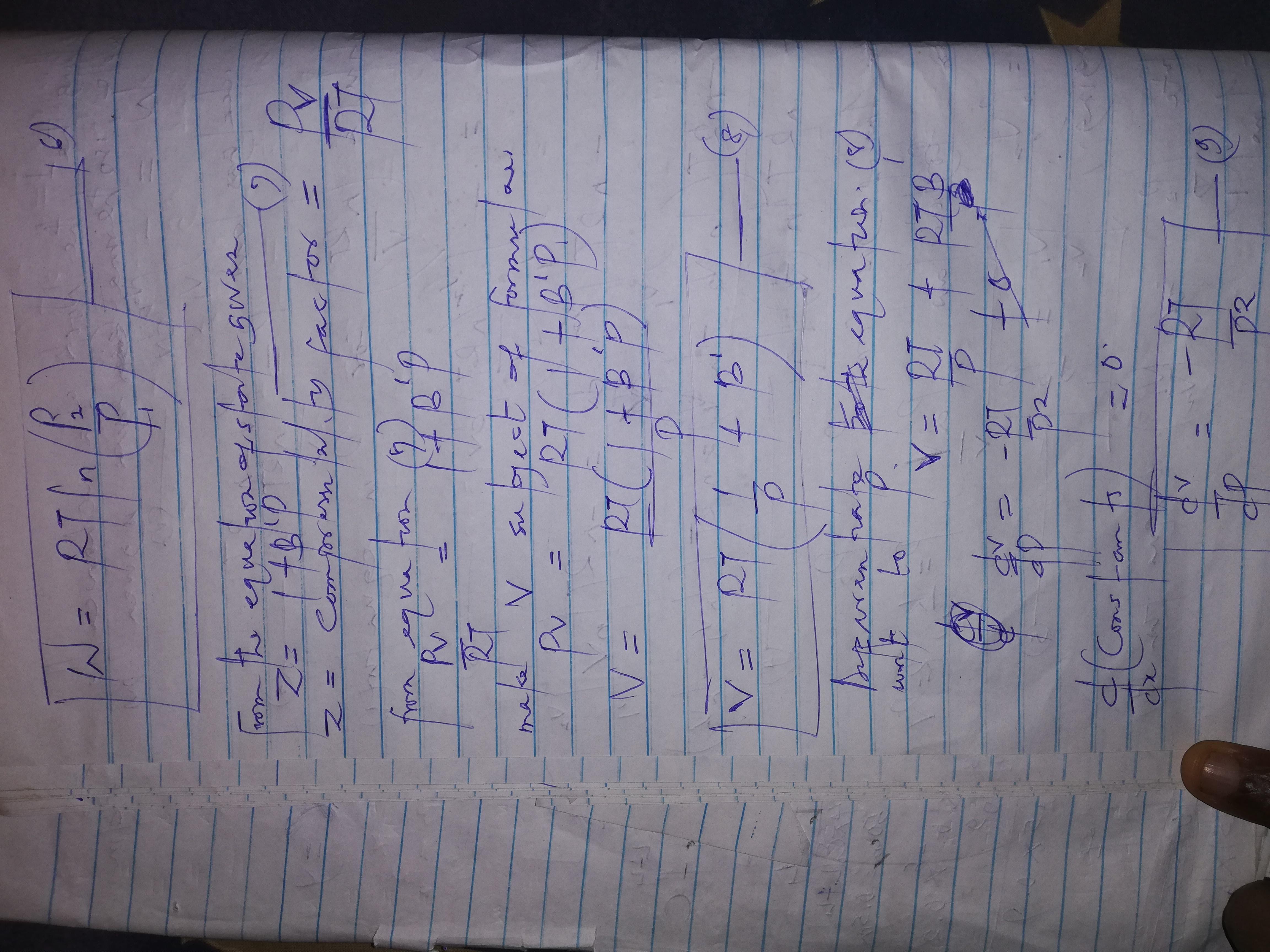
Derive an equation for the work of a mechanically reversible, isothermal compression of 1 mol of a gas from an initial pressure
Lyrx [107]

Answer:

The long derivation for work of a mechanically reversible, isothermal compression was done with detailed steps as shown in the attachment.

Explanation:

what is applied here is a long derivation from Work done in an isobaric process, the expression for the compressibility factor (Z) and the equation of state that was given. The requisite knowledge of Differentiation and Integration was used.

The detailed derivation from firs principle is as shown in the attachment.

5 0
2 years ago
Other questions:
  • Oil with a density of 800 kg/m3 is pumped from a pressure of 0.6 bar to a pressure of 1.4 bar, and the outlet is 3 m above the i
    9·1 answer
  • Define a) Principal Plane b) Principal Stress c) anelasticity d) yield point e) ultimate tensile stress f) hardness g) toughness
    5·1 answer
  • Air is compressed adiabatically from p1 1 bar, T1 300 K to p2 15 bar, v2 0.1227 m3 /kg. The air is then cooled at constant volum
    13·1 answer
  • 4.9 Given that I 4 amps when Vs 40 volts and Is 4 amps and I 1 amp when Vs 20 volts and Is 0, use superposition and linearity to
    5·1 answer
  • The Hamming encoder/decoder in the lecture detected and corrected one error bit. By adding a thirteen bit which is the exclusive
    13·1 answer
  • A pipe is insulated such that the outer radius of the insulation is less than the critical radius. Now the insulation is taken o
    11·1 answer
  • Two airstreams are mixed steadily and adiabatically. The first stream enters at 35°C and 30 percent relative humidity at a rate
    6·1 answer
  • Anytime scaffolds are assembled or __________, a competent person must oversee the operation.
    15·2 answers
  • What ratio between differential gain and common-mode gain is called​
    9·1 answer
  • 1. A _____ is applied to a wall or roof rafters to add strength and keep the building straight and plumb.
    9·1 answer
Add answer
Login
Not registered? Fast signup
Signup
Login Signup
Ask question!