answer.
Ask question
Login Signup
Ask question
All categories
  • English
  • Mathematics
  • Social Studies
  • Business
  • History
  • Health
  • Geography
  • Biology
  • Physics
  • Chemistry
  • Computers and Technology
  • Arts
  • World Languages
  • Spanish
  • French
  • German
  • Advanced Placement (AP)
  • SAT
  • Medicine
  • Law
  • Engineering
Vlada [557]
2 years ago
4

Deviating from the collusive outcome Mays and McCovey are beer-brewing companies that operate in a duopoly (two-firm oligopoly).

The daily marginal cost (MC) of producing a can of beer is constant and equals $0.80 per can. Assume that neither firm had any startup costs, so marginal cost equals average total cost (ATC) for each firm.Suppose that Mays and McCovey form a cartel, and the firms divide the output evenly. (Note: This is only for convenience; nothing in this model requires that the two companies must equally share the output.)
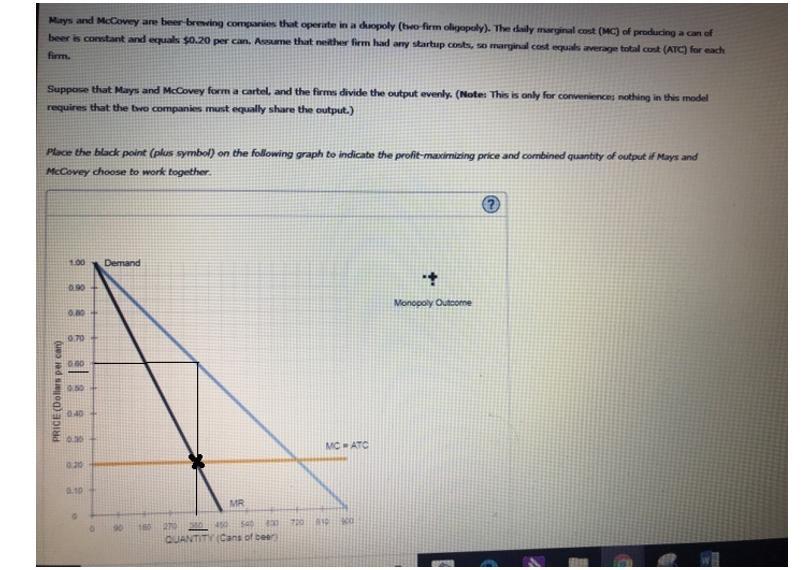
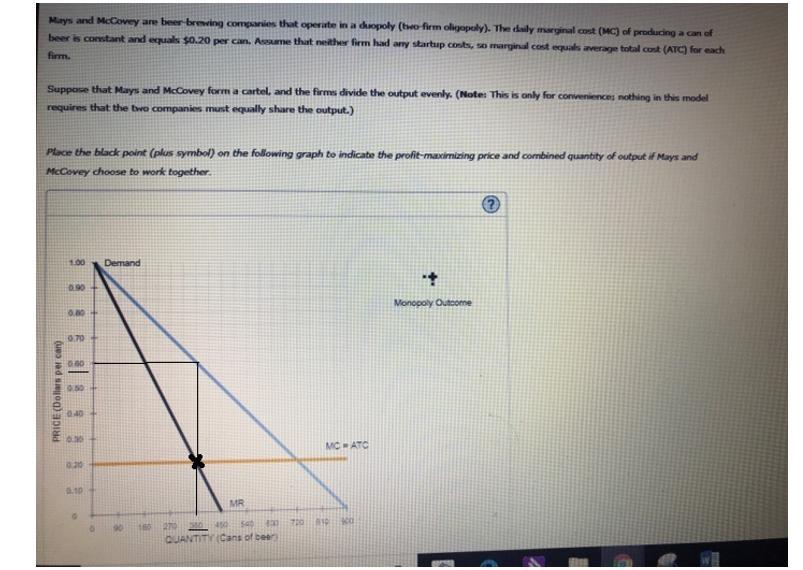
Place the black point (plus symbol) on the following graph to indicate the profit-maximizing price and combined quantity of output if Mays and McCovey choose to work together.

Monopoly Outcome PRICE (Dollars per can)QUANTITY (Thousands of cans of beer)DemandMRMC = ATC

When they act as a profit-maximizing cartel, each company will producecans and chargeper can. Given this information, each firm earns a daily profit of, so the daily total industry profit in the beer market is.

Oligopolists often behave noncooperatively and act in their own self-interest even though this decreases total profit in the market. Again, assume the two companies form a cartel and decide to work together. Both firms initially agree to produce half the quantity that maximizes total industry profit. Now, suppose that Mays decides to break the collusion and increase its output by 50%, while McCovey continues to produce the amount set under the collusive agreement.

Maysâs deviation from the collusive agreement causes the price of a can of beer to toper can. Mays's profit is now, while McCoveyâs profit is now. Therefore, you can conclude that total industry profit when Mays increases its output beyond the collusive quantity.

Business
1 answer:
ololo11 [35]2 years ago
4 0

Total industry profits have decreased when May increased output beyond collusive quantity.

<u>Explanation:</u>

1) The profit is maximised when Marginal Revenue = Marginal Cost. This is where extra revenue from producing one more unit of good equals extra cost from producing that good.

Equilibrium point is marked by a cross and equilibrium price and quantity is underlined.

2) We see that the equilibrium quantity is 360 and price is 0.60. Because these two firms have identical costs, they will produce equal amounts of goods. Therefore each of them will produce 180 cans and charge 0.60 for them. Each firm earns a daily profit of:

Total revenue minus total cost

=Price into Quantity minus Total cost

=180 into 0.6 minus 0.2 into 80

=180 ( 0.6 minus 0.2)

=180 inot 0.4 = 72

Therefore each firm earns $72 and total industry profit is 72 into 2 = $144.

3) Now May decides to break the collusion and produce 50% more output. So orginally May was producing 180 units of good.

50% of 180 units is: (0.5) inot 180

=90

Therefore total units May is now producing is 50% more than 180, which is:

=180 plus 90

=270 units.

McCovey is honoring the original agreement and is producing 180 units of good.

So total units of goods in the market is = units produced by May + Units produced by McCovey

= 270 plus 180

=450 units

From the above schedule or demand-supply diagram, we have to find out the corrosponding price to 450 units units of quantity.

You might be interested in
For the most recent year, Camargo, Inc., had sales of $546,000, cost of goods sold of $244,410, depreciation expense of $61,900,
weqwewe [10]

Answer:

Explanation:

As we know that time interest earned ratio = Income before interest and taxes / interest expense.

Sales                                                                                           = 546000

less: cost of goods sold                                                            =  (<u>244410</u>)

            Gross profit                                                                       301590

Less: <u>expenses</u>

          Depreciation expense                                                      =( <u>61900   </u>)    

         Profit before interest and taxes                                         239690

Less: tax

      (239690 * 23%)                                                                =   (<u>55128</u>)            

                         Profit                                                                   184562

Profit - Retained earning Addition  = Interest

      184562 - 74300 = 110262.

Interest earned ratio = 239690 / 110262 = 2.17 times  

3 0
2 years ago
Which of the following statements does not accurately describe the fair-value method of accounting?
Mama L [17]

Answer: Option (A)

Explanation:

Fair values mostly tends to exist for the marketable security but this in terms does not state that this method is applicable. For instance if investor tends to control the entity with the traded equity, therefore the investment is centralized and thereby, fair-value method of accounting is not being used.

Therefore, from the given options we can state that option (A) does not precisely describes the fair value method.

8 0
2 years ago
Juarez builders incurred $285,000 of labor costs for construction jobs completed during the month of august, of which $212,000 w
Feliz [49]
The answer is

debit work in process inventory $212,000; credit factory wages payable $212,000.
6 0
2 years ago
Read 2 more answers
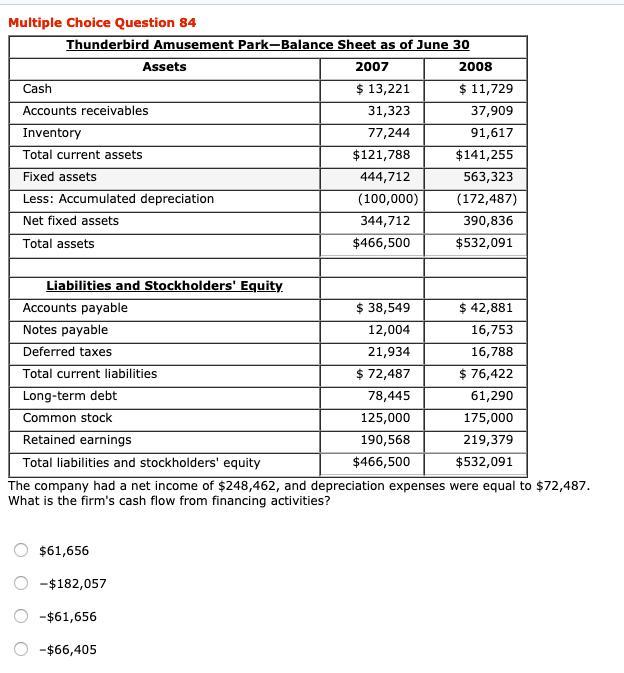
The company had a net income of $248,462, and depreciation expenses were equal to $72,487. What is the firm's cash flow from fin
Mademuasel [1]

Complete Question:

The complete question can be seen the in the attachment at the end of the solution of the question.

Answer:

Option B. -$182,057

Explanation:

The Cash flow from financing activities can be calculated by using the following formula:

Cash flow from financing activities = Changes in the equity finance

+ Changes in long term borrowings + Changes in short term borrowings

- Interest paid - Dividends paid

Here

Changes in the equity = $175,000 common stock in year 2008

- $125,000 common stock in year 2008 = $50,000

Changes in long term Borrowings = $61,290 - $78,445 = - $17,155

Changes in short term Borrowings = $16,753 - $12,004 = $4749

Interest paid is $0 because interest rate is not given hence we can't calculate it.

Dividends paid = $190,568 Opening Retained Earnings + $248,462 Net Profit for the year - $219,379 Closing Retained Earnings  = $219,651

Now, by putting values in the above equations, we have:

Cash flow from financing activities = $50,000 - $17,155 + $4749 - 0 - $219,651 = -$182,057
4 0
2 years ago
At a sales volume of 40,000 units, Lonnie Company's total fixed costs are $40,000 and total variable costs are $60,000. The rele
eduard

Answer:

$115,000

Explanation:

Calculation for the total expected cost

First step is to find the variable cost per unit

Variable costs per unit= 60,000/40,000

Variable costs per unit= 1.50 per unit.

Second step is to find the Total variable costs

Total variable costs =50,000 units × 1.50 per units

Total variable costs=$75,000

Last step is add the total fixed costs of the amount of $40,000 to the Total variable costs of $75,000

Total expected cost =$75,000+$40,000

Total expected cost =$115,000

Therefore the total expected cost will be $115,000

3 0
2 years ago
Other questions:
  • If an automobile gets 24.5 miles to the gallon and the cost of gasoline is $2.75 a gallon, how much will it cost to drive 975 km
    6·1 answer
  • One study of 195 critical incidents in banking and medical settings showed that a major difference between effective and ineffec
    14·1 answer
  • You are working as a medical administrative assistant at Saint Catherine Children’s Hospital. Janet, your supervisor, asks you t
    14·2 answers
  • Brian has been working for a few years now and has saved a substantial amount of money. He now wants to invest 50 percent of his
    9·2 answers
  • Shelly works as a call-center employee from inside her home. The company she works for does not mind that she works from home be
    10·1 answer
  • According to the video game industry’s statistics, the average gamer is 34 years old. Imagine the standard deviation for age is
    9·1 answer
  • St. Augustine Corporation originally budgeted for $360,000 of fixed overhead at 100% of normal production capacity. Production w
    9·1 answer
  • Studies indicate that the price elasticity of demand for beer is about 0.9. A government policy aimed at reducing beer consumpti
    15·1 answer
  • When Walmart issued new standards for livestock products that were raised on food without antibiotics or artificial growth hormo
    5·2 answers
  • Bardell, Inc. prepared its statement of cash flows for the year. The following information is taken from that statement: Net cas
    5·1 answer
Add answer
Login
Not registered? Fast signup
Signup
Login Signup
Ask question!