answer.
Ask question
Login Signup
Ask question
All categories
  • English
  • Mathematics
  • Social Studies
  • Business
  • History
  • Health
  • Geography
  • Biology
  • Physics
  • Chemistry
  • Computers and Technology
  • Arts
  • World Languages
  • Spanish
  • French
  • German
  • Advanced Placement (AP)
  • SAT
  • Medicine
  • Law
  • Engineering
Black_prince [1.1K]
2 years ago
14

Researchers studied the relationship between glucose concentration, oxygen level, and ATP production in one type of mammalian ce

ll. Cells were isolated and cultured in growth medium containing either 1.5mM glucose or 25 mM glucose and at oxygen levels that varied from 0% to 21% . The researchers determined the concentration of ATP per cell under the different conditions. The ATP concentrations are shown as relative to the maximum ATP concentration obtained when cells were cultured in the presence of 25 mM glucose and 21% oxygen, standard culture conditions. The data are shown in Table 1.

Biology
1 answer:
Lana71 [14]2 years ago
4 0

Complete Question:

(a)  Describe the role of oxygen in cellular respiration.

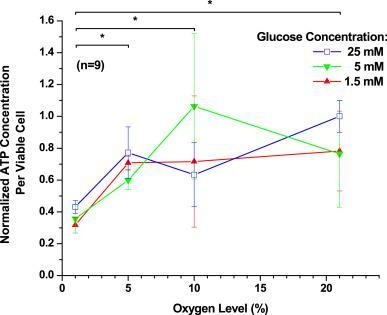
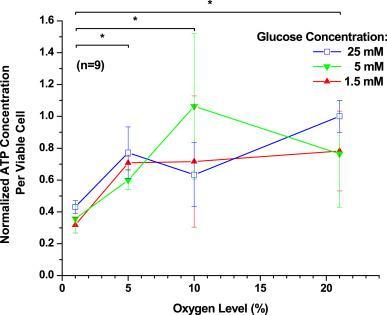
(b) Using the template,  construct an appropriately labeled graph to represent the data in Table 1.

(c)  Describe the relationship between the concentration of glucose in the culture medium and the  ATP concentration in the cells.

(d) In a further experiment, the researchers add a compound to the cell growth medium that both binds and releases protons  (H+) and also passes through lipid membranes.  Predict the effect of this added compound on  ATP production by the cells.  Justify your prediction.

Answer and Explanation:

<u>(a)  Describe the role of oxygen in cellular respiration. </u>

Oxygen is essential for aerobic respiration only. This process occurs in the mitochondria and is abbreviated as :

C6H12O6 (glucose) + 6 O2 → 6 CO2 + 6 H2O + ≈38  

...this requires glucose, which is then broken down through several processes that begin in the cytoplasm, to produce energy in the form of ATP. To terminate the reaction, oxygen acts as the final electron acceptor after the electrons have traveled along the electron transport chain and ATPase. This forms water as a byproduct.

<u>(b) Using the template,  construct an appropriately labeled graph to represent the data in Table 1</u>.

An appropriate graph or data plot should be  a line graph. In the graph, (as seen in the attached example)

  • the responding variable relative concentration of ATP should be placed on the y axis,
  • the independent variable, the O2 concentration should be placed on the x axis.

Each varying concentration of glucose, should be plotted on a separate line within the graph, denoted in the legend.

<u> (c)  Describe the relationship between the concentration of glucose in the culture medium and the  ATP concentration in the cells. </u>

Glucose fuels the respiration process, and is broken down over a series of steps in glycolysis, the Kreb's cycle, and oxidative phosphorylation. With higher concentrations of glucose in the culture media, the rate of aerobic respiration increases as more glucose is processed. However, the breakdown of glucose shows higher efficiency (Table 1)  in  the presence of higher concentration of Oxygen.

<u>(d)In a further experiment, the researchers add a compound to the cell growth medium that both binds and releases protons  (H+) and also passes through lipid membranes.  Predict the effect of this added compound on  ATP production by the cells.  Justify your prediction.</u>

An electron transport chain, in Oxidative phosphorylation includes NADH and FADH2 which donate electrons and are converted to NAD+ and FAD. The donated electrons move down a chain of membrane proteins and release energy, the energy pumps protons out of the mitochondrial matrix.

The protons H+ build up and form a gradient in the intermembrane space of the mitochondria; they flow back into the matrix through ATP synthase in a process that leads to the production of ATP through the phosphorylation of ADP.

This cannot occur without the proton motive force formed through the buildup of H+ and the resulting chemiosmosis- here the H+ are not funneled through ATPase, disrupting the electron transport chain and reducing the amount of energy produced.
You might be interested in
Examine the image of the relatedness of vertebrates represented in this phylogenetic tree. Select all the statements that are su
sveticcg [70]

Answer: Gray whales are the common ancestor of the Blue and Humpback whales.

Ancestors of Blue whale include: Gray?

3 0
2 years ago
Read 2 more answers
The hydrosphere refers to the total amount of water on Earth, including liquid, gas, and solid forms. Which is one way the
Zielflug [23.3K]

Answer:

The correct option is;

Glaciers that once covered South Africa have melted and can no longer form.

Explanation:

The Karoo Supergroup that formed hundres of millions of year ago covered the most part of South Africa. The Tillite debris from melting glaciers, in Dwyka Tillite are located at the bottom layers of the Karoo Supergroup, which is an indication that millions of years ago, South Africa was under extensive glacier coverage formed during the movement of the continent past the South Pole

The eventual arrival of the continent to temperate regions away from the South Pole resulted in the melting of the glaciers from which a huge swamp was formed.

8 0
2 years ago
Read 2 more answers
Grand Canyon is getting wider every day. What is making the canyon wider?
ira [324]

The Grand Canyon of Arizona is one of world’s largest and steepest canyons. It ranges up to 277 miles long and 18 miles wide. Its formation is carved due to the erosive power of the water’s current.  As heavy rains continue to occur, more rocks and stones erode and fall which adds length and width to the Grand Canyon.

4 0
2 years ago
Read 2 more answers
Drinking alcohol can cause dehydration, which makes the blood hypertonic. Which option best describes the consequences of this h
julsineya [31]

Answer:

Hypertonic blood draws water out of the interstitial fluid, which makes the interstitial fluid hypertonic. This, in turn, draws water out of the cells.

Basically an hype tonic blood has high solute potential,( low water potential)  compare with  the surrounding  plasma  and the interstitial fluid. Thus the interstitial fluid is hypotonic to the blood.

Consequently,water with higher potential moves   from the interstitial fluid medium into the blood by osmosis through the capillary endothelial. This raises the water potential of the blood, lowering the solute potential, thus making it hypotonic to the interstitial fluid; which is now hypertonic(lower water potential ,due to loss to the blood by osmosis).

Since the interstitial fluids is now hyper tonic to the surrounding cells, water moves from the hypo tonic surrounding cells through osmosis into the interstitial fluids. The sequence continues until a stable internal environment is achieved,

8 0
2 years ago
Which best describes the bond that would form between lithium (Li) and fluorine (F)?
Vladimir79 [104]
They form an ionic bond by exchanging one electron
3 0
2 years ago
Read 2 more answers
Other questions:
  • Drag each tool below into the box corresponding to the step in the dmaic cycle where it is most likely to be used.
    5·1 answer
  • Question text this term means the return of substances into the bloodstream from the filtrate.
    12·1 answer
  • Muscle cells contain numerous __________ to serve their high demand for atp.
    8·1 answer
  • A pregnant female is rh negative and at 28 weeks gestation. the child's father is rh positive. the mother is given an injection
    10·2 answers
  • A puff of air is directed toward a rabbit's eyeball. The air puff causes the rabbit to blink. Just before the air hits the eyeba
    8·1 answer
  • "A nursing student is critiquing a study for her nursing research class. She feels like the study findings are generalizable to
    6·1 answer
  • Chen Yu suffered a head injury after crashing his motorcycle. When he awoke from a two-day coma, he found that he could formulat
    5·1 answer
  • Select the correct text in the passage.
    10·1 answer
  • ASAP What is a photosynthetic pigment? What is a photosynthetic pigment? A. An oxygen based compound that captures light energy.
    8·2 answers
  • What two parts of a nucleotide do not ?change throughout the structure of DNA a. Five-Carbon Sugar and Phosphate Group b. Five-C
    8·1 answer
Add answer
Login
Not registered? Fast signup
Signup
Login Signup
Ask question!
