answer.
Ask question
Login Signup
Ask question
All categories
  • English
  • Mathematics
  • Social Studies
  • Business
  • History
  • Health
  • Geography
  • Biology
  • Physics
  • Chemistry
  • Computers and Technology
  • Arts
  • World Languages
  • Spanish
  • French
  • German
  • Advanced Placement (AP)
  • SAT
  • Medicine
  • Law
  • Engineering
Nataliya [291]
2 years ago
4

Groleau Corporation has an activity-based costing system with three activity cost pools--Processing, Setting Up, and Other. The

company's overhead costs, which consist of factory utilities and indirect labor, are allocated to the cost pools in proportion to the activity cost pools' consumption of resources. Costs in the Processing cost pool are assigned to products based on machine-hours (MHs) and costs in the Setting Up cost pool are assigned to products based on the number of batches. Costs in the Other cost pool are not assigned to products. Data concerning the two products and the company's costs and activity-based costing system appear below:
Factory utilities (total) $36,500
Indirect labor (total) $11,000

Distribution of Resource Consumption Across Activity Cost Pools

Processing Setting Up Other
Factory utilities 0.30 0.20 0.50
Indirect labor 0.50 0.30 0.20


MHs Batches
Product S8 3,600 1,500
Product F1 7,600 900
Total 11,200 2,400


Product S8 Product F1
Sales (total) $70,900 $100,100
Direct materials (total) $25,400 $37,500
Direct labor (total) $32,400 $44,000


Required:

a. Assign overhead costs to activity cost pools using activity-based costing.
b. Calculate activity rates for each activity cost pool using activity-based costing.
c. Determine the amount of overhead cost that would be assigned to each product using activity-based costing.
d. Determine the product margins for each product using activity-based costing.

Business
1 answer:
grin007 [14]2 years ago
3 0

Answer:

Look up attached file

Explanation:

You might be interested in
A chemical manufacturer is setting up capacity in Europe and North America for the next three years. Annual demand in each marke
Yuri [45]

Answer:

Explanation:

The two choices under consideration are building 4 million units of capacity in North America

YEAR                         1                    2                           3  

Production and Sales 4,000,000.00   4,000,000.00   4,000,000.00  

Variable cost @ 10  40,000,000.00   40,000,000.00   40,000,000.00  

Divide by:

Conversion Factor  1.33                         1.33                     1.33  

Multiply by:

Growth(.1*.5)+(-.05*.5) 1.025                        1.025^2                  1.025^3  

NET CASHFLOWS  30,827,068.00   31,597,744.00   32,387,688.00  

DCF @ 10%     0.909090909           0.83                  0.75  

Present Values  28,024,607.27   26,113,838.02   24,333,349.36  

NET TOTAL COST 78,471,794.65  

or building 2 million units of capacity in each of the two loca-tions. Building two plants will incur an additional one-time cost of $2 million.

YEAR                  0            1                      2                              3  

Production and Sales       4,000,000.00      4,000,000.00   4,000,000.00  

Variable cost @ [(10+9)/2] 38,000,000.00  38,000,000.00   38,000,000.00  

Additional cost  2,000,000.00      

Conversion Factor     1.33     1.33                   1.33                       1.33  

Growth(.1*.5)+(-.05*.5)    1.025               1.025^2              1.025^3  

CASHFLOWS  1,503,759.40  29,285,714.29  30,017,857.00  30,768,304.00  

DCF @ 10%       1           0.909090909    0.826446281 0.751314801  

Present Value 1,503,759.40  26,623,376.62   24,808,146.28   23,116,682.19  

NET TOTAL COST = 76,051,964.50  

DECISION: The manufacturer should build 2 plants in 2 different locations because it gives a lower net present cost

<u>At what initial cost differential from building the two plants will the chemical manufacturer be indifferent between the two options?</u>

The difference in both options came from the fact that variable cost is lower in Europe and building the plant is more expensive. If there is no increase in cost and variable cost is same everywhere, then both options will be same.
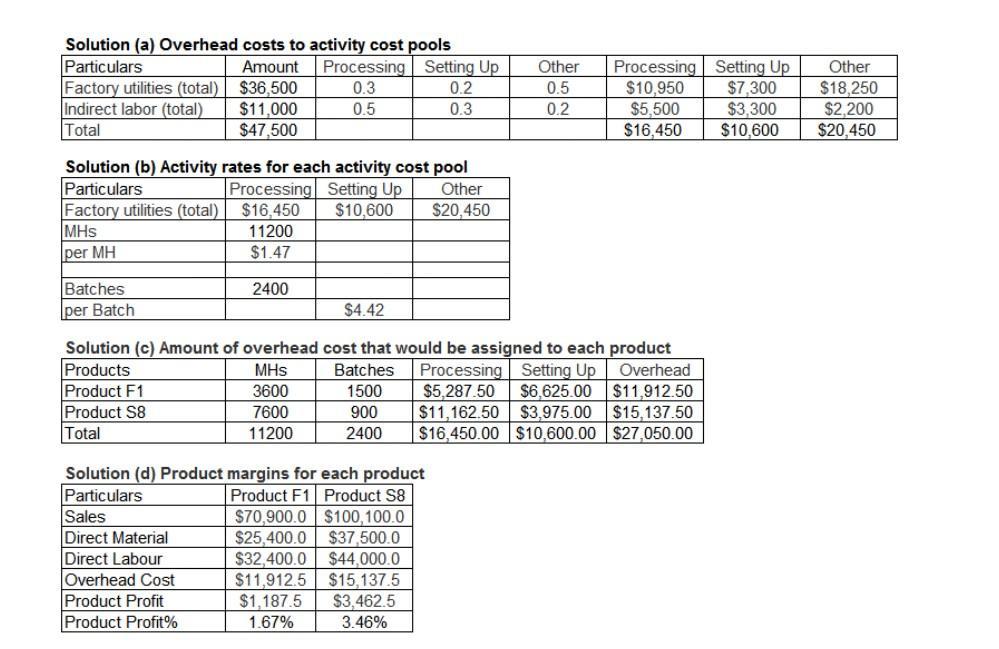
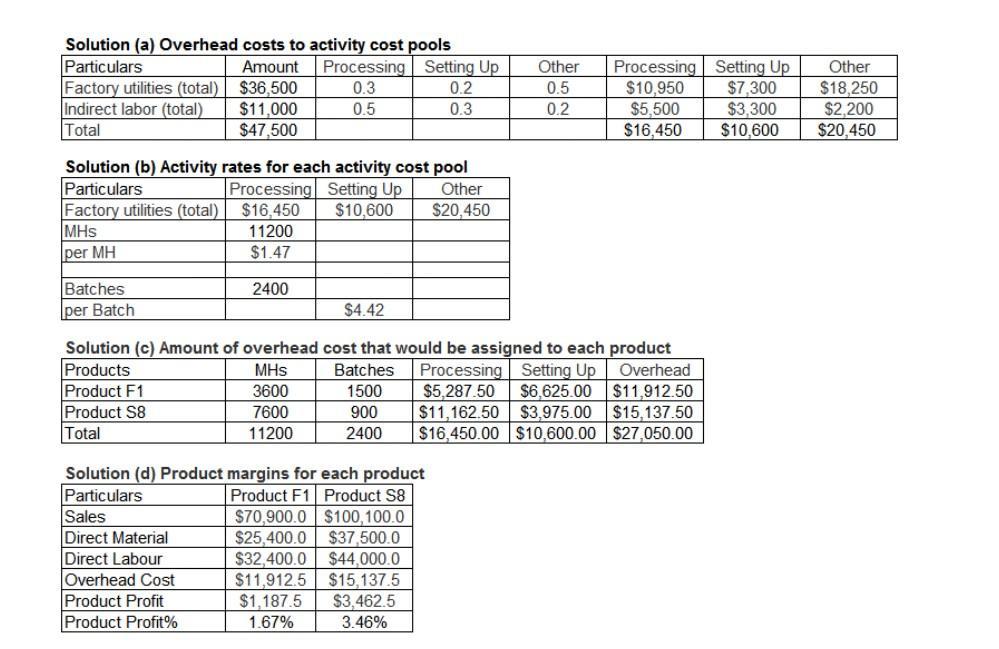
5 0
2 years ago
A company uses the FIFO method for inventory costing. At the start of the period the production department had 20,000 units in b
UkoKoshka [18]

Answer:

equivalent cost per unit for labor: $4.1982

Explanation:

complete and transferred    165,000

work on ending WIP               16,500  //   22,000 x 75%

previous work on beginning (8,000) //  20,000 x 40%

Equivalent units                   173,500

labor cost added during the period 726,825

equivalent cost 726,825/173,500 = 4.198193084

equivalent cost per unit for labor: $4.1982

7 0
2 years ago
On January 1, 2019, Shields, Inc., issued $800,000 of 9%, 20-year bonds for $879,172, yielding a market (yield) rate of 8%. Semi
Ghella [55]

Answer:

cash 879,172 debit

   bonds payble   800,000 credit

   premium on BP    79,127 credit

--to record issuance--

Interest expense 35,166.84 debit

premium on BP      833.16 debit

cash                    36,000 credit

--to record first interest payment--

Interest expense 35133.52 debit

premium on BP          866.48 debit

cash                       36,000 credit

--to record second interest payment--

<em><u>Financial Statement effect:</u></em>

<em><u>Cash flow:</u></em>

financing:

proceed from bonds 879,172

interest paid                 72,000

<em><u>Net income</u></em>

interest expense 35,133.52 + 35,166.84 = 70.250,36

<em><u>Balance sheet</u></em>

Bonds payable   800,000

Premium on Bonds 77,471

Explanation:

The price will be the discounted future coupon and maturity payment at market rate

C \times \frac{1-(1+r)^{-time} }{rate} = PV\\

C 36,000.000 (800,000 x 9% x 1/2)

time 40 ( 20 years x 2)

rate 0.04 (8% x 1/2)

36000 \times \frac{1-(1+0.04)^{-40} }{0.04} = PV\\

PV $712,539.8598

\frac{Maturity}{(1 + rate)^{time} } = PV  

Maturity   800,000.00

time   40.00

rate  0.04

\frac{800000}{(1 + 0.04)^{40} } = PV  

PV   166,631.24

PV c $712,539.8598

PV m  $166,631.2357

Total $879,171.0955

The interest expense will be the carrying value times market rate

the cash outlay will be the same for each period:

principal x coupon rate x half-year as payment are semiannual.

800,000 x 0.09 x 1/2 = 36,000

The difference between each one will determinate the amortization onthe premium

6 0
2 years ago
Manta Ray Company manufactures diving masks with a variable cost of $31. The masks sell for $40. Budgeted fixed manufacturing ov
riadik2000 [5.3K]

Answer:

When there is no change in the beginning and ending units of inventory i.e the  units sold are equal to the units produced,the income under variable and absorption costing remains the same which is the condition in the given question.

Explanation:

If we have 80,000 units produced and sold then the income under both methods will be the same.

Manta Ray Company

Income Statement Variable Costing

Sales                $40*80,000=  $ 3200,000

Variable Costs $ 31*80,000=  $ 2480,000

Contribution Margin  $ 720,000

Less Fixed Costs $  $712,800

Gross Profit $ 7200

Manta Ray Company

Income Statement Absorption Costing

Sales                $40*80,000=  $ 3200,000

Variable Costs $ 31*80,000=  $ 2480,000

Fixed Costs $  $712,800

Gross Profit $ 7200

When there is no change in the beginning and ending units of inventory i.e the  units sold are equal to the units produced,the income under variable and absorption costing remains the same which is the condition in the given question.

If there is an increase in the inventory units ( ie. production is less than the Sales) the fixed manufacturing overhead cost is released from inventory and deducted from variable income.

Similarly when the inventory units decrease  ( ie. production is more than the Sales)  the fixed manufacturing overhead cost is deferred from inventory and added to variable income.

8 0
2 years ago
Southern Rim Parts estimates its manufacturing overhead to be $396,000 and its direct labor costs to be $990,000 for year 1. The
S_A_V [24]

Answer:

Southern Rim Parts

Journal Entry:

Account Title                        Debit           Credit

Work-in-process inventory  $9,760

Finished goods inventory   24,400

Cost of goods sold              63,440

Manufacturing overhead                      $97,600

To record the prorated under-applied overhead cost.

Explanation:

a) Data and Calculations:

Estimated manufacturing overhead = $396,000

Estimated direct labor costs = $990,000

Actual manufacturing overhead = $434,000

Actual direct labor costs =  $841,000

Predetermined overhead rate = estimated overhead/estimated direct labor costs = $396,000/$990,000 = $0.40 per DL

Applied overhead:

Work-in-process inventory $ 33,640

Finished goods inventory 84,100

Cost of goods sold 218,660

Total overhead applied = $336,400

Underapplied overhead = $97,600 ($434,000 - $336,400)

Prorating the underapplied overhead to:

Work-in-process inventory $33,640/$336,400 * $97,600 = $9,760

Finished goods inventory 84,100/$336,400 * $97,600 = $24,400

Cost of goods sold 218,660/$336,400 * $97,600 = $63,440

Total underapplied overhead = $97,600

5 0
2 years ago
Other questions:
  • The owner of Firewood To Go is considering buying a hydraulic wood splitter which sells for $50,000. He figures it will cost an
    12·1 answer
  • Tonya's budget constraint for gallons of gasoline (G) and shirts (S) each month can be expressed by the equation G = 100 – 2S, w
    12·2 answers
  • This member of the construction crew stands above all the crew chiefs and answers only to the director, the designers, and the b
    5·1 answer
  • Kwok Enterprises has the following income statement. How much after-tax operating income does the firm have? Sales $2,050 Costs
    6·1 answer
  • Tesla, a vehicle manufacturer, incurs the following costs. (1) Classify each cost as either a product or a period cost. If a pro
    14·1 answer
  • Ervin Company uses the allowance method to account for uncollectible accounts receivable. Bad debt expense is established as a p
    5·1 answer
  • You purchased 1000 shares of stock in Cumberland Software for $3 per share on January 1, 2006. Over the next four years, you rec
    13·1 answer
  • You move 18% of your online checking account balance of $2,525 to your savings account. How much of your checking account did yo
    6·1 answer
  • The following monthly data are taken from Ramirez Company at July 31: Sales salaries, $660,000; Office salaries, $132,000; Feder
    12·1 answer
  • Which diagram(s) represent(s) how life roles can affect careers and lifestyles?
    10·2 answers
Add answer
Login
Not registered? Fast signup
Signup
Login Signup
Ask question!
