answer.
Ask question
Login Signup
Ask question
All categories
  • English
  • Mathematics
  • Social Studies
  • Business
  • History
  • Health
  • Geography
  • Biology
  • Physics
  • Chemistry
  • Computers and Technology
  • Arts
  • World Languages
  • Spanish
  • French
  • German
  • Advanced Placement (AP)
  • SAT
  • Medicine
  • Law
  • Engineering
Cerrena [4.2K]
2 years ago
10

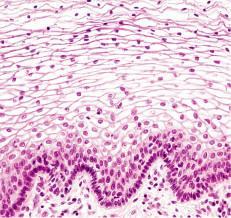
Correctly identify this tissue type and then label the features of the tissue.

Biology
1 answer:
never [62]2 years ago
7 0

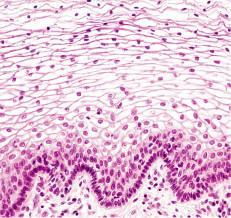
Hello. You forgot to put the image necessary for this question to be answered. The image is attached below.

Answer:

This is a connective tissue that has non-stratified and non-keratinized squamous epithelium. In addition, it has live epithelial cells.

Explanation:

As already mentioned, the image below shows connective tissue. this tivo has the function of giving support and filling empty spaces between different tissues, allowing a strong support in the body. In the image, we can notice the presence of non-stratified and non-keratinized squamous epithelium, commonly found in regions that are subjected to friction such as mouth, esophagus and vagina, for example.

You might be interested in
A cell has undergone determination to become an epithelial lung cell. If it is transplanted to a leg muscle, what do you think w
olasank [31]

Answer:

Change occur in form and structure of the cell.

Explanation:

The structure and shape of the cell change because the function of leg is different from the lungs. In the lungs the epithelial lung cell is responsible for the detection and protection of the cells against pathogen while on the other hand, the leg has the function to move an individual from one place to another so due to difference in function, the cells of both regions have different shape and structure of the cell and the epithelial lung cell will be changed into a leg muscle cell.

4 0
1 year ago
The distant ancestors of tigers may have had bodies without stripes. Use the theory of natural selection to explain how tigers m
Degger [83]

The tigers have stripes because it is advantageous for them because they are an ambush predator and need good camouflage. The stripes are excellent camouflage for places that are shady, so the tiger can easily get close to its prey and attack it.

There's a very big possibility that the distant ancestors of the tigers did not had stripes. The reasons for that are different environment, but also that the stripes are actually a very rare type of pattern among the felidae family members.

As the environment started changing, the tigers needed to adapt to it, so they also needed a different camouflage. As some tigers in the population started to develop stripes, they were better hunters, thus were stronger, and seen as suitable mates for the females, as it would provide an offspring with the advantage that the male tiger has. Through this selection in the breeding process of mates that have advantageous camouflage patterns, the stripes were becoming more and more present, to the point where they totally pushed aside and eliminated the previously dominant camouflage pattern.

8 0
2 years ago
Explain have a fats sugars and or starch contained in seeds or milk are useful for the plant sprouting from the seed or the baby
Kipish [7]
There is a lot of calories in fats that can be a good help and can be used for growth, fats are high energy molecules that help in growing organism. Fats produces carbon dioxide, water, and ATP when metabolism.  The sugars and or starch is useful in the same method, they provide calories necessary for a seed or baby animal to grow. The sugars used in glycolysis and then the products of glycolysis used in  the citric acid cycle, and the starch can be cleaved into more manageable sugars. 
5 0
2 years ago
As he concludes his talk, Snelgrove says, “And as the oceans go, so shall we.” Explain what he means by this statement.
Charra [1.4K]

Answer:

Well it only makes sense that he meant that since humans use the oceans for so much once they are gone, humans will die not too long after

Explanation:
3 0
2 years ago
The pentose phosphate pathway is a two‑stage pathway that generates which is a reductant in many biosynthetic reactions and take
morpeh [17]

Answer:

NADPH

ribose 5-phosphate

G6P

Nonoxidative

glycolytic

Explanation:

  • The pentose phosphate pathway is a two‑stage pathway that generates NADPH which is a reductant in many biosynthetic reactions and takes part in detoxifying reactive oxygen species, and ribose 5-phosphate which is a nucleotide (DNA and RNA) precursor.
  • The substrate for the pentose phosphate pathway is G6P.
  • Nonoxidative the is the phase of the pentose phosphate pathway interconverts phosphorylated monosaccharides, some of which can feed into the glycolytic pathway.
7 0
2 years ago
Other questions:
  • The big bang theory is one of the most accepted theories on the origin of the universe because of scientific evidence, such as
    5·1 answer
  • Higher levels of "heavy" oxygen in ocean water indicate ___ climates, whereas lower levels of "heavy" oxygen in the oceans indic
    10·1 answer
  • Describe how energy and matter move through the environment under both aerobic and anaerobic conditions.
    5·2 answers
  • A team of scientists is working to formulate a drug that can treat children who are diagnosed with gigantism. Which effect shoul
    12·2 answers
  • A student reads the article "Autoimmune Diseases Stopped in Mice" and claims that this research will revolutionize
    8·2 answers
  • "Freezing-up" or being unable to move or respond physically during a traumatic event is an example of:
    14·1 answer
  • Red blood cells carry antigens on their surfaces coded for by alleles of the gene designated by the letter I. IA is dominant to
    6·1 answer
  • In cats, curled ears result from an allele, Cu, that is dominant over an allele cu, for normal ears. Black color results from an
    10·1 answer
  • In normal cells, stathmin is inactivated by phosphorylation at the start of M phase. Phosphatases remove these phosphates as the
    15·1 answer
  • The diagram below shows a cross-section through an alveolus and a capillary. Why does oxygen move from P to Q?
    5·2 answers
Add answer
Login
Not registered? Fast signup
Signup
Login Signup
Ask question!