
answer.
Ask question
Login Signup
Ask question
All categories
  • English
  • Mathematics
  • Social Studies
  • Business
  • History
  • Health
  • Geography
  • Biology
  • Physics
  • Chemistry
  • Computers and Technology
  • Arts
  • World Languages
  • Spanish
  • French
  • German
  • Advanced Placement (AP)
  • SAT
  • Medicine
  • Law
  • Engineering
Stella [2.4K]
2 years ago
4

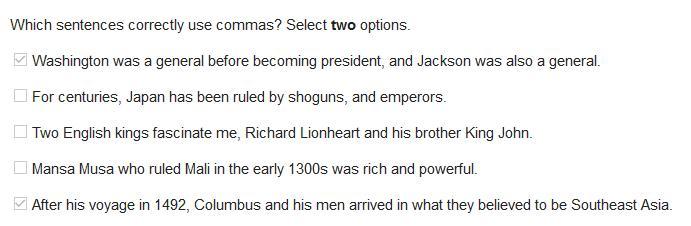
Which sentences correctly use commas? Select two options.

English
2 answers:
Mrrafil [7]2 years ago
8 0

Answer:

A. Washington was a general before becoming president, and Jackson was also a general.

E. After his voyage in 1492, Columbus and his men arrived in what they believed to be Southeast Asia.

Explanation:

B is wrong because the comma before 'and emperors' is unnecessary.

C is wrong because commas should not be used before a list. Colons (:) are to be used.

D is wrong because there are no commas.

kaheart [24]2 years ago
4 0
A and E are the correct answers
You might be interested in
Respond to the following prompt by writing an essay of at least 750 words. According to Camus in “The Myth of Sisyphus,” “…fate.
disa [49]

Answer:The gods had condemned Sisyphus to ceaselessly rolling a rock to the top of a mountain, whence the stone would fall back of its own weight. They had thought with some reason that there is no more dreadful punishment than futile and hopeless labor.

If one believes Homer, Sisyphus was the wisest and most prudent of mortals. According to another tradition, however, he was disposed to practice the profession of highwayman. I see no contradiction in this. Opinions differ as to the reasons why he became the futile laborer of the underworld. To begin with, he is accused of a certain levity in regard to the gods. He stole their secrets. Aegina, the daughter of Aesopus, was carried off by Jupiter. The father was shocked by that disappearance and complained to Sisyphus. He, who knew of the abduction, offered to tell about it on condition that Aesopus would give water to the citadel of Corinth. To the celestial thunderbolts he preferred the benediction of water. He was punished for this in the underworld. Homer tells us also that Sisyphus had put Death in chains. Pluto could not endure the sight of his deserted, silent empire. He dispatched the god of war, who liberated Death from the hands of the conqueror.

It is said also that Sisyphus, being near to death, rashly wanted to test his wife's love. He ordered her to cast his unburied body into the middle of the public square. Sisyphus woke up in the underworld. And there, annoyed by an obedience so contrary to human love, he obtained from Pluto permission to return to earth in order to chastise his wife. But when he had seen again the face of this world, enjoyed water and sun, warm stones and the sea, he no longer wanted to go back to the infernal darkness. Recalls, signs of anger, warnings were of no avail. Many years more he lived facing the curve of the gulf, the sparkling sea, and the smiles of the earth. A decree of the gods was necessary. Mercury came and seized the impudent man by the collar and, snatching him from his joys, led him forcibly back to the underworld, where his rock was ready for him.

You have already grasped that Sisyphus is the aburd hero. He is,as much through his passions as through his torture. His scorn of the gods, his hatred of death, and his passion for life won him that unspeakable penalty in which the whole being is exerted toward accomplishing nothing. This is the price that must be paid for the passions of this earth. Nothing is told us about Sisyphus in the underworld. Myths are made for the imagination to breathe life into them. As for this myth, one sees merely the whole effort of a body straining to raise the huge stone, to roll it and push it up a slope a hundred times over; one sees the face screwed up, the cheek tight against the stone, the shoulder bracing the clay-covered mass, the foot wedging it, the fresh start with arms outstretched, the wholly human security of two earth-clotted hands. At the very end of his long effort measured by skyless space and time without depth, the purpose is achieved. Then Sisyphus watches the stone rush down in a few moments toward that lower world whence he will have to push it up again toward the summit. He goes back down to the plain. It is during that return, that pause, that Sisyphus interests me. A face that toils so close to stones is already stone itself! I see that man going back down with a heavy yet measured step toward the torment of which he will never know the end. That hour like a breathing-space which returns as surely as his suffering, that is the hour of consciousness. At each of those moments when he leaves the heights and gradually sinks toward the lairs of the gods, he is superior to his fate. He is stronger than his rock.

If this myth is tragic, that is because its hero is conscious. Where would his torture be, indeed, if at every step the hope of succeeding upheld him? The workman of today works every day in his life at the same tasks, and this fate is no less absurd. But it is tragic only at the rare moments when it becomes conscious. Sisyphus, proletarian of the gods, powerless and rebellious, knows the whole extent of his wretched condition: it is what he thinks of during his descent. The lucidity that was to constitute his torture at the same time crowns his victory. There is no fate that cannot be surmounted by scorn.

Explanation:

6 0
2 years ago
Trying new things on the job is one way of staying sharp
Semenov [28]

It certainly is. Routine at work can lead to monotony, when we constantly repeat already well-learned actions. Routine can make us somehow sure, but not too much. Security arising from routine over time becomes a cause of lack of motivation, and therefore a loss of sharpness. Sometimes we think it's better not to face new challenges, as this could lead to mistakes that can cost us at work. It is desirable to try new things, not only when it is ordered from higher instances, but also on our own initiative, because this promotes our creativity, we become more motivated, happier, and most importantly, more productive, which goes directly to our advantage. This makes us more mobile and, of course, sharper, which is much closer to human nature, which wants to explore. Let us make mistakes, but they are an integral part of our sharpness.

5 0
2 years ago
Read 2 more answers
Pressed tightly against one another, in an effort to resist the cold, our heads empty and heavy, our brains a whirlwind of decay
nikdorinn [45]

Explanation:

1. Adjective that is best describing the atmosphere in this passage is ''never-ending''. It is showing the readers how the people are feeling about their situation which is also causing a never-ending night. The night was growing longer because of their numb minds and they were questioning themselves when they will die.

2. ''Our minds numb with indifference.'' is the excerpt from the passage that is revealing the atmosphere because the people in the story are indifferent. They are not afraid of death anymore because they know that they will die sooner or later. They are only questioning themselves when will that happen but they are also knowing that it does not matter when. They don't feel any emotions because they had surrendered.

3. This numb atmosphere of the story is showing us the meaning of it. People had found themselves in cold place and they stick together in order to survive the coldness. Their heads are heavy and they are remembering things. The author is showing that in those difficult situation people get indifferent and they can stop worrying about life. At the end of the passage, we can see that their thoughts are not good because they are making the situation even harder for them and causing never-ending night. The more they think, the more night is growing.

7 0
2 years ago
Read 2 more answers
A homework routine is a set schedule designed by
DIA [1.3K]

Answer:

you

Explanation:

The only person that can build a homework routine is the person that do the homework, and it includes start time, break time, an space free of distraction, end time and study materials.

4 0
3 years ago
Read 2 more answers
2. What is another central idea of the passage?
frosja888 [35]

Answer:

the answer is a.

Explanation:

6 0
2 years ago
Other questions:
  • Select all that apply.
    9·2 answers
  • Which sentence does not contain any errors in comma usage?
    11·2 answers
  • In the first section of Beowulf, which part is most clearly exposition?
    11·2 answers
  • When an author wants to increase the pace of a story, what narrative technique might she use?
    14·2 answers
  • What did the Frinks see a lot of in the desert
    7·2 answers
  • Read the excerpt from a short story. The Sonoran Desert route was his favorite. His friends were surprised he could endure the s
    9·2 answers
  • Define intertextuality. Discuss three examples that have helped you in reading specific works.
    13·1 answer
  • How might the issues Gregor faces as an insect reflect Franz Kafka’s upbringing in Prague as part of the Jewish minority in a di
    8·1 answer
  • In the video during the team meeting, when the team member shakes his head and raises his eyebrows, he is providing an example o
    9·1 answer
  • How does the concept vocabulary clarify the reader’s understanding of Whitman’s worldview
    7·1 answer
Add answer
Login
Not registered? Fast signup
Signup
Login Signup
Ask question!