answer.
Ask question
Login Signup
Ask question
All categories
  • English
  • Mathematics
  • Social Studies
  • Business
  • History
  • Health
  • Geography
  • Biology
  • Physics
  • Chemistry
  • Computers and Technology
  • Arts
  • World Languages
  • Spanish
  • French
  • German
  • Advanced Placement (AP)
  • SAT
  • Medicine
  • Law
  • Engineering
Shkiper50 [21]
2 years ago
11

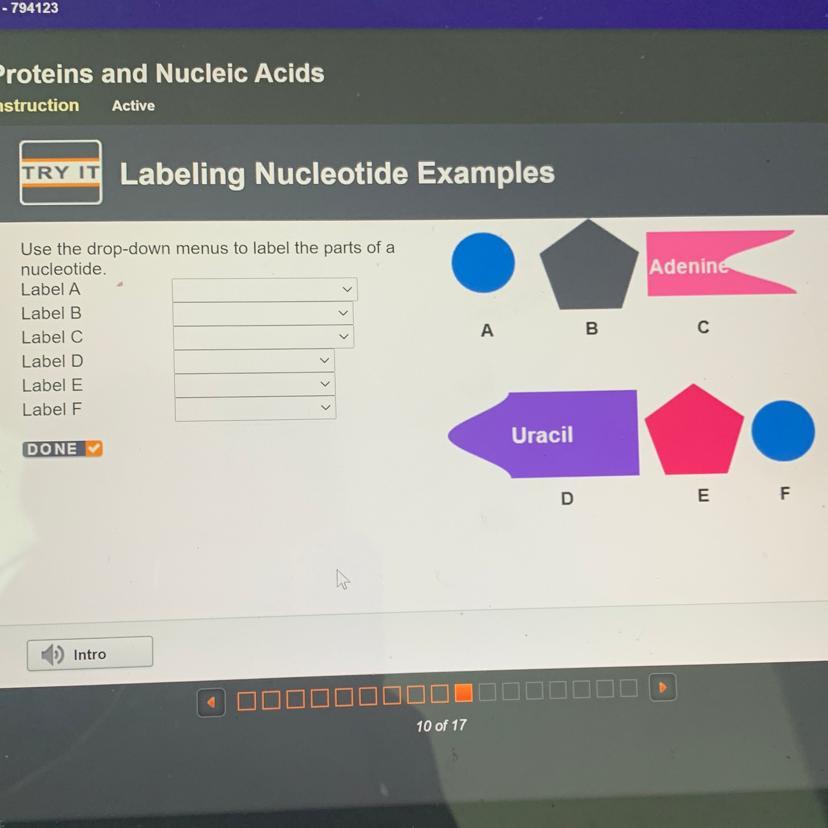
Use the drop-down menus to label the parts of a

Biology
2 answers:
sergey [27]2 years ago
8 0

Answer:

A. phosophate group

B. sugar

C. nitrogeous

D. nitrogeous

E. sugar

F. phosophate group

hammer [34]2 years ago
7 0

Answer:

A and F are phosphate groups.

B and E are sugars.

C and D are nitrogenous bases.

Explanation:

Nucleotides are the molecules responsible for composing DNA and RNA. They are formed by three units: a phosphate group, a sugar molecule and a nitrogenous base.

The sugar molecule is a pentose, which means that it is a molecule formed by 5 carbons. These collections are represented by geometrical figures such as the letters "B" and "E" shown in the figure above, where each tip represents a carbon.

The nitrogenous bases are molecules that are named adenine (A) and guanine (G) and the pyrimidine bases cytosine (C), uracil (U) and thymine (T).

The phosphate group, in turn, is a molecule derived from phosphoric acid and is the only one that does not vary in each nucleotide.

You might be interested in
Which of the following is an important exception to the central dogma of molecular biology? a) Proteins are responsible for most
iogann1982 [59]

Answer:

b: many genes code for RNAs that function directly in the cell

Explanation:

<em>The central dogma</em> theory describes the basic framework for gene expression in living organisms. Genetic information from DNA is encoded or transcribed as RNA which then becomes translated as proteins.

The processes that take place for gene to be successfully expressed are;

  • Replication
  • Transcription
  • Translation

<em>Replication</em> is a process whereby DNA makes a copy of itself to be distributed in daughter cells during cell division.

<em>Transcription</em> is the process whereby genetic information in DNA is encoded as RNAs. The RNAs are short-lived as they are quickly utilized in protein synthesis or <em>translation </em>process.

Hence, the RNAs do not function directly in the cells but mere intermediaries in the synthesis of proteins.

<em>The correct option is b.</em>

3 0
2 years ago
A student models moon phases. She holds a foam ball on a stick in front of her body and then stands in front of a light as shown
mr Goodwill [35]

Answer:

D

Explanation:

i took the test

3 0
2 years ago
Read 2 more answers
Henry bought 280 red and blue paper cups. He used of the blue
stellarik [79]

Answer:didn’t put the number for how many blue cups were used

Explanation:

6 0
2 years ago
In addition to the ABO system, humans have other blood groups, including the MN system. Individuals who have alleles for both M
Semenov [28]
Both show Codominance
7 0
2 years ago
Which term describes the breaking down of body cells or substances?
Alex777 [14]
The term which describes the breaking down of body cells or substance is CATABOLISM.
The metabolic processes which occur in living things are of two types, these are anabolic and catabolic processes. The anabolic process involves the building up of needed materials in the body while the catabolic process involves the breaking down of waste materials in the body in order to eliminate them through excretion.
6 0
2 years ago
Read 2 more answers
Other questions:
  • The axons of the olfactory sensory neurons project to the _____________ in the brain.
    5·1 answer
  • What is the difference between lycopodium and equisetum
    8·1 answer
  • These images both represent years with strong El Niño events. What information from the images correlates with the factors that
    8·1 answer
  • A student encounters a plant bearing small, purple flowers in the wild. The size of the flowers and the purple color are determi
    15·2 answers
  • Alcohol dehydrogenase (ADH) is an enzyme that aids in the decomposition of ethyl alcohol (CH3OH) into nontoxic substances. Methy
    11·1 answer
  • Although each of the following has a better chance of influencing gene frequencies in small populations than in large population
    14·1 answer
  • if an earthworm eats enough matter that it consumes 100 grams of nitrogen in its lifespan, how much nitrogen did it release into
    12·1 answer
  • When a partially rotted log was turned over, mushrooms, termites, pill bugs, ants, slugs and earthworms were found to be living
    11·1 answer
  • How might retaining too much heat be a disadvantage to an organism?
    15·1 answer
  • Describe how nitrogen in proteins in dead leaves is recycled to be absorbed by plants? Please help!
    12·1 answer
Add answer
Login
Not registered? Fast signup
Signup
Login Signup
Ask question!
