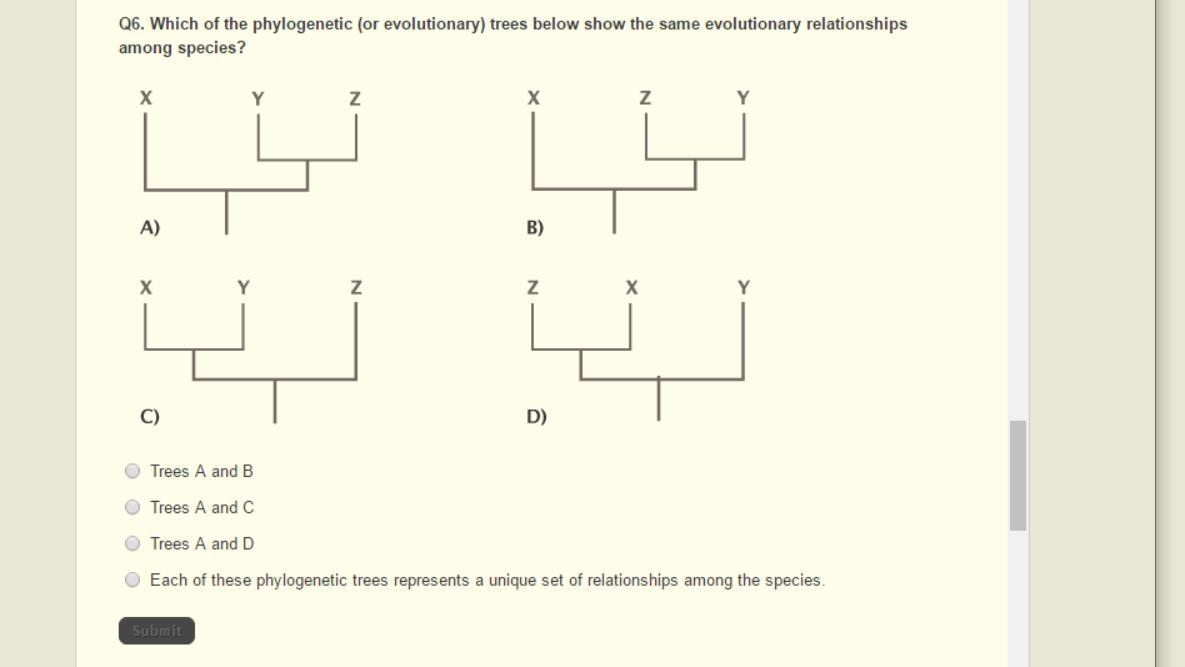
Answer: <em>(Note: You will find the analyzed phylogenetic trees in the attached file) </em>
Trees A and B show the same evolutionary relationships among species.
Explanation:
In phylogenetic trees, two species are more related if they have a recent common ancestor. On the other hand, two species will be less related if their common ancestor is not a recent one and is located far away in the tree.
In the phylogenetic tree, the taxonomic groups of interest are located in the extremes of the lines called branches. In the present example, X, Y, and Z are the species located in the extreme of the branches. The ramification point, which is also called "node" or divergence point, represents the location of the most recent common ancestor.
The basic elements in a phylogenetic tree are:
- External nodes, that correspond to taxa;
- Internal nodes, that correspond to ramification points. These represent hypothetical ancestors and also indicate cladogenetic or speciation events;
- Branches are the ones that join the nodes. Their length might or not be proportional to the number of changes during evolution;
- Root, which is the basal node. It represents the common ancestor of the whole tree. It indicates the direction of evolutive change.
The three shown trees have three taxonomic groups X, Y and Z. All of them have a common ancestor, which can be noticed because of the presence of the root. The first node in the three cases expresses the first divergence in evolution, where one two groups got differentiated from the other. The second node expresses a second divergence, where that group separated into two other groups. Now, analyzing each tree we can say that:
- The A tree shows that first <em>X</em> got separated from <em>Y and Z</em>, and later in time, <em>Y</em> and <em>Z</em> separated from each other. <em>X</em> and <em>Z</em> form a monophyletic group, with a recent common ancestor.
- The B tree expresses the exact same cases of divergence.
- The C tree shows that Z separated first from X and Y. And that later in time, X and Y got separated from each other.
- The D tree shows that Y separated first from X and Z. And that later in time, X and Z got separated from each other.