answer.
Ask question
Login Signup
Ask question
All categories
  • English
  • Mathematics
  • Social Studies
  • Business
  • History
  • Health
  • Geography
  • Biology
  • Physics
  • Chemistry
  • Computers and Technology
  • Arts
  • World Languages
  • Spanish
  • French
  • German
  • Advanced Placement (AP)
  • SAT
  • Medicine
  • Law
  • Engineering
Alecsey [184]
2 years ago
15

The structures of TeF4 and TeCl4 in the gas phase have been studied by electron diffraction (S. A. Shlykov, N. I. Giricheva, A.

V. Titov, M. Szwak, D. Lentz, G. V. Girichev, Dalton Trans., 2010, 39, 3245).
a. Would you expect the Te i X (axial) distances in these molecules to be longer or shorter than than Te i X (equatorial) distances? Explain briefly.
b. Which compound would you predict to have the smaller X(axial) i Te i X(axial) angles? The smaller X(equatorial) i Te i X(equatorial) angles? Explain briefly.

Chemistry
1 answer:
Studentka2010 [4]2 years ago
7 0

Answer:

See explanation

Explanation:

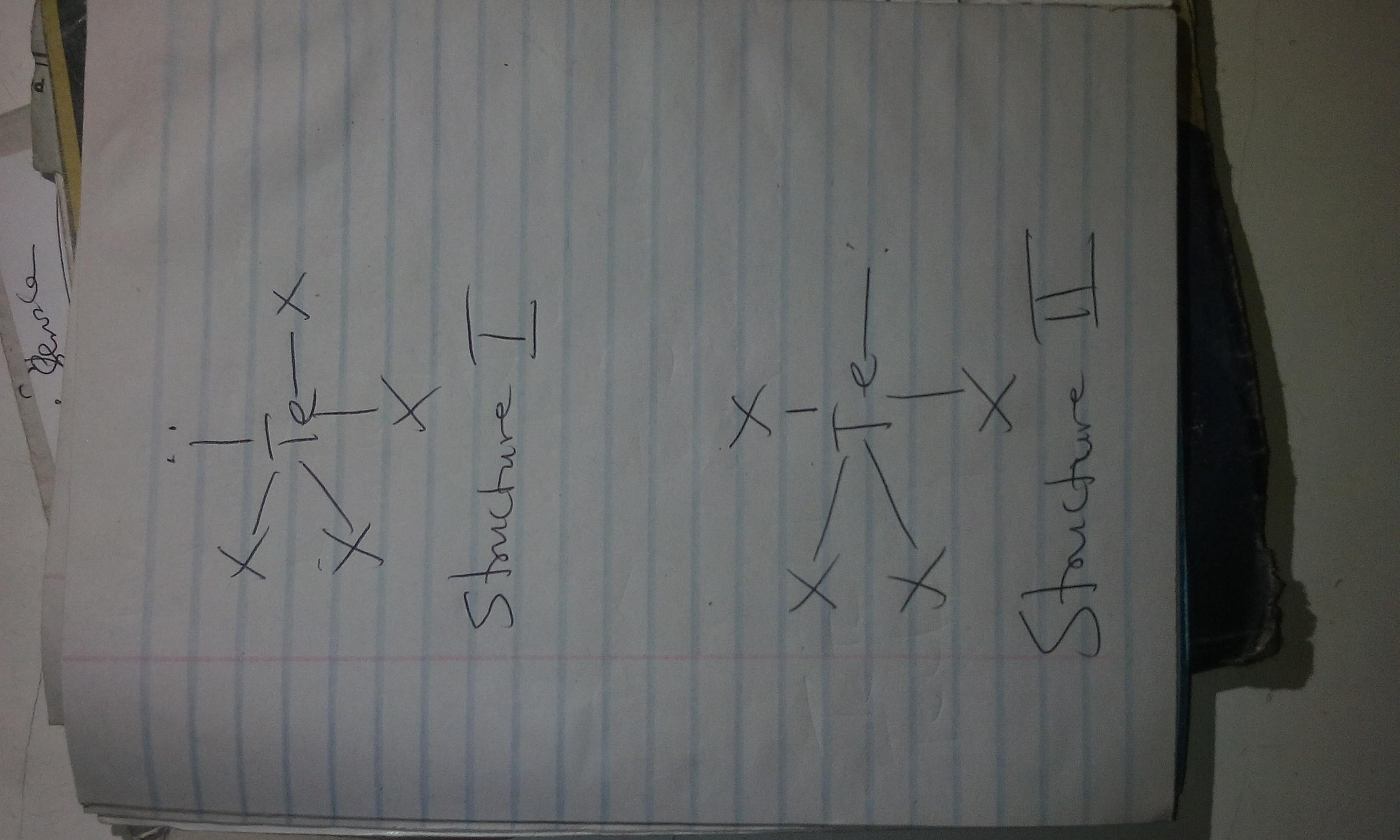
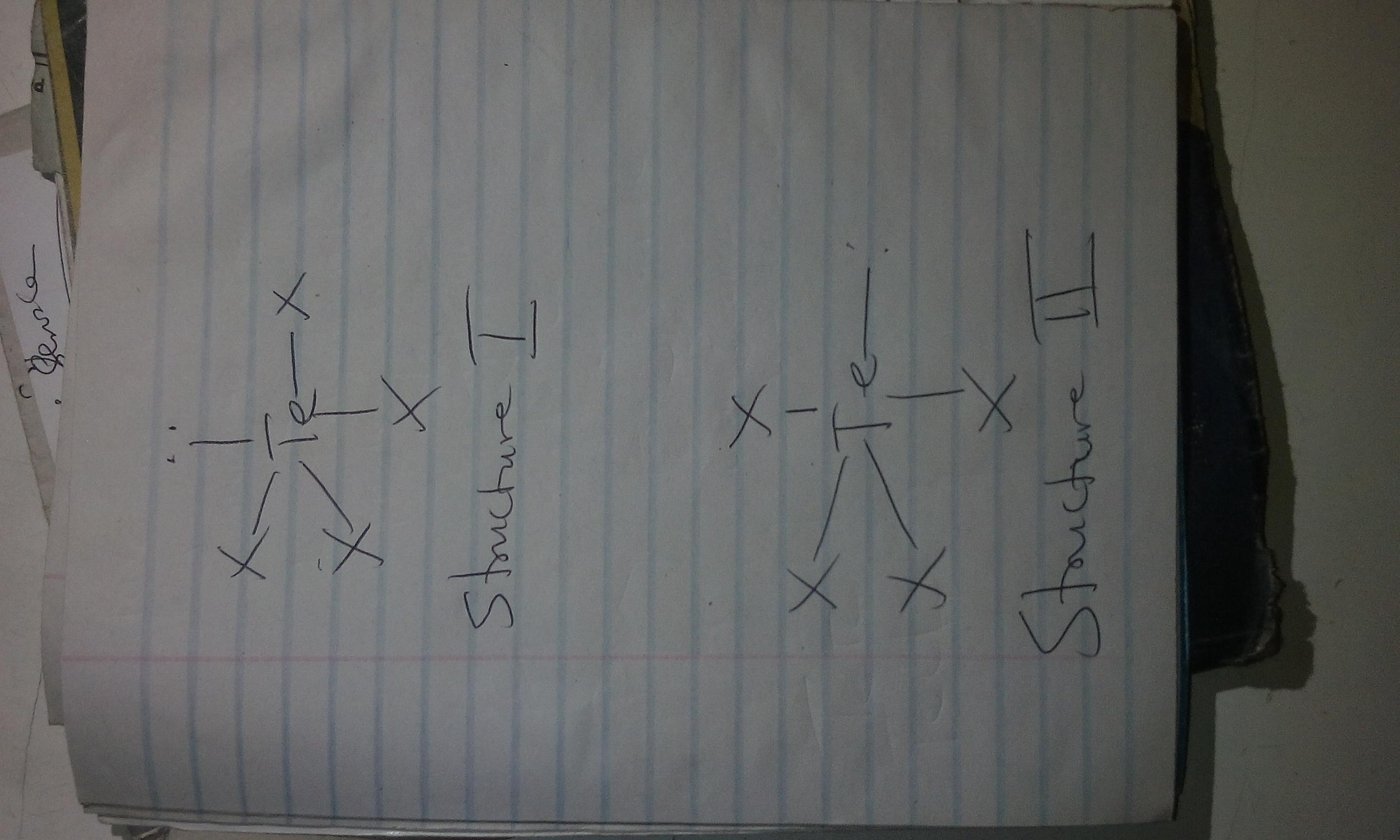
Two structures are pictured in the image attached, structure 2 is a more stable structure for TeF₄ or TeCl₄ since the lone pair in the structure is present at an equatorial position. Note that the structure of the compound is based on a trigonal bipyramid but of the structure type AX4E, where the lone pair could be positioned at axial or equatorial positions as shown in the images attached.

As a result of repulsion between electron pairs, the bond distance between Te - X(axial) is greater than Te-X (equatorial). This implies that the Te - X(axial) bonds are longer than Te - X(equatorial) bonds.

In answering the question, we must take cognisance of the fact fluorine is more electronegative than chlorine. This implies that fluorine will draw more electron density towards itself than chlorine and this shortens the bond length.

The structures of the both compounds are based on a trigonal bipyramid with a bond angle of 90° for axial position and 120° for the equatorial position.

Owing to the greater electo negativity of fluorine, both the fluorine F-axial and F-equatorial bonds of TeF4 are shorter than the Cl-axial and Cl-equatorial bonds of TeCl4. Hence the axial and equatorial angles in TeF4 are smaller than the axial and equatorial bond angles in TeCl4 due to the greater electro negativity of the fluorine atom.

You might be interested in
what is 31/50000 If the toxic quantity is 1.5 g of ethylene glycol per 1000 g of body mass, what percentage of ethylene glycol i
Sveta_85 [38]

Answer:

\%m=0.15\%

Explanation:

Hello,

In this case, we are asked to compute the by mass percent representing the toxicity of ethylene glycol in the body mass. In such a way, since the by mass percent is computed with the shown below formula:

\%m=\frac{m_{ethylene \ glycol}}{m_{ethylene \ glycol}+m_{body\ mass}}*100\%

We can use the given masses to obtain:

\%m=\frac{1.5g}{1.5g+1000g}*100\%\\ \\\%m=0.15\%

Best regards.

7 0
2 years ago
Before landing, the brakes and the tires of an airliner have a temperature of 15.0∘C. Upon landing, the 90.7 kg carbon fiber bra
Goryan [66]

Answer:

0.921 J/g degrees C

Explanation:

Recall that the First Law of Thermodynamics demands that the total internal energy of an isolated system must remain constant. Any amount of energy lost by the brakes must be gained by the tires (in the form of heat in this situation).  Therefore, heat given off by the brakes = −heat taken in by tires, or:

−qbrakes=qtires

The equation used to calculate the quantity of heat energy exchanged in this process is:

−qbrakes=−cbrakes mbrakes ΔTbrakes=ctires mtires ΔTtires=qtires

First we must convert the mass of the tires and the brakes from  kg to  g.

massbrakes=90.7 kg×1,000. g1 kg=9.07×10⁴ g

masstires=123 kg×1,000. g1 kg=1.23×10⁵ g

Next, substitute in known values and rearrange to solve for ctires. Note that the final temperature for both the tires and the brakes is 172∘C, the initial temperature of the brakes is 312∘C and the initial temperature of the tires is 15∘C.

−(1.400Jg∘C)(9.07×10⁴ g)(172∘C−312∘C)=(ctires)(1.23×10⁵ g)(172∘C−15∘C)

ctires=−(1.400 Jg∘C)(9.07×10⁴ g)(−140∘C)(1.23×10⁵ g)(157∘C)=17,777,200 J19311000 g∘C=0.9206Jg∘C

The answer should have three significant figures, so round to 0.921Jg∘C.
6 0
2 years ago
If you fill up a balloon with a small amount of air, then set it in direct sunlight, you will see that the balloon expands. This
almond37 [142]
I just did guessed on the question and got it right. The answer is kinetic energy.
6 0
2 years ago
Read 2 more answers
Be sure to answer all parts. liquid ammonia autoionizes like water: 2nh3(l) → nh4+(am) + nh2−(am) where (am) represents solvatio
Genrish500 [490]
Answer is: concentration of ammonium ions are 7,14·10⁻¹⁴ M.
Chemical reaction: 2NH₃(l) → NH₄⁺(am) + NH₂⁻(am).
Kam = 5,1·10⁻²⁷.
[NH₄⁺] · [NH₂⁻] = x; equilibrium concentration of cations and anions.
Kam = [NH₄⁺] · [NH₂⁻].
Kam = x².
x = [NH₄⁺] = √5,1·10⁻²⁷.
[NH₄⁺] = 7,14·10⁻¹⁴ M.

5 0
2 years ago
Which of the following is a valid conversion factor?
VMariaS [17]

Answer:

100 cg/1g

Step-by-step explanation:

    1 cg = 0.01 g     Multiply by 100

100 cg = 1 g

(a) is <em>wrong</em>. The correct conversion factor is 1000 cm³/1 L.

(b) is <em>wrong</em>. The correct conversion factor is 1000 mL/1 L.

(c) is <em>wrong</em>. The correct conversion factor is 1 m/10 dm.

7 0
2 years ago
Read 2 more answers
Other questions:
  • Which reactants would lead to a spontaneous reaction?
    13·1 answer
  • A compound is 40.0% C, 6.70% H, and 53.3% O by mass. Assume that we have a 100.-g sample of this compound. Part A What are the s
    10·2 answers
  • Insert the values from the question above for x, y, z, &amp; n into KxFey(C2O4)z·nH2O and provide the correct coefficients to ba
    9·1 answer
  • Aqueous potassium phosphate reacts with aqueous aluminum chloride to form aqueous potassium chloride and solid aluminum phosphat
    7·1 answer
  • What is the ph of the solution prepared by dissolving 0.927 mol hcl in enough water to make a 150 l aqueous solution?
    11·1 answer
  • How much energy must be added to a bowl of 125popcorn kernels in order for them to reach a popping temperature of 175°C? Assume
    8·1 answer
  • Write the balanced half-equation describing the oxidation of mercury to hgo in a basic aqueous solution. Please include the stat
    12·1 answer
  • The element thallium is 70% thallium-205 and 30% thallium-203. Calculate its relative atomic mass to 1 decimal place.
    14·1 answer
  • A metal tank containing hydrogen gas has a pressure gauge that reads 575 psi. What is causing the pressure inside of the tank?
    13·1 answer
  • A laboratory utilizes a mixture of 10% dimethyl sulfoxide (DMSO) in the freezing and long-term storage of embryonic stem cells.
    5·1 answer
Add answer
Login
Not registered? Fast signup
Signup
Login Signup
Ask question!