answer.
Ask question
Login Signup
Ask question
All categories
  • English
  • Mathematics
  • Social Studies
  • Business
  • History
  • Health
  • Geography
  • Biology
  • Physics
  • Chemistry
  • Computers and Technology
  • Arts
  • World Languages
  • Spanish
  • French
  • German
  • Advanced Placement (AP)
  • SAT
  • Medicine
  • Law
  • Engineering
GalinKa [24]
1 year ago
8

Lakeland Chemical manufactures a product called Zing. Direct materials are added at the beginning of the process, and conversion

activity occurs uniformly throughout production. The beginning work-in-process inventory is 60% complete with respect to conversion; the ending work-in-process inventory is 20% complete. The following data pertain to May: Units Work in process, May 1 15,000 Units started during May 60,000 Units completed and transferred out 68,000 Work in process, May 31 7,000 Total Direct Materials Conversion Costs Costs: Work in process, May 1 $41,250 $16,500 $24,750 Costs incurred during May 234,630 72,000 162,630 Totals $275,880 $88,500 $187,380 Using the weighted-average method of process costing, the total costs remaining in work in process on May 31 are:
Business
1 answer:
Evgesh-ka [11]1 year ago
8 0

Answer:

$5,000

Explanation:

<em>Note that Lakeland Chemical manufactures uses weighted-average method of process costing</em>

Equivalent units

Materials  = 9,000

Conversion Costs = 7,500

Total Costs

Materials = $20,500

Conversion Costs = $15,000

Cost per equivalent units

Materials =

Conversion Costs =

Total Cost in remaining in work in process

Total Cost

The total costs remaining in work in process on May 31 are $5,000.

You might be interested in
Compounding
r-ruslan [8.4K]

Answer:

Task A:

<u>What is the effecting annual rate changed on this loan?</u>

Answer is 3.03%

<u>Task B: </u>

<u>What would be the quarterly payment on this loan?</u>

Answer is $5,403.06

<u>Task C:</u>

<u>Dr. Zoidberg also discovers that instead of the special promotional rate he can make  an additional down payment of $20,000 that would lower his loan amount accordingly (i.e. by $20,000). At what APR would Dr. Zoidberg have the same quarterly payment with this option as with the initial promotional rate of 3%?</u>

Answer is 12.21%

<u>Task D</u>

<u>Dr. Zoidberg finds that he can get 1.5% APR if he elects option (c). What will his quarterly payment be under this option?</u>

The answer is $4,159.37

<u>Task E:</u>

<u>Now assume that that payment frequency changes to annual, preserving the same EAR. What is his payment now?</u>

The answer is $21,835.46

Explanation:

<h2>Task A: </h2><h3>What is the effecting annual rate changed on this loan?</h3>

Solution:

Effective annual rate = (1 + (APR/n))ⁿ - 1

where

n = number of compounding periods per year = 4 (compounding quarterly)

APR = 3%

Effective annual rate = (1 + (3%/4))⁴ - 1

Effective annual rate = 3.03% (answer).

<h2>Task B: </h2><h3>What would be the quarterly payment on this loan?</h3>

Solution:

Quarterly loan payment is calculated using PMT function in Excel :

Rate = 3% / 4   (converting annual rate into Quarterly rate)

nper = 5*4 (5 year loan with 12 Quarterly payments each year)

pv = 100000 (loan amount)

PMT Formula = PMT(3%/4,5*4,100000)

PMT is calculated to be $5,403.06 (answer)  

Note: PMT calculation has been attached.

<h2>Task C:</h2><h3>Dr. Zoidberg also discovers that instead of the special promotional rate he can make  an additional down payment of $20,000 that would lower his loan amount accordingly (i.e. by $20,000). At what APR would Dr. Zoidberg have the same quarterly payment with this option as with the initial promotional rate of 3%?</h3>

Solution

The quarterly rate to have the same quarterly payment is calculated using RATE function in Excel :

nper = 5*4 (5 year loan with 12 Quarterly payments each year)

pmt = -5403.06 (Quarterly payment. This is entered with a negative sign because it is a payment)

pv = 80000 (loan amount)

RATE is calculated to be 3.05%. This is the quarterly rate. To get APR, we multiply by 4.

Formula for APR = RATE(5*4,C1,80000)*4

APR = 12.21% (answer)

<h2>Task D</h2><h3>Dr. Zoidberg finds that he can get 1.5% APR if he elects option (c). What will his quarterly payment be under this option?</h3>

Solution:

Quarterly loan payment is calculated using PMT function in Excel :

rate = 1.5% / 4   (converting annual rate into Quarterly rate)

nper = 5*4 (5 year loan with 12 Quarterly payments each year)

pv = 80000 (loan amount)

PMT formula: PMT(1.5%/4,5*4,80000)

PMT is calculated to be $4,159.37

<h2>Task E</h2><h3>Now assume that that payment frequency changes to annual, preserving the same EAR. What is his payment now?</h3>

Solution:

PMT = PMT(3%,5,100000)

PMT = $21,835.46

6 0
2 years ago
The demand function for a certain make of ink-jet cartridge is the following where p is the unit price in dollars and x is the q
Paul [167]

Answer:

The answer to the following question is: (-9.34)

Explanation:

Given that:

p = -0.07 x^2 - 0.7x  + 6

The price elasticity of demand = ( change in quality / change in price)

     =   (dp / dx)  (x/p)

     =   d / dx   (-0.07 x^2 - 0.7x  + 6)   x / p

     =   (-0.14x - 0.7)  x/ (-0.07 x^2 - 0.7x  + 6)

elasticity = (-0.14x^2 - 0.7x) / (-0.07 x^2 - 0.7x  + 6)

at x=5;

elasticity = (-0.14(5)^2 - 0.7(5)) / (-0.07 (5)^2 - 0.7(5)  + 6)

              = (-3.5 - 3.5) / (-1.75 - 3.5 + 6)

              =  -7/ 0.75 = -9.333

              = -9.34

7 0
2 years ago
Albert transfers land (basis of $140,000 and fair market value of $320,000) to Gold Corporation for 80% of its stock and a note
-Dominant- [34]

Answer:

1. Albert has a recognized gain on the transfer of $140,000.

Explanation:

Option D is wrong because Gold corporation has a basis in the land of Albert's recognized gain plus the cost of the value of land's Albert. Therefore, $140,000 + $140,000 = $280,000.

Option A is correct because, under the recognized gain clause 357(C), the mortgage on the land exceeds the cost of value of the land by $(200,000 - $140,000) = $60,000. Moreover, Alberta has received $80,000 additional from notes payable. So, total recognized gain on the transfer = $80,000 + $60,000 = $140,000.

5 0
2 years ago
Assume that Jackson is a​ price-taker and the current wholesale market price is $7.30 per can of paint. What is the target total
Mumz [18]

Answer:

Jackson's target total cost of producing and selling 6 million cans of paint of $31,800,000 will enable it to reach stockholders' profit goals of $6 million.

The implication is that it should not allow its total costs (Production and other business expenses) to exceed $37,800,000.

This is because its sales revenue will be equal to $43,800,000 (6,000,000 * $7.30).

As such, Jackson can produce a can of paint for $5.30.  It can also incur an average business expense of $1.00 per can to maintain and reach its $6 million profit target.

Explanation:

Profit is the difference obtained after deducting all costs from the revenue.  There are some profit stages.  The first is the gross profit, which considers the sales revenue and the cost of goods sold.  The next profit stage is the operating profit, which subtracts the business running expenses from the gross profit.  There are also profits before and after interest and taxes.  The after tax profit is also called the net income or net profit.  If it is negative, then it is called the net loss.  It is from the net income that distributions are made to stockholders in the form of dividends while a part is retained in the business to increase its capital stock or stockholders' equity.

8 0
2 years ago
Your investment bank has an investment of $100 million in the stock of the Swiss Roll Corporation and a short position in the st
stealth61 [152]

Answer:

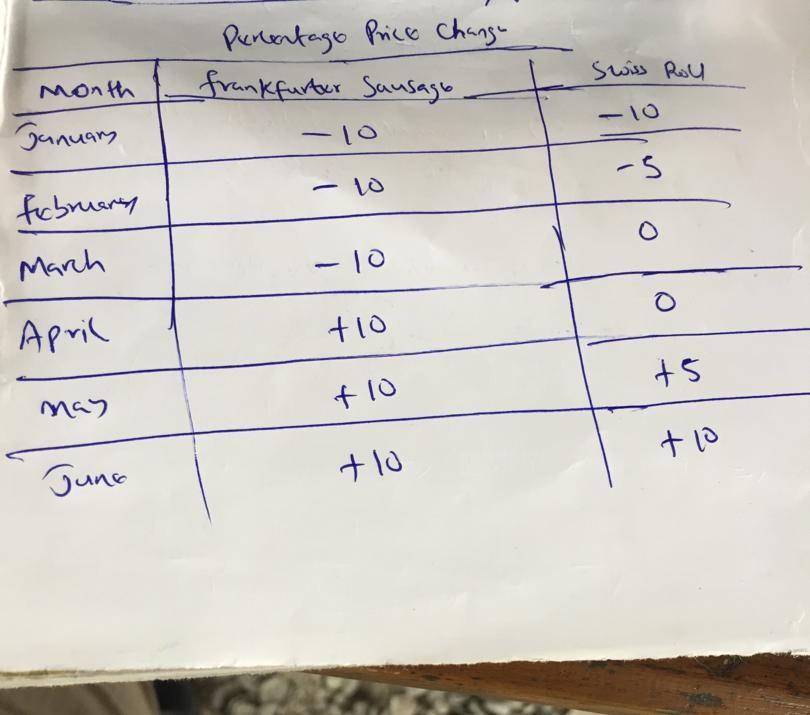
hello  your question is incomplete below is the complete question and the missing table

Your investment bank has an investment of $100 million in the stock of the Swiss Roll Corporation and a short position in the stock of the Frankfurter Sausage Company. Here is the recent price history of the two stocks: on the evidence of these six months how large would your short position in Frankfurter sausage needed to be to hedge you as far as possible against movements in the price of swiss Roll

answer : $42003667

Explanation:

$100 million in stocks

According to the data provided in the table attached below, to short the Frankfurt in order to hedge investment in Rolls is calculated below

we have to calculate the total return on both Roll corporation and Frankfurter sausage

for f-sausage

∑ (1 + monthly returns ) / 100

= ( 1 - 0.1 + 1 - 0.1 .... + 1 + 0.1 ) = -0.0297 =  -2.97%

for Roll corporation

∑ (1 + monthly returns ) / 100

= ( 1 - 0.1 + 1 - 0.05 .... + 1 + 0.1 ) = -0.012475 =  - 1.24%

next we will calculate the total loss inquired when investing in Roll corporation

Total loss = percentage loss * total investment

                 = 0.012475 * $100 million  =  - $ 1247500

we will have to offset the loss by shorting investments in F sausage

hence : $1247500 = investment in sausage * total return

             1247500 = investment in sausage * 0.0297 ( The total return of F sausage is positive because it was a short position )

hence short investment in F sausage to offset loss incurred in ROLLS INVESTMENT

= 1247500 / 0.0297 = $42003667

8 0
2 years ago
Other questions:
  • Elliot wants to open a checking account. He researched checking accounts at different banks near his house. List at least five b
    12·1 answer
  • In the BIG BUCKS LOTTERY, the chance of winning a $10 prize is 1%. What is your best guess about how many people would win a $10
    14·2 answers
  • Suppose 30% of a club are above 25 years old (M), 50% are between 21 and 25 (W) and 20% are below 21 (L). If all are exposed to
    7·1 answer
  • Stacey inherits unimproved land (fair market value of $6 million) from her father on June 1, 2019. She disclaims her interest in
    9·1 answer
  • Which of the statements correctly represents the accounting equation?
    9·1 answer
  • Pattup Company makes 40,000 units per year of a part that it uses in the products it manufactures. The unit product cost of this
    7·1 answer
  • Before he went to​ college, Jon bought a car from his brother Tony. They agreed that Jon would pay Tony​ $10,000 when Jon gradua
    5·1 answer
  • On January 1, Wei company begins the accounting period with a $42,000 credit balance in Allowance for Doubtful Accounts.
    15·1 answer
  • Decide whether the following example applies descriptive or inferential statistics:
    15·1 answer
  • Consider the following data on U.S. GDP: Year GDP (Billions of current dollars) (Billions of 2012 dollars) 2014 17,521.7 16,899.
    6·1 answer
Add answer
Login
Not registered? Fast signup
Signup
Login Signup
Ask question!