answer.
Ask question
Login Signup
Ask question
All categories
  • English
  • Mathematics
  • Social Studies
  • Business
  • History
  • Health
  • Geography
  • Biology
  • Physics
  • Chemistry
  • Computers and Technology
  • Arts
  • World Languages
  • Spanish
  • French
  • German
  • Advanced Placement (AP)
  • SAT
  • Medicine
  • Law
  • Engineering
nikdorinn [45]
2 years ago
8

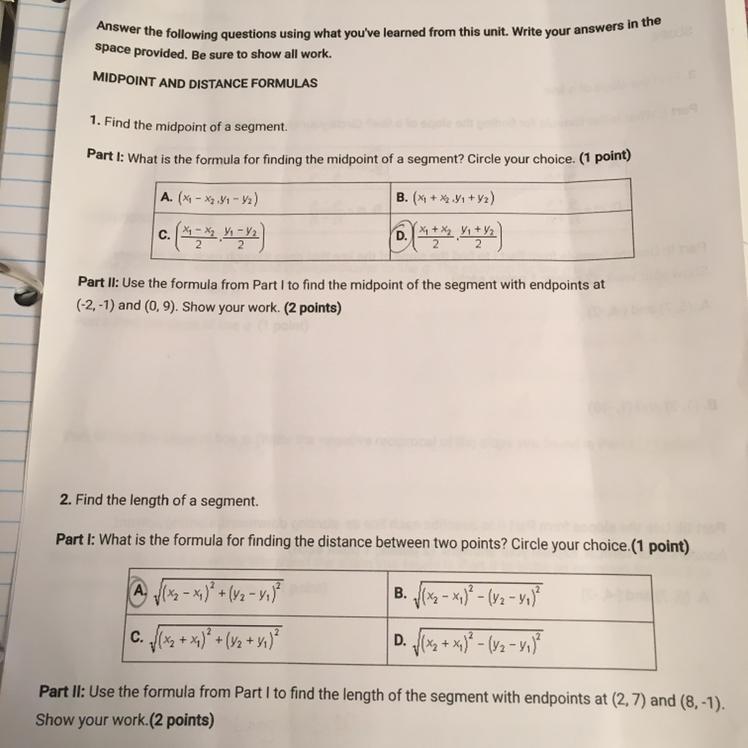
1.10.4 Test: Coordinate Geometry HELP PLEASE

Mathematics
1 answer:
Zielflug [23.3K]2 years ago
6 0

Answer:

1.

M = (\frac{x_1+x_2}{2},\frac{y_1+y_2}{2})

M = (-1,4)

2.

D = \sqrt{(x_2 - x_1)^2 +(y_2 - y_1)^2}

D =10\ units

Step-by-step explanation:

Solving (1):

1a) This has already been answered in the attachment, and the selected option is correct.

i.e. Midpoint (M) is:

M = (\frac{x_1+x_2}{2},\frac{y_1+y_2}{2})

1b) Midpoint of (-2,-1) and (0,9)

This implies that:

(x_1,y_1) = (-2,-1)

(x_2,y_2) = (0,9)

So:

M = (\frac{-2+0}{2},\frac{-1+9}{2})

M = (\frac{-2}{2},\frac{8}{2})

M = (-1,4)

2a) This has already been answered in the attachment, and the selected option is correct.

i.e. Distance (D) is:

D = \sqrt{(x_2 - x_1)^2 +(y_2 - y_1)^2}

1b) Midpoint of (2,7) and (8,-1)

This implies that:

(x_1,y_1) = (2,7)

(x_2,y_2) = (8,-1)

So:

D = \sqrt{(x_2 - x_1)^2 +(y_2 - y_1)^2}

D = \sqrt{(8 - 2)^2 +(-1 - 7)^2}

D = \sqrt{(6)^2 +(-8)^2}

D = \sqrt{36+64}

D = \sqrt{100}

D =10\ units

You might be interested in
Amy and two of her friends eat lunch at a restaurant. Their bill, including tax, comes to $27.63. They decide to split the bill
Art [367]

Answer:

Step-by-step explanation:

$27.63 / 2 = $13.82

$13.82 * 0.20 = $2.76

$13.82 + $2.76 = $16.58

6 0
2 years ago
For a certain type of copper wire, it is knownthat, on the average, 1.5 flaws occur per millimeter.Assuming that the number of f
mario62 [17]

Answer:

The probability that no flaws occur in a certain portion of wire of length 5 millimeters =  1.1156 occur / millimeters

Step-by-step explanation:

<u>Step 1</u>:-

Given data A copper wire, it is known that, on the average, 1.5 flaws occur per millimeter.

by  Poisson random variable given that λ = 1.5 flaws/millimeter

Poisson distribution P(X= r) = \frac{e^{-\alpha } \alpha ^{r} }{r!}

<u>Step 2:</u>-

The probability that no flaws occur in a certain portion of wire

P(X= 0) = \frac{e^{-1.5 } \(1.5) ^{0} }{0!}

On simplification we get

P(x=0) = 0.223 flaws occur / millimeters

<u>Conclusion</u>:-

The probability that no flaws occur in a certain portion of wire of length 5 millimeters = 5 X P(X=0) = 5X 0.223 = 1.1156 occur / millimeters

5 0
2 years ago
A company makes wax candles in the shape of a solid sphere. Suppose each candle has a diameter of 15 cm. If
jekas [21]

We have been given that a company makes wax candles in the shape of a solid sphere. Each candle has a diameter of 15 cm. We are asked to find the number of candles that company can make from 70,650 cubic cm of wax.

To solve our given problem, we will divide total volume of wax by volume of one candle.

Volume of each candle will be equal to volume of sphere.

V=\frac{4}{3}\pi r^3, where r represents radius of sphere.

We know that radius is half the diameter, so radius of each candle will be \frac{15}{2}=7.5 cm.

\text{Volume of one candle}=\frac{4}{3}\cdot 3.14\cdot (7.5\text{ cm})^3

\text{Volume of one candle}=\frac{4}{3}\cdot 3.14\cdot 421.875\text{ cm}^3

\text{Volume of one candle}=1766.25\text{ cm}^3

Now we will divide 70,650 cubic cm of wax by volume of one candle.

\text{Number of candles}=\frac{70,650\text{ cm}^3}{1766.25\text{ cm}^3}

\text{Number of candles}=\frac{70,650}{1766.25}

\text{Number of candles}=40

Therefore, 40 candles can be made from 70,650 cubic cm of wax.

8 0
2 years ago
Jan accidentally ran 7 minutes longer than she was supposed to. Write an expression for the total amount of time Jan ran if she
vovangra [49]

Answer:

m+7

Step-by-step explanation:

If she ran 7 minutes longer and m represents the amount of time she ran, then it would just be addition.

Let's say m=60 minutes. She would've ran for 67 minutes, which is also m+7.

6 0
2 years ago
The sum of the first 1 million primes is N. Without knowing N's value, one can determine that the ones'digit of N cannot be
insens350 [35]
All primes are odd, except two. Therefore the sum of the first million primes is one even number plus 999999 odd numbers. Since odd*odd = odd, the first million primes must be even + odd = odd.

An odd number obviously has an odd final digit, so the only option that can be firmly rules out is b (which is even).
3 0
2 years ago
Other questions:
  • Michael breeds chickens and ducks. Last month, he sold 505050 chickens and 303030 ducks for \$550$550dollar sign, 550. This mont
    12·1 answer
  • For model 5, the tip of the blade travels 0.18 mile per revolution. What is the approximate speed, in revolutions per minute,for
    8·2 answers
  • What input value produces the same output value for the two functions on the graph ?
    11·2 answers
  • Tristan has found a good job as a bookkeeping clerk after finishing his associates degree at the local community college. He is
    7·2 answers
  • Nina made two investments: Investment \text{A}A has a value of \$50$50 at the end of the first year and increases by 8\%8% per y
    13·3 answers
  • A major tire manufacturer wishes to estimate the mean tread life in miles for one of its tires. It wishes to develop a confidenc
    11·2 answers
  • The table shows the cost of buying pencils at the school bookstore. If the data were graphed
    15·2 answers
  • A curious student asks his math teacher: "I heard you have three daughters. How old are they?" The math teacher says: "Well, the
    9·1 answer
  • Which expression is equivalent to Two-thirds x minus one-half y minus four-fifths? One-third x minus one-fourth y minus four-fif
    13·2 answers
  • Given line m is parallel to line n. What theorem or postulate justifies the statement? ∠1 ≅ ∠4 Corresponding angles postulate Al
    12·1 answer
Add answer
Login
Not registered? Fast signup
Signup
Login Signup
Ask question!
