answer.
Ask question
Login Signup
Ask question
All categories
  • English
  • Mathematics
  • Social Studies
  • Business
  • History
  • Health
  • Geography
  • Biology
  • Physics
  • Chemistry
  • Computers and Technology
  • Arts
  • World Languages
  • Spanish
  • French
  • German
  • Advanced Placement (AP)
  • SAT
  • Medicine
  • Law
  • Engineering
enyata [817]
2 years ago
10

Researchers found that specific combinations of serotonin transporter alleles affected how students reacted to being bullied. st

udents with the ss alleles had the strongest reaction, those with the ll alleles the mildest reaction, and those with the heterozygous sl alleles reacted somewhere in between. what do these results suggest?
a. the l and s alleles do not have a strict dominant?recessive relationship.
b. the s allele is the dominant allele.
c. the s allele is the recessive allele.
d. the l allele is the dominant allele.
Biology
1 answer:
ser-zykov [4K]2 years ago
3 0
I think it would be A because none of them can be dominant over the other since the heterozygous did not take a side.
You might be interested in
A population of 200 Mongolian gerbils living near Russia's Lake Baikal includes 80 brown gerbils with the AA genotype, 64 brown
Blababa [14]

Answer:

A homozygous dominant trait can be described as a trait in which both the alleles of a gene are the dominant one. For example, the AA genotype of the 80 brown gerbils.

A heterozygous trait can be described as the trait in which one of the alleles is dominant and the other is recessive. For example, the Aa genotype of the 64 brown gerbils.

A recessive trait can be described as a trait in which both the alleles are recessive. For example, the aa genotype of the black gerbils.

The completed table is shown in the attachment.

Download docx
5 0
2 years ago
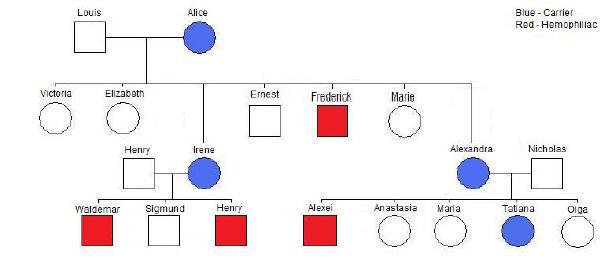
Pedigrees are used to help geneticists understand how traits are inherited between generations. The Romanovs, a Russian royal fa
inysia [295]

Answer:

Waldemar carried the recessive allele.

Explanation:

The carrier is the individual that has the affected allele or mutation but does not express the trait, or might express it in different levels. Although, as the person carries the mutation, she or he might transmit the genetic mutation associated with a disease to the progeny.  In general, these diseases are inherited as recessive traits.

So, in the exposed example we know that:

  • hemophilia is a sex-linked disorder
  • hemophilia is determined by a recessive allele on the X chromosome.
  • Irene is a carrier.
  • Her husband is not a carrier.
  • Her children Waldemar and Henry have hemophilia.

If Irene is a carrier, this means that she is heterozygous and that her genotype is X⁺X⁻ (Being the symbol + the dominant allele, and - the recessive one for that expresses the trait)

The fact that Irene´s husband is not a carrier means that his genotype is X⁺Y

Their boys Waldemar and Henry have hemophilia, so both their genotypes are X⁻Y

The best evidence to prove that Irene was heterozygous for hemophilia is that Alice carried the recessive allele.

  • Alice is Irene´s Mother, and she is a carrier as well. Irene´s father, Louis, is not a carrier, so she could have inherited a dominant allele from her father and a recessive allele from her mother, X⁺X⁻, or she could have inherited two dominant alleles from both her parents X⁺X⁺. This is not proof enough of Irene being heterozygous.
  • The fact that Alexandra, Irene´s sister, was also a carrier does not say anything about Irene´s genotype, because they could both share the same genotype or not. This is not proof of Irene being heterozygous.
  • Frederick (her brother) was hemophilic.  He received a recessive allele from Alice, but this does not say anything about Irene´s genotype.  
  • The fact that Waldemar (her son) was hemophilic, is the best evidence to prove that Irene was heterozygous for hemophilia. Walderman received the Y chromosome from his father and an X chromosome from his mother. The X chromosome that he received from his mother carried the recessive allele for the trait, and this is why he had hemophilia. This means that there is no best evidence for Irene´s genotype than her son´s genotype.


6 0
2 years ago
3) The dimensions of your living room are 13 ft. by 16 ft. How many square meters of carpet
mixas84 [53]

Answer:

19.32 m²

Explanation:

The area of a living room is the product of its length and breadth. The area is given by:

Area = length × breadth

1 meter = 3.28 feet. Hence:

Length = 16 ft

16 ft = 16\ ft*\frac{1\ m}{3.28\ ft} =4.88\ m

Breadth = 13 ft

13 ft = 13\ ft*\frac{1\ m}{3.28\ ft} =3.96\ m

Area = length × breadth = 4.88 m × 3.96 m = 19.32 m²

Hence 19.32 m² of carpet is needed for the living room

3 0
2 years ago
Acentric chromosomes, which lack centromeres, can form as a result of chromosome breakage or as a consequence of inversion with
Furkat [3]

Answer:

It wouldn't be able to migrate to the cell's poles.

Explanation:

During anaphase, microtubules attach the chromosome's centromeres and start dragging them towards the poles of the cell. In mitosis, this causes the separation of both sister chromatids for each chromosome, and each chromatid migrates to a different pole. In meiosis, first each homologous chromosome is separated by the same process, and then the sister chromatids are separated during anaphase II. If a chromosome doesn't have centromeres, microtubules are unable to attach the chromosomes, and so the separation of either sister chromatids or homologous chromosomes can't take place.

8 0
2 years ago
A boy threw a small bundle toward his girlfriend on a balcony 10. meters above him. The bundle stopped rising in 1.5 seconds. Ho
Alisiya [41]

Hi!


We know that the boy must have thrown the bundle with some initial velocity 'v', and that the bundle stops after 1.5 seconds at a height 's' with a final velocity 'u' -which would be 0.

Our known values thus are:

Time (t) = 1.5 s

Final velocity (u) = 0 m/s

Gravitational acceleration (g) = -9.8 m/s^(2)

<em>Note: that the acceleration is negative as it is opposing the direction of motion (acting  down on the object, causing deceleration)</em>

We will be using <em>equations of motion for an accelerating object</em> to solve first for initial velocity, in order to find the distance.

<h3>Initial Velocity using     <u>v = u + at</u></h3>

Rearranging the equation, and using the value 'g' as our acceleration, we get,<em> u = v - at</em>

u = 0 - (-9.8)(1.5) = 14.7m/s

<h3>Distance Travelled using   <u>v^2 = u^2 + 2as</u></h3>

Rearranging the equation, we get, <em>s= v^(2) - u^(2) / 2a</em>

s = 0^(2) - 14^(2) / 2(-9.8)                          

<em>Note: the negative sign is not a part of the initial velocity, but a part of the equation </em>

s = - 216.09 / -19.6 = 11.025 m


The distance traveled by the bundle is hence, ~ 11 meters, which is high enough for the girl to catch.


Hope this helps!


6 0
2 years ago
Other questions:
  • Which process of soil erosion is being prevented by the activity shown below?
    12·2 answers
  • Jake designed an experiment to demonstrate interactions between Earth systems. He tied a clear plastic bag firmly around some le
    8·2 answers
  • Damage to which structure will most directly disrupt water balance within a single celled organism?
    14·2 answers
  • Most of the nutrients in the rainforest ecosystem are in the _____. organisms groundwater topsoil air its organisms nvm
    13·2 answers
  • Suppose the human trait for hair type is controlled by a simple dominant and recessive relationship at one locus. Curly hair, C,
    9·1 answer
  • The cerebral cortex plays a major role in all of the following except
    5·1 answer
  • Where do talbots sympathies lie does she believe that naming a single valedictorian is right or wrong?
    8·2 answers
  • The ovarian cycle describes the monthly events of a post-pubescent ovary that causes a small number of primary follicles to grow
    9·1 answer
  • Researchers propose a model to explain variation in phytoplankton cell sizes in a marine environment. They base their model on t
    12·1 answer
  • Many species of bacteria live in your mouth and throat. These bacteria come from several different groups within domain Bacteria
    6·2 answers
Add answer
Login
Not registered? Fast signup
Signup
Login Signup
Ask question!