answer.
Ask question
Login Signup
Ask question
All categories
  • English
  • Mathematics
  • Social Studies
  • Business
  • History
  • Health
  • Geography
  • Biology
  • Physics
  • Chemistry
  • Computers and Technology
  • Arts
  • World Languages
  • Spanish
  • French
  • German
  • Advanced Placement (AP)
  • SAT
  • Medicine
  • Law
  • Engineering
Flura [38]
2 years ago
15

the property taxes on a house that Alan owns and rents out to have increased. to balance his monthly budget, he decides to incre

ase his talents rent by $10 per month. he will use extra money to pay his property tax. in this scenario, what type of tax do his tenants pay?
Business
2 answers:
DiKsa [7]2 years ago
5 0

Answer:

indirect tax

Explanation:

Indirect taxes are taxes that can be transferred to other individuals, so that they pay them instead of the original taxpayer.

In this question, Alan should have paid the extra $10 in property taxes, but instead he transferred them to his tenants so that they were responsible for paying them.

Allushta [10]2 years ago
3 0
In this scenario the type of tax his tenants pay is called Indirect tax
You might be interested in
The firm is currently in the process of forecasting sales, asset requirements, and required funding for the coming year. In the
beks73 [17]

Answer:

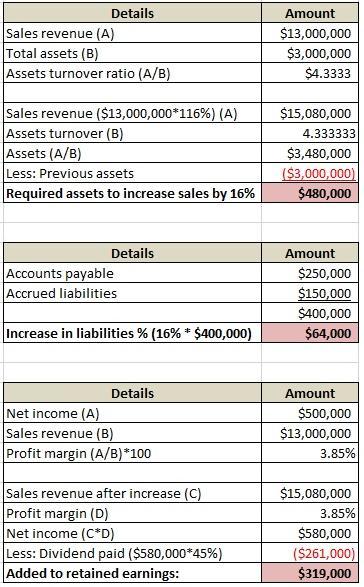
Required Asset to increase sales by 16% is $480,000

Increased liability percentage is $64,000

Added to retained earnings $319,000

Explanation:

8 0
2 years ago
Kate and Sarah work in a bakery for 8 hours per day. Kate can make 1 cake in 1 hour or 1 loaf of bread in 2 hours. Sarah can mak
Oxana [17]

Answer:

Please read explanation whilst referring to the attached table :)

Explanation:

1. Absolute Advantage

Absolute advantage is the ability of an individual, company, region or country to produce a greater quantity of a good or service than another individual, company, region or country using the same resources.

Cake: Sarah

Bread: Sarah

Sarah takes the least time to produce both a loaf of bread as well as a cake when compared to Kate. In the time Kate takes to produce one cake, Sarah can produce 2 cakes (60 mins / 30 mins). In the time it takes Kate to produce one loaf of bread, Sarah can produce 3 loaves (120 mins / 40 mins).

2. Kate's opportunity cost of producing one cake

Opportunity cost is the benefit lost from the second best alternative. In this case, the number of loaves of bread Kate sacrifices to produce 1 cake. It takes 60 mins for her to produce a cake whilst it takes 120 mins to produce a loaf of bread. Hence opportunity cost of producing one cake = 60 / 120 = 1/2 a loaf of bread. This means that when she is producing a cake, she is using up the time that she can use to produce half a loaf of bread.

3. Sarah's opportunity cost of producing one cake

The second best alternative to Sarah to cake production, is the production of bread. It takes 30 mins for her to produce a cake whilst it takes 40 mins for her to produce a loaf of bread.  Hence opportunity cost of producing one cake = 30 / 40 = 3/4 a loaf of bread. In other words, in the time that Sarah spends producing a cake, she is actually able to accomplish three-quarters of a loaf of bread production.

4. Comparative Advantage

Comparative advantage is referred to as an individual, company, region or country's ability to produce goods and services at a lower opportunity cost than that of its trade partners. The person with the least opportunity cost has comparative advantage in that product.

Cake: Kate

As per the above calculations, Kate only loses making 1/2 a loaf of bread whilst Sarah loses making 3/4 of a loaf of bread.

Bread: Sarah (explanation below)

Kate = 120 / 60 = 2 cakes sacrificed

Sarah = 40 / 30 = 1.3 cakes sacrificed

Hence, Sarah has comparative advantage in the production of a loaf of bread as she has to sacrifice producing only 1.3 cakes whilst Kate sacrifices producing 2 cakes in the time taken to produce a loaf of bread.


8 0
2 years ago
In the video "Demonstrating Time Management," Mandy tells Angie that even though her foil highlighting service isn't until later
Anastasy [175]

Answer:

Taking advantage of free time

Explanation:

Time management is the process of scheduling activities to be performed in a specific period in such a way that efficiency is increased. It is a conscious control of the time an individual spends on an activity.

Mandy is planning to use her break period for her foil highlighting service.

She is using the time management strategy taking advantage of time.

This strategy uses any free time one has to attend to certain activities.

5 0
2 years ago
In your portfolio, you began with an equal investment in stocks and Money Market funds. Your stocks are now worth 3 times your M
Jobisdone [24]

Answer:

Explanation:1.6%/2.7%

6 0
2 years ago
Read 2 more answers
Which statement best describes a significant similarity between the AICPA and IESBA codes? Both codes incorporate the conceptual
34kurt

Both codes incorporate the conceptual framework approach for evaluating threats when specific rules on a matter do not exist.

Explanation:

IFAC has enacted a Code of Ethics for Professional Accountants (IESBA Code), the International Ethics Standards Committee for Competent. The latest IESBA Code edition was upgraded and modified in July 2009 and comes into force on 1 January 2011. The adjustments clarified and considerably strengthened the independence specifications for all competent accountants.

IESBA and AICPA are more comparable than they are, but there are substantial differences. In many instances it will produce similar effects if codes are added to the same pattern of truth.

The IESBA Code deals with a number of possible independence issues which are covered by the AICPA Conceptual Structure but not AICPA. Examples include the Long Senior Human Resources Group (including Team Rotation).

Certain independence restrictions are enforced by the IESBA Code representing the "extent of public interest in certain companies" (i.e. entities listed on an accepted stock exchange for whose shares are listed), and institutions whose auditors are legally or administrative authorities required to comply with the same requirements for independence as the listings).

The IESBA splits the conditions for freedom into two regions. Section 290 offers the toughest prohibitions and includes accounting reports and audits. Section 291 generally provides less stringent requirements of freedom for all other insurance obligations. The AICPA does not change the principles of equality.

6 0
2 years ago
Other questions:
  • Ms. lee is enrolled in an ma-pd plan, but will be moving out of the plan's service area next month. she is worried that she will
    6·2 answers
  • Why would you use the above sampling methods to collect data on the diversity of an area? (hint: how would the information colle
    13·1 answer
  • You saved $500 in currency in your piggy bank to purchase a new laptop. The $500 you kept in your piggy bank illustrates money’s
    14·1 answer
  • Explain how to determine the maximum amount of money a company is willing to pay for a a consultant that can be predict the futu
    11·1 answer
  • B&T Company's production costs for May are: direct labor, $16,000; indirect labor, $6,800; direct materials, $15,300; proper
    6·1 answer
  • At the present time, Perpetualcold Refrigeration Company (PRC) has 10-year noncallable bonds with a face value of $1,000 that ar
    14·1 answer
  • Nathan works as an accountant for a mid-sized retail store. He has just completed a trial balance that resulted in no unexpected
    14·1 answer
  • Rede Inc. manufactures a single product. Variable costing net operating income was $63,800 last year and its inventory decreased
    11·1 answer
  • What are three critical questions that entrepreneurs need to ask themselves while starting a business? Which location would be t
    5·1 answer
  • Rodgers Company gathered the following reconciling information in preparing its May bank reconciliation. Calculate the adjusted
    15·1 answer
Add answer
Login
Not registered? Fast signup
Signup
Login Signup
Ask question!