answer.
Ask question
Login Signup
Ask question
All categories
  • English
  • Mathematics
  • Social Studies
  • Business
  • History
  • Health
  • Geography
  • Biology
  • Physics
  • Chemistry
  • Computers and Technology
  • Arts
  • World Languages
  • Spanish
  • French
  • German
  • Advanced Placement (AP)
  • SAT
  • Medicine
  • Law
  • Engineering
Tatiana [17]
2 years ago
11

Mohammad would like to graph the line that represents the total number of baseball cards he will have collected, T, after m mont

hs, given that he buys 5 cards each month and he started with no cards. He would like the graph to show the number of cards after 6 and 12 months. Select from the drop-down menus to correctly complete each statement. To best show this information, the scale for the T-axis of his graph should go from 0 to at least , and the m-axis of his graph should go from 0 to at least .

Mathematics
2 answers:
Darina [25.2K]2 years ago
6 0

Solution:

Number of Baseball cards bought by Mohammad each month = 5

As number of baseball cards is represented by T , which are

T = 0,5,10,15,20,25,30,35,40,45,50,55,60   →→  Y axis

Number of months(m) from which Mohammad started buying cards is given as

m = 0,1,2,3,4,5,6,7,8,9,10,11,12   →→     X axis

The given information represented in equation form

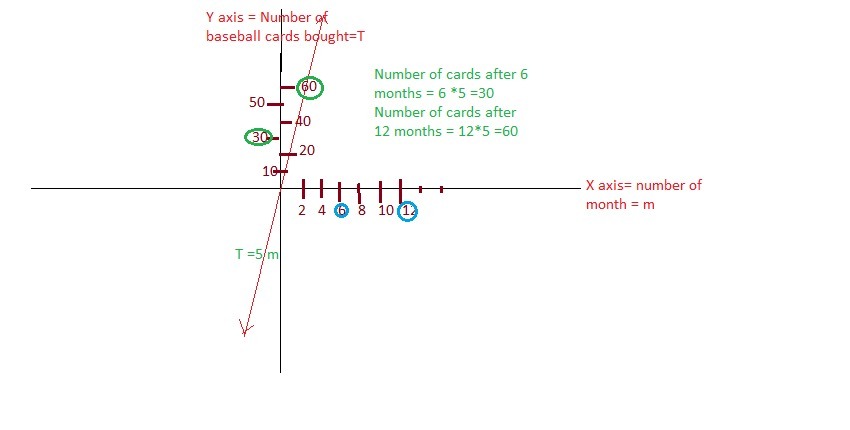
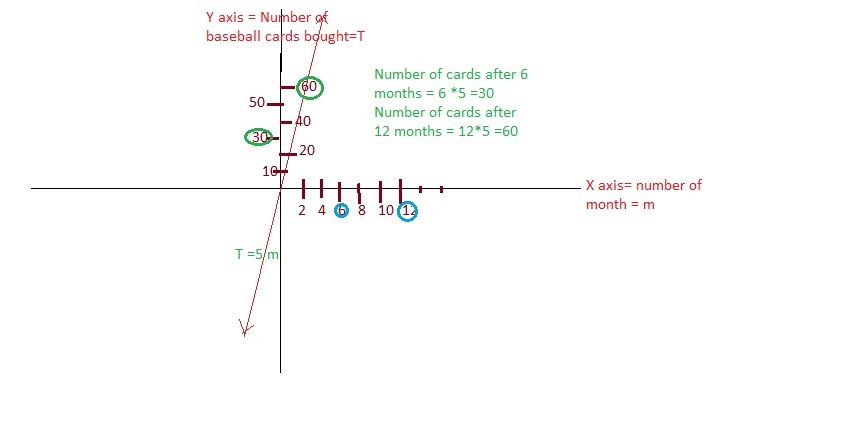
T = 5 m

This is a equation of line in two variable passing through origin.

Slope of line = 5 =Amount of baseball card bought each month

Number of cards bought after 6 months = 5 × 6=30

Number of cards bought after 12 months = 5 ×12 =60

Graph is depicted below.

The scale for the T-axis of his graph should go from 0 to at least 60 , and the m-axis of his graph should go from 0 to at least 12 .
mylen [45]2 years ago
3 0
T-axis of his graph should go from 0 to at least 60 <span>and the </span>m<span>-axis of his graph should go from 0 to at least 12.

</span>
You might be interested in
Which shows a recursive and an explicit formula for a sequence whose initial term is 14 and whose common difference is −4? A. A(
liberstina [14]

Answer: A. A(1) = 14; A(n) = (n − 1) −4; A(n) = 14 + (n − 1)(−4)

Step-by-step explanation:

Arithmetic sequence is a sequence that is identified by their common difference. Let a be the first term, n be the number of terms and d be the common difference.

For an arithmetic sequence, common difference 'd' is added to the preceding term to get its succeeding term. For example if a is the first term of a sequence, second term will be a+d, third term will give a+d+d and so on to generate sequence of the form,

a, a+d, a+3d, a+4d...

Notice that each new term keep increasing by a common difference 'd'

The nth term of the sequence Tn will therefore give Tn = a+(n-1)d

If the initial (first) term is 14 and common difference is -4, the nth of the sequence will be gotten by substituting a = 14 and d = -4 in the general formula to give;

Tn = 14+(n-1)-4 (which gives the required answer)

Tn = 14-4n+4

Tn = 18-4n

5 0
2 years ago
Read 2 more answers
Joe is taking the train from his hometown to Georgetown and back to his hometown. The distance to Georgetown is 350 miles. How m
ivanzaharov [21]

Answer:

it would be A.

Step-by-step explanation:

HIUSHISGSOUCOUVCVC

4 0
2 years ago
​Cameron, Arthur, and Jamie are playing soccer. Their locations are recorded by a motion tracking system. The grid shows distanc
Luden [163]

Answer:

1. Arthur is about 54 meters away from Cameron.

2. Jamie is about 56 meters away from Cameron.

3. Arthur is closer to Cameron.

Step-by-step explanation:

We have been given the locations of Cameron (70,10), Arthur (20,30) and Jamie (45,60) on the the grid in meters.

1. To find the distances of Arthur and Jamie from Cameron we will use distance formula.

\text{Distance}=\sqrt{(x_2-x_1)^{2}+(y_2-y_1)^{2}}

\text{Distance between Cameron and Arthur}=\sqrt{(70-20)^{2}+(10-30)^{2}}

\text{Distance between Cameron and Arthur}=\sqrt{(50)^{2}+(-20)^{2}}

\text{Distance between Cameron and Arthur}=\sqrt{2500+400}

\text{Distance between Cameron and Arthur}=\sqrt{2900}

\text{Distance between Cameron and Arthur}=53.8516480713450403\approx 54

Therefore, the distance Arthur is about 54 meters away from​ Cameron.

2. Let us find the distance between Cameron and Jamie.

\text{Distance between Cameron and Jamie}=\sqrt{(70-45)^{2}+(10-60)^{2}}

\text{Distance between Cameron and Jamie}=\sqrt{(25)^{2}+(-50)^{2}}

\text{Distance between Cameron and Jamie}=\sqrt{625+2500}

\text{Distance between Cameron and Jamie}=\sqrt{3125}

\text{Distance between Cameron and Jamie}=55.9016994374947424\approx 56

Therefore, Jamie is about 56 meters away from​ Cameron.

3. We can see that 56 is greater than 54, therefore, Arthur is closer to Cameron.


4 0
2 years ago
Read 2 more answers
A survey of 481 of your customers shows that 79% of them like the recent changes to the product. Is this percentage a parameter
vitfil [10]

Answer:

Statistic, because it is a property of a sample and not the population.

Step-by-step explanation:

The difference between a parameter and an statistic is that the parameter is a property of a population distribution and an statistics is referred to a sample property.

For example, a sample mean is a statistic while a population mean is a parameter.

In t his case, the proportion is referring to the sample of 481 customers, so it is not a property of the population (altough we can use it to infere about the population), so this proportion (79%) is an statistic.

5 0
2 years ago
During exercise, the recommended maximum heart rate in beats per minute is modeled by the formula M = 176 − 0.8A, where M is the
mafiozo [28]

Answer:

51 or 53

Step-by-step explanation:

135=176-.8(52)

5 0
2 years ago
Read 2 more answers
Other questions:
  • Which congruence theorem can be used to prove △MLQ ≅ △NPQ?<br><br> AAS <br> SSS <br> ASA <br> SAS
    8·2 answers
  • Organic milk costs $2.52 per half gallon. At this rate, how can the price of 4 gallons of organic milk be determined?
    15·2 answers
  • Point F is on circle C.
    14·2 answers
  • What is 4x-4y/2=x+2 in slope intercept form?
    11·1 answer
  • The geometric average of -12%, 20%, and 25% is _________.
    15·1 answer
  • A proper unbiased coin was tossed 10 times for 3 trials, giving TTHHTHTTHH, TTTTTHHHHH, and THTHHHTTHT (T = Tails; H = Heads). W
    12·2 answers
  • Graph the linear equation. Find three points that solve the equation, then plot on the graph. -3y=x-6
    13·1 answer
  • Which of the following are descriptive images? Select all that apply.
    11·1 answer
  • 1. Melissa went to lunch with two friends. She purchased 3 corn dogs, 2 fruit cups, and
    12·1 answer
  • Given that r||s and q is a transversal, we know that by the [________]. corresponding angles theorem alternate interior angles t
    6·2 answers
Add answer
Login
Not registered? Fast signup
Signup
Login Signup
Ask question!
