answer.
Ask question
Login Signup
Ask question
All categories
  • English
  • Mathematics
  • Social Studies
  • Business
  • History
  • Health
  • Geography
  • Biology
  • Physics
  • Chemistry
  • Computers and Technology
  • Arts
  • World Languages
  • Spanish
  • French
  • German
  • Advanced Placement (AP)
  • SAT
  • Medicine
  • Law
  • Engineering
Degger [83]
2 years ago
13

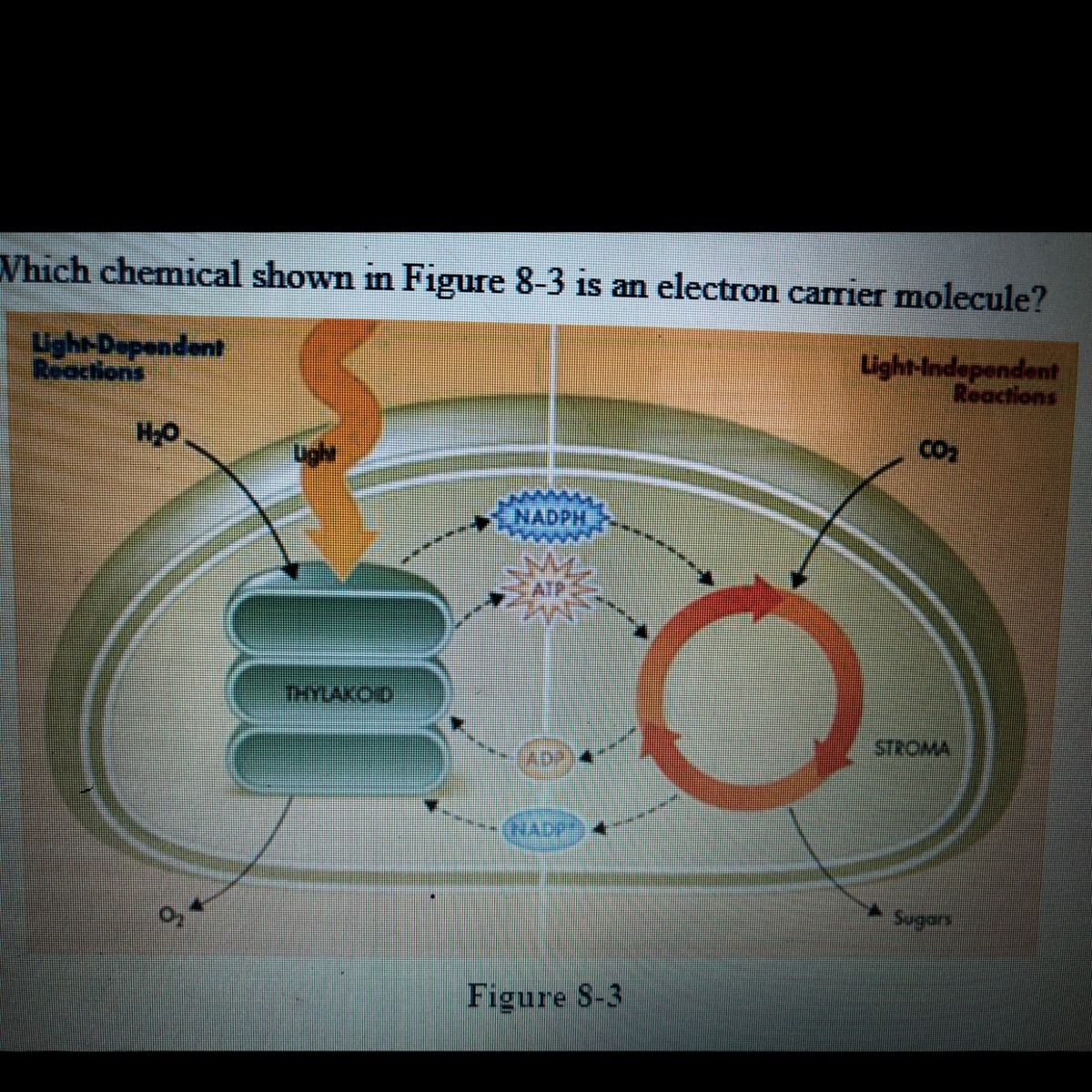
Which chemical shown in figure 8-3 is an electron carrier molecule

Biology
2 answers:
Semmy [17]2 years ago
7 0

Ans.

An electron carrier is defined as a molecule, which is capable of receiving one or more electrons from an electron donating molecule (electron donor). In given figure, molecule NADP (nicotinamide adenine dinucleotide phosphate) is acting as an electron carrier that accepts electrons form chlorophylls and form NADPH.  

Thus, the correct answer is 'option C). NADP.'

Marina86 [1]2 years ago
3 0

I might be a little too late, I apologize, but the answer is

C) NAPD+

You might be interested in
The bridge in the picture is connecting two pieces of land that represents two distinct places. What type of boundary is this?
lions [1.4K]

Answer:

The correct answer is physical boundary.

Explanation:

In my opinion, the kind of boundary it signifies is the physical boundary. The physical boundary is the most general type and is a naturally taking place obstruction in between the two regions due to the existence of either an ocean, river, desert, or mountain ranges. At various occasions, the political boundaries between the states or the countries form along the physical boundaries.

7 0
2 years ago
Read 2 more answers
You carry a 20.N bag of dog food up a 6.0 m flight of stairs.how much work was done
gavmur [86]
Vertical stairs :P: W = (20 N) * (6.0 m) * cos (0 degrees) = <span>120 Joules

At 45 degrees: W = (20.0 N) * (6.0 m) * cos (45 degrees) =

(20N) * 6m) * (</span><span>0.707106781) = 84.853 Joules</span>
4 0
2 years ago
Read 2 more answers
The seeds collected from the first generation monohybrids are called _____. P1 F3 F1 F2
nadezda [96]
<span>The seeds collected from the first generation monohybrids are called F1. The first generation is called P generation or parental generation. The seeds collected from the first generation (P generation) is called F1 generation or the first filial generation. The seeds collected from the second generation (F1 generation) is called F2 generation or the second filial generation.</span>
5 0
2 years ago
Read 2 more answers
Choose the statements below that are true. Cells are the smallest unit of life. Cells are important to the structure and functio
Irina-Kira [14]

Cells are the smallest unit of life. This is true.

Cells are important to the structure and function of living things. This is true.

All organisms are made of multiple cells. This is false, because there are many single celled organisms like bacteria.

Cells come in different shapes and sizes. This is true, as there are cells with a variety of shape and size (round shaped cocci and the elongated and flat bacillus). There are cells from squid's nervous system, called the neurons, that are comparatively very large in size than the vast majority of the other cells.

6 0
2 years ago
Read 2 more answers
1. The nucleic acids DNA and RNA carry genetic information and are made up of many . 2. Myoglobin is a protein that binds oxygen
OverLord2011 [107]

Answer:

1. Nucleotides

2. Amino acids

3. Amino acids

4. Glucose

Explanation:

All the above substance described are biomolecules. They are all polymers i.e. complex molecule bond together in a long repeating chain, made up of simpler subunits called monomers. The monomers of the different biomolecules outlined above are:

1. The nucleic acids, DNA and RNA carry genetic information and are made up of many NUCELEOTIDES. A nuceleotide is a chemical combination of a five carbon sugar (pentose), phosphate group and nitrogenous base. These nucleotides are arranged sequentially to form nucleic acids (RNA and DNA).

2. Myoglobin is a protein that binds oxygen molecules and is a polymer of AMINO ACIDS. Amino acids are the building blocks of proteins. They are arranged to form a 3D structure that determines the function of the protein.

3. Insulin is a protein hormone that regulates blood glucose levels and is a polymer of AMINO ACIDS. All proteins are made up of the amino acid but the protein's function is dependent on the 3D structure formed by the amino acid sequence.

4. Animals store energy in the form of glycogen, a carbohydrate made up of thousands of monosaccharide (GLUCOSE). Glycogen is a polysaccharide made up of many monosaccharide units. These units are glucose molecules that are multibranched to form the glycogen that stores mainly in the liver and muscles of animals.
3 0
2 years ago
Other questions:
  • Chemical mechanisms that can turn off or reduce an enzyme are _____.
    11·2 answers
  • Marcus is admitted to the hospital for a bone marrow stem cell transplant from his brother. What will happen after his brother’s
    14·2 answers
  • Which component is more medial: the right lung or the tracheal bifurcation?
    10·1 answer
  • Fertilizer runoff from farms can get into groundwater and travel to nearby streams. Then, it can eventually end up in lakes. Wha
    6·2 answers
  • Gene A has two alleles (A1 and A2). A1A1 homozygotes are twice as likely to survive from birth to reproductive age as heterozygo
    12·1 answer
  • An investigation was set up to study the movement of water through a membrane. The results are shown in the diagram below. Based
    15·1 answer
  • During a biology lab practical, students were required to identify a metal by its density. All the metals were painted green so
    9·2 answers
  • Multiple answers) A man is at risk of developing colon cancer because his grandfather and father died of it. Adding which of the
    5·1 answer
  • What might account for the unusual results you obtained in the experiment in Part C? Select the two correct answers. Select the
    14·1 answer
  • 9. Draw brackets from left to right to signify the codons in this amino acid chain (please someone help) (No Sending LINKS!)
    15·1 answer
Add answer
Login
Not registered? Fast signup
Signup
Login Signup
Ask question!
