answer.
Ask question
Login Signup
Ask question
All categories
  • English
  • Mathematics
  • Social Studies
  • Business
  • History
  • Health
  • Geography
  • Biology
  • Physics
  • Chemistry
  • Computers and Technology
  • Arts
  • World Languages
  • Spanish
  • French
  • German
  • Advanced Placement (AP)
  • SAT
  • Medicine
  • Law
  • Engineering
ollegr [7]
2 years ago
12

Gene A has two alleles (A1 and A2). A1A1 homozygotes are twice as likely to survive from birth to reproductive age as heterozygo

tes or A2A2 homozygotes (w11=1, w12=0.5, w22=0.5). A population starts with 40 individuals of each genotype allowed to mate at random. Their progeny then survive according to the fitness values given above. What will be the allele frequencies in those progeny when they reach reproductive age
A. 0.40 A1, 0.60 A2 B. 0.50 A1, 0.50 A2 C. 0.60 A1, 0.40 A2 D. 0.80 A1, 0.20 A2 E. All A1
Biology
1 answer:
Usimov [2.4K]2 years ago
8 0

Answer:

The correct answer is C: <em>0.60 </em><em>A1</em> and <em>0.40 A2</em> will be the allele frequencies in those progeny when they reach reproductive age

Explanation:

<em>Genotype</em>                                <u><em>A1A1 </em></u><em>  </em><u><em>A1A2</em></u><em> </em><u><em>A2A2 </em></u>

<em>Relative aptitude, w</em>                  1           0.5    0.5

<em>Number of individuals</em>                 40            40     40

<em>Initial allelic frequency</em>      p0= (40+20)/120=0.5    q0= (40+20)/120=0.5

<em>Zygote frequency</em>                  p2= 0.25 2pq=0.25 q2=0.625

<em>Relative contribution</em>         0.25x1=0.25     0.5x0.5=0.25 0.25x0.5=0.125

<em>of each genotype</em>              

<em>Average aptitude W</em>              W= 0.025 + 0.25 + 0.125 = 0.625

<em>Population</em>                    AA= 0.25/0.625    AB=0.25/0.625  BB=0.125/0.625

<em>Genotype frequency</em>             AA= 0.4             AB=0.4          BB=0.2  

<em>New Allelic frequency</em>       p1=0.4+(0.4/2)=0.6   q1=0.2+(0.4/2)=0.4

  • <em>Total number of individuals</em>: 120
  • <em>Initial allelic frequency</em>:

                  (number of homozygote individuals + half number of  

                   heterozygote individuals) / Total number of individuals

  • <em>Relative contribution of each genotype</em>:

                           Zygote frequency x Relative aptitude

  • <em>Average aptitude W</em>: It is the sum of relative contribution of each genotype to the next generation.  

                    wA1A1 x p2 + WA1A2 x 2 x p x q + WA2A2 x q2

  • <em>Population Genotype frequency</em>:

                Relative contribution of each genotype / Average aptitude

  • <em>Allelic frequency</em>:

                      Homozygote population genotype frequency +  half  

                           heterozygote population genotype frequency

You might be interested in
Please help asap the scientific name Canus nipponicus. To which classification levels does this scientific name belong?
Amiraneli [1.4K]

The correct answer is - C. genus and species.

The final scientific name of an animal represents two things, its genus, and its species.

The first name is the genus of the animal, in this case we have Canus. The second name is the species of the animal, in this case nipponicus.

All living organisms are classified in a same manner: kingdom, phylum, class, order, family, genus, species.

Since the name Canus reminds me a lot of Canis, I will take the wolf as an example:

Kingdom: Animalia

Phylum: Chordata

Class: Mammalia

Order: Carnivora

Family: Canidae

Genus: Canis

Species: C. Lupus

6 0
2 years ago
Read 2 more answers
How would signaling be affected if a mutation caused a g protein to replace gdp with gtp on its own without needing to be activa
Elan Coil [88]

Answer:

This mutation will produce a conformational change capable of maintaining the receptor continuously in its activated mode

Explanation:

G proteins are inactive when guanosine diphosphate (GDP) is bound, while they are active when guanosine triphosphate (GTP) is bound

5 0
2 years ago
Which of the following claims about the TYR, TRP2, and TRP1 mammalian genes is most likely to be accurate?
Illusion [34]

The TYR, TRP2, and TRP1 genes are located next to each other on a single chromosome and are organized into an operon is most likely to be accurate.

The option a is correct.

Explanation:

The genes for the Tyrosinase, TRP2 and TRP1 are located on the same chromosome and are operons. These are operons because they are controlled by same transcription factors on mRNA.

Tyrosinase enzyme is important for the synthesis of melanin, eye pigments and hair colour. The synthesis of all these is completed in three distinct reactions  catalysed by TRP1, TRP2 and Tyr genes. These work as operon and the protein product is almost 40% similar of the three genes.

The amount of melanin production depends on tyrosinase enzyme activity of all the three genes.

The genetic regulation is done by operons.

4 0
2 years ago
What situation best represents how DNA sequencing, PCR, and gene probes might be used together? Multiple Choice Scientists might
Ivahew [28]

Answer:

Scientists might replicate a strand of DNA using PCR before sequencing it. Once the sequence is known, they can produce a corresponding gene probe

Explanation:

PCR refers to the polymerase chain reaction that amplifies the small sample of DNA into multiple copies in three steps. These steps are denaturation of sample DNA to produce single-stranded template strand, binding of primer to the template and elongation. The multiple copies of the sample DNA are then used to decipher its sequence using various sequencing methods.

Once the sequence of the sample DNA is known, the short, single-stranded DNA molecules that are complementary to the specific sequence of DNA are formed. These single-stranded DNA molecules are called DNA probe and are used to detect the specific nucleotide sequence in some other sample DNA.

8 0
2 years ago
In a flowering plant, tall (T) is dominant to short (t), and blue flowers (B) is dominant to white flowers (b). A tall plant wit
Bumek [7]
<h3>Answer: </h3><h3 />

25%

<h3>Explanation:</h3>

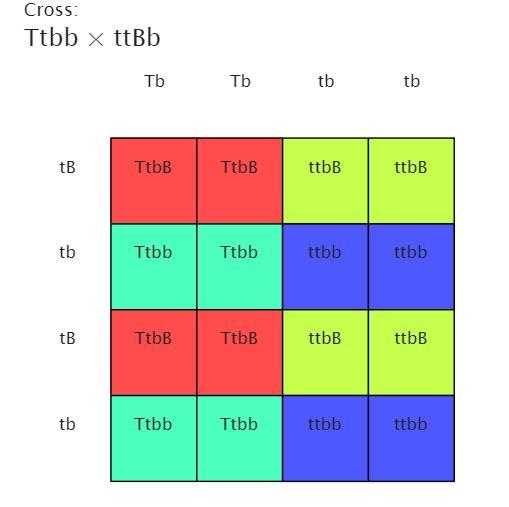
Following a cross between <u>Ttbb</u> and <u>ttBb</u>, the resulting offspring would be:

TtbB , TtbB , Ttbb , Ttbb , ttbB , ttbB , ttbb , ttbb , TtbB , TtbB , Ttbb , Ttbb , ttbB , ttbB , ttbb , ttbb

To have a clearer idea, see the attached image.

Of the 16 possible combinations from this dihybrid cross, there will be:

4 tall plants with blue flowers

4 tall plants with white flowers

4 short plants with blue flowers

4 short plants with white flowers

There are 4 possible genotypic recombinations that would yield short plants with white flowers out of a possible 16, so the chance that the offspring will be short with white flowers would be 4/16 which is 1/4 or 25%

<h3>Hope this helps</h3>

6 0
2 years ago
Other questions:
  • Explain how these properties of water are related to the phenomena described in the statements below. More than one property may
    13·2 answers
  • Maria is studying fungi in a forest. She makes some observations and takes some notes on a variety of fungi found on the forest
    12·2 answers
  • In which biome would you most likely find plants that grow far apart from one another, with narrow leaves and shallow roots? Why
    15·2 answers
  • Suppose the parents indicated in the interactive produced 192 peas. Determine the expected number of green and round offspring.
    6·2 answers
  • Rewrite the following sentence to make it true.<br><br>Geologists subdivide periods into eras​
    11·1 answer
  • If the biomass of flowers that support the butterflies the same grassy meadow was known to contain 100,000 units of energy, and
    11·1 answer
  • Uncle Mel mentioned having difficulty sleeping. If he was prescribed a medication that targeted serotonin, such as a SSRI (selec
    14·2 answers
  • Identify one food item Tara’s Doctor would not approve for her diet and explain why Tara should avoid that food while she recove
    9·1 answer
  • Which of the following ECG components represents a lack of electrical activity? A. T-wave B. Q-T interval C. P-R interval D. Iso
    7·1 answer
  • How would a geologist use absolute dating to determine the age of sedimentary layers? by dating the age of intrusions and extrus
    15·2 answers
Add answer
Login
Not registered? Fast signup
Signup
Login Signup
Ask question!