answer.
Ask question
Login Signup
Ask question
All categories
  • English
  • Mathematics
  • Social Studies
  • Business
  • History
  • Health
  • Geography
  • Biology
  • Physics
  • Chemistry
  • Computers and Technology
  • Arts
  • World Languages
  • Spanish
  • French
  • German
  • Advanced Placement (AP)
  • SAT
  • Medicine
  • Law
  • Engineering
Stella [2.4K]
2 years ago
9

Y-: yellow S-: star yy: black ss: starless

Biology
1 answer:
Ede4ka [16]2 years ago
7 0

Answer:

1. heterozygous yellow and star

2. 37

3. 1/8

4. 168

5. 1/4

Explanation:

Given ,

In f1 generation a cross is made between a true breeding black star bellied sneetch mated with a true breeding yellow starless sneetch

yySS x YYss

It is taken as - Y (yellow) is dominant over y (black)

and S (star) is dominant over s (starless)

1. F1 Generation

Genotype of parents yySS X YYss

gametes - yS, yS, Ys, Ys

All 16 offspring will have genotype YySs

phenotype would be heterozygous yellow and star

2. F2 generation cross

YySs X YySs

YS        Ys         yS        ys

YS YYSS YYSs YySS YySy

Ys YYSs YYss YySs Yyss

yS YySS YySs yySS yySs

ys YySs Yyss yySs yyss

Genotype of offspring are –  

YYSS – 1

YYSs – 2

YySS – 2

YySs – 4

YYss- 1

Yyss- 2

yySS – 1

yySs- 1

yyss- 1

2. Out of 16, 2 are black star bellied sneetches . Which means only 1/8 are black star bellied sneetches

So out of 300, 37 are black star bellied sneetches

3. Only 2 out of 16 are true breeding. i.e 1/8

4. 9 out of 16 are yellow star bellied sneetches, so out of 300, 168 are yellow star bellied sneetches

5. 4 out of 16 are true breeding yellow. Thus, ¼ are true breeding

You might be interested in
Which of the factors likely contributed to the evolution of inducible defenses against herbivory? Select all that apply. a. diff
Triss [41]

Answer:

c. the cost to growth of allocating resources to defense

d. consistent fitness benefits of high allocations to defense

Explanation:

In order to ensure survival by  escape of  grazing and browsing by herbivores (and insects) plant usually adopt different defence mechanisms.This forms the basis for the optimum defence hypothesis .

The basic idea of the hypothesis is that the type   of  defence that an organism e.g plant  will adopt  against an herbivore depends on its fitness, and since this involve expenditure of energy it will be expensive for the organism to afford and maintain.

4 0
2 years ago
Glucokinase has a Km value of 10.0 mM, whereas hexokinase has a Km value of 0.1 mM. This is consistent with which of the followi
Goshia [24]

Answer:

B. Glucokinase acts on glucose only at high glucose concentrations.

Explanation:

To understand the answer, first, we have to know that the Michaelis Menten kinetics requires to have a constant concentration of enzyme quantity to see what happens with the rate.

To determine that we can evaluate how much time takes the total consumption of substrate or the time taken to obtain a product.

We know that when an enzymatic reaction occurs, the enzyme accelerates the reaction by minimizing the activation energy.

Suppose we have the enzyme on this case glucokinase and hexokinase, and we going to make them react with the substrate, in this case, the glucose.

Any of both enzymes will be abbreviated as E, and glucose as a substrate will be abbreviated as S. And we have the following reaction:

E  +  S = ES = E + P

When ES is the enzyme-substrate complex, and P is the product of the reaction, in these case, when the hexokinase or glucokinase takes the glucose the product is the phosphorylation of the glucose.

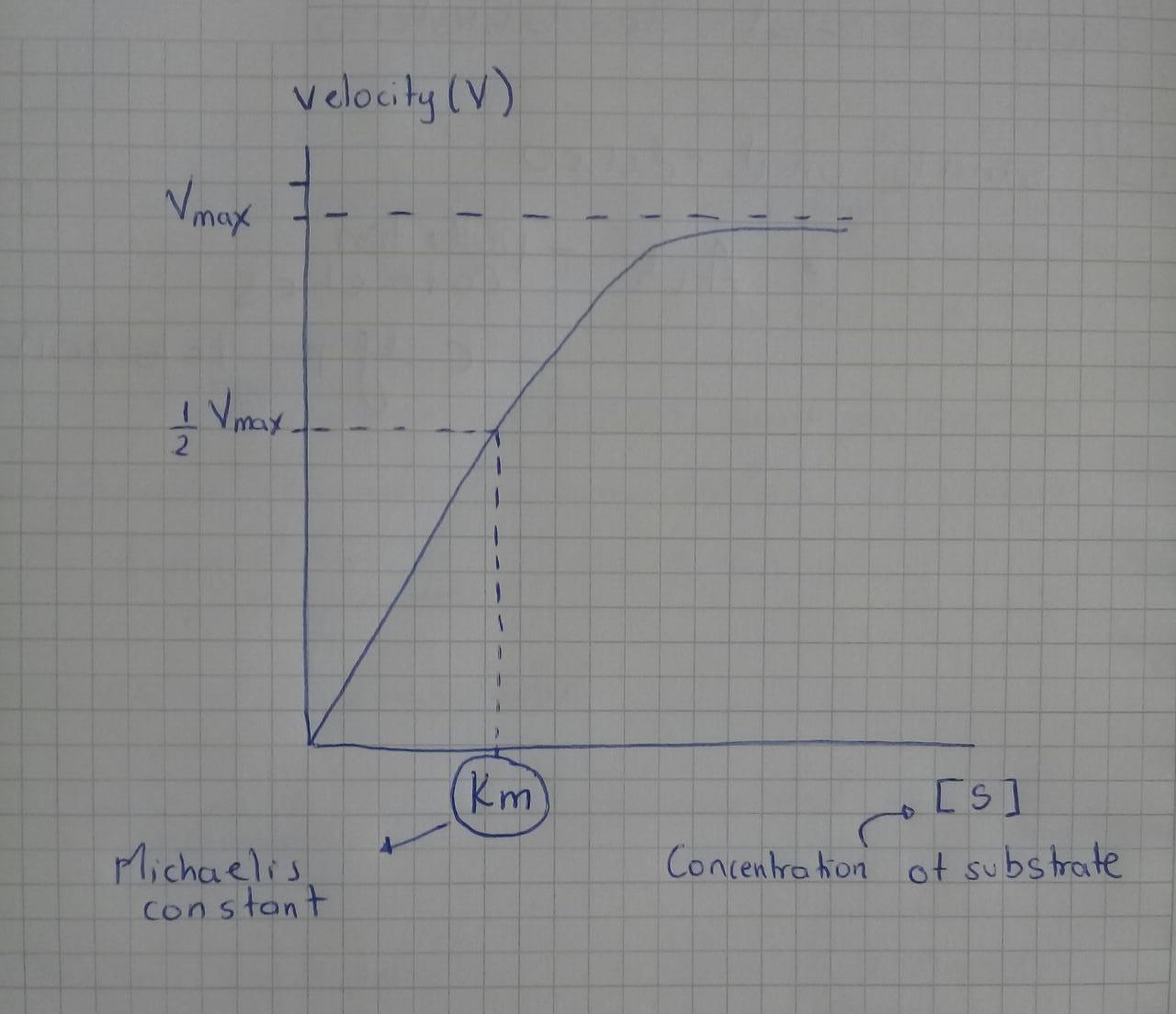
We can see this reaction, for both enzymes or any enzyme as a graph (watch image attached).

This image explains that when you have a constant concentration of enzyme and you add more substrate, the velocity will rise but, when the reaction reaches the maxim velocity (Vmax), this value will be constant, and it is because all the enzyme active site are full with substrate already, so even if you add, the reaction will not accelerate.

Take a look at the graph and note the Km value related to the

1/2 Vmax. And the Km is finally just the substrate concentration when the half value of velocity is reached.

So, for any enzyme reaction, the Km value is the concentration of the substrate when the half higher value of velocity will be reached.

So for glucokinase, who has a Km value of 10 mM, and hexokinase with a Km = 0.1 mM we can say that glucokinase requires more quantity of substrate (glucose) to reach the maximum velocity, but hexokinase reaches the maximum velocity a very small quantity of glucose concentration. And that behavior has to be related to the higher affinity of glucose with the hexokinase instead of glucokinase.

For that reason the answer must be :

B. Glucokinase acts on glucose only at high glucose concentrations.

As you must know, glucokinase is an enzyme produced on the liver and has a higher specify for D-glucose instead for other hexoses, the glucokinase has a poor activity at lower blood concentration of glucose ( fast periods, before breakfast).


7 0
2 years ago
Place these steps of the insulin signaling pathway in the correct order from insultin is secreted to glucose enters the cell. Pl
horsena [70]

Answer:

1. Binding of insulin to the alpha subunit of the insulin receptor

2. Activation of insulin receptor tyrosine kinase

3. Phosphorylation of IRS proteins

4. Activation of PIP3-dependent protein kinase B (PDK1)

5. Phosphorylation of phosphinositide 3-kinase (PI-3K)

6. Conversion of PIP2 to PIP3

7. Activation of Akt

8. Glut4 receptors transported to cell membrane

8 0
2 years ago
Use this model of a eukaryotic transcript to answer the following question. E = exon and I = intron 5' UTR E1 I1 E2 I2 E3 I3 E4
sveticcg [70]

Answer:

<h2>5' UTR E1 E2 E3 E4 UTR 3'</h2>

Explanation:

During RNA splicing, introns are removed and exons are joined tp each other to form  a mature mRNA and this RNA moves to cytosol.. So 5' UTR , UTR 3' and all exons are joined together.

All introns are removed and exons are joind during RNA splicing process.

So the final mRNA is 5' UTR E1 E2 E3 E4 UTR 3'.

8 0
2 years ago
​jamal was born 34 weeks after he was conceived and weighed 6 pounds. jamal is best described as
Serggg [28]
<span>Preterm and normal birth weight </span>
4 0
2 years ago
Other questions:
  • How does the concentration of salt in water affect the rate of osmosis?
    6·1 answer
  • Which type of protein plays an important role in transmitting signals in the nervous system? A] ion channel membrane proteins. B
    7·1 answer
  • Hypothesize one way that a diploid organism could have offspring that are 3n or 4n
    6·2 answers
  • What three types of information does laboratory analysis of blood, urine, or other body fluids or substances provide about a pat
    14·1 answer
  • As a mechanism of evolution, natural selection can be most closely equated with __________.
    13·1 answer
  • Charlie contracted Lyme disease when he was bitten by a tick, which is a small spider-like animal. The tick carries harmful bact
    11·1 answer
  • Trinna and Suzanne are identical twins who were the same length at birth. They were adopted by different families at birth and t
    9·1 answer
  • The drug cytochalasin targets actin filaments in the cytoskeleton, preventing them from forming. Treatment of a cell with cytoch
    10·1 answer
  • Earth’s axis passes through the_____and South Poles. It takes Earth____hours to rotate once around its axis. Earth revolves once
    8·1 answer
  • The fact that choanoflagellates and collar cells of sponges resemble each other supports the inference that ________. Group of a
    7·1 answer
Add answer
Login
Not registered? Fast signup
Signup
Login Signup
Ask question!