answer.
Ask question
Login Signup
Ask question
All categories
  • English
  • Mathematics
  • Social Studies
  • Business
  • History
  • Health
  • Geography
  • Biology
  • Physics
  • Chemistry
  • Computers and Technology
  • Arts
  • World Languages
  • Spanish
  • French
  • German
  • Advanced Placement (AP)
  • SAT
  • Medicine
  • Law
  • Engineering
Darina [25.2K]
2 years ago
7

In cucumbers, dull fruit (D) is dominant over glossy (d) fruit, orange friut (R) is dominant over cream fruit (r), and bitter co

tyledon (B) is dominant over non-bitter cotyledons (b). The three characters are encoded by genes located on different pairs of chromosomes. A plant homozygous for dull, orange fruit and bitter cotyledons is crossed with a plant that is homozygous for glossy, cream fruit and non-bitter cotyledons. The F1 are intercrossed to produce the F2. Assume that all 3 traits are encoded by independent genes.
a. Write out the parental anf F1 crosses using appropriate genotypic annotation. Indicate the phenotypes and their expected proportions in the F1 and F2.

b. An F1 plant is crossed with a plant that has glossy, cream fruit and non-bitter cotyledons. Write out this cross using appropriate annotation, and give the genotypes, phenotypes, and respectuve proprtions among the progeny of this cross.

Biology
1 answer:
stiv31 [10]2 years ago
4 0

Explanation:

  • Dull fruit (D) is dominant over glossy (d) fruit.
  • Orange friut (R) is dominant over cream fruit (r).
  • Bitter cotyledon (B) is dominant over non-bitter cotyledons (b).

The three genes are independent.

<h3>a)</h3>
  • A plant homozygous for dull, orange fruit and bitter cotyledons has the genotype <em>DDRRBB</em><em>.</em>
  • A plant homozygous for glossy, cream fruit and non-bitter cotyledons has the genotype <em>ddrrbb</em>.

100% of the F1 will have dull, orange fruit and bitter cotyledons and will be heterozygous for all genes: <em>DdRrBb</em>.

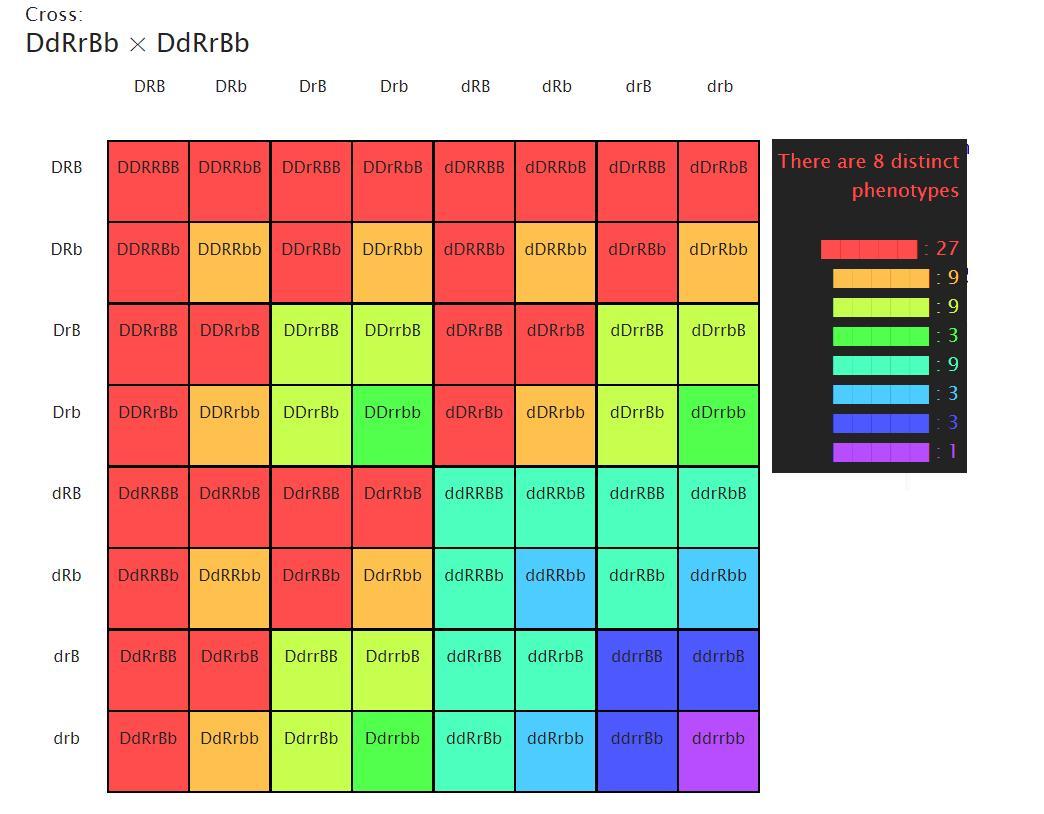
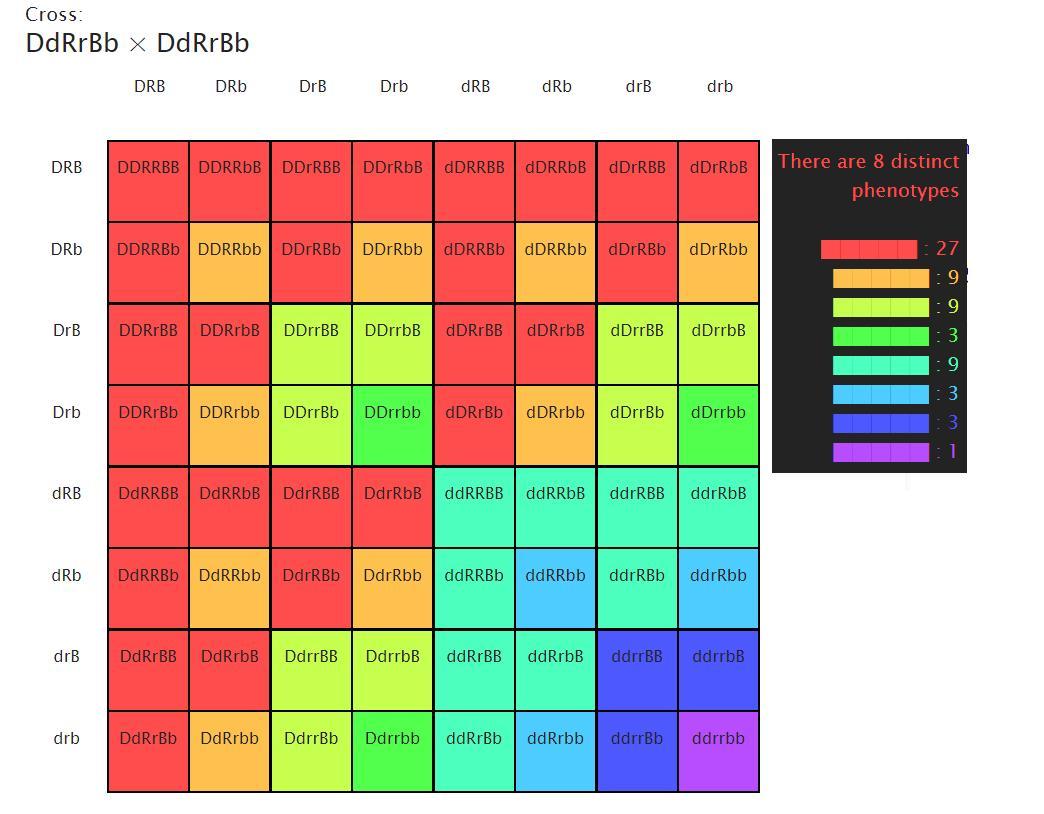
<u>The F2 will have 8 possible phenotypes:</u>

  • 27 D_R_B dull, orange fruit and bitter cotyledons
  • 9 D_R_bb dull, orange fruit and non-bitter cotyledons
  • 9 D_rrB_ dull, cream fruit and bitter cotyledons
  • 3 D_rrbb dull, cream fruit and non-bitter cotyledons
  • 9 ddR_B_ glossy, orange fruit and bitter cotyledons
  • 3 ddR_bb glossy, orange fruit and non-bitter cotyledons
  • 3 ddrrB_ glossy, cream fruit and bitter cotyledons
  • 1 ddrrbb  glossy, cream fruit and non-bitter cotyledons

<h3>b)</h3>

An F1 plant is crossed with a plant that has glossy, cream fruit and non-bitter cotyledons.

<h3>DdRrBb x ddrrbb </h3>

The F1 individual can produce 8 types of gametes: DRB, DRb, DrB, Drb, dRB, dRb, drB and drb. The cream fruit and non-bitter cotyledons individual can only produce drb gametes. This cross also produces a progeny with the following genotypes and phenotypic proportions:

  • 8 DdRrBb dull, orange fruit and bitter cotyledons
  • 8 DdRrbb dull, orange fruit and non-bitter cotyledons
  • 8 DdrrBb dull, cream fruit and bitter cotyledons
  • 8 Ddrrbb dull, cream fruit and non-bitter cotyledons
  • 8 ddRrBb glossy, orange fruit and bitter cotyledons
  • 8 ddRrbb glossy, orange fruit and non-bitter cotyledons
  • 8 ddrrBb glossy, cream fruit and bitter cotyledons
  • 8 ddrrbb  glossy, cream fruit and non-bitter cotyledons

You might be interested in
A scientist grows tomatoes in greenhouses that differ only in the amount of carbon dioxide in the air. He determines the weight
Leno4ka [110]

Answer:

This is an controlled experiment because he is only changing the amount of carbon dioxide in the air. Since he is only changing one variable at a time and comparing it to a natural, unaltered tomatoe area, his experiment is controlled.

Explanation:

The definition of a controlled experiment is a test where the person conducting the test only changes one variable at a time in order to isolate the results. An experiment where all subjects involved in the experiment are treated exactly the same except for one deviation is an example of a control experiment.

8 0
2 years ago
Read 2 more answers
Which of the following represents an isotope for lithium (73Li)?
NARA [144]

Answer:

The correct answer is - option b) 3Li .

Explanation:

Lithium that is occurring naturally have two isotopes that are stable one with an atomic mass of 7 and the other with an atomic mass of 6 both have the same atomic number.

In question 7(atomic mass) 3 (atomic number) is given and there is only two option have 3 atomic number with 3 b) 3.Li and d) 43Li. 4 atomic mass is not naturally occurring isotopes and as option b) has a no atomic mass so it would be the correct answer.

Thus, the correct answer is - option b) 3Li .

5 0
2 years ago
Although Burundi and U.A.E. have the same population of 9 million, why does Burundi have a smaller ecological impact?
Furkat [3]

Answer:

Due to the amount of money people make in Burundi they have a much smaller impact due to the fact they cant consume as much. With meat being  

rare due to how expensive it have become.  The average person in U.A.E make around 50x the average person in Burundi so they do consume more. So in the end the ecological footprint is much smaller in Burundi than in U.A.E.

Explanation:

4 0
2 years ago
Read 2 more answers
The single largest portion of the human genome consists of noncoding _______, some of which include ______. These are DNA segmen
yuradex [85]

Answer:

Repetitive DNA segments: transposable elements.

I hope it helps.

8 0
2 years ago
A micrograph of dividing cells from a rat, a diploid animal, shows a cell where 21 pairs of sister chromatids are being pulled a
Elanso [62]

Answer:

<h2>b) Anaphase II of meiosis </h2>

Explanation:

1. Meiosis is the process of cell division in which one cell is divided into four daughter cell, each contains equal number of chromosome, half the number of chromosomes as compared to parental cell.

2. In meiosis I, DNA duplication occurs but the sister chromatids are not separated, only homologous pair of chromosomes are separated, so this is called reductional division.

3. In meiosis II, chromatids are pulled apart and and are separated into different chromosomes, so it is called equational division. There is no DNA duplication in meiosis II.
8 0
2 years ago
Other questions:
  • Disruptive selection events select for _______.
    8·2 answers
  • What role does intraspecies competition play in natural selection?
    14·1 answer
  • A phylogeny of some land plants is shown above. Which statement correlates accurately with the tree shown above?
    5·1 answer
  • Drag pink labels to pink targets to identify the name of each process. Drag blue labels to blue targets to identify where in the
    10·1 answer
  • dentify all the false statements. 1. CDK's confer target specificity to cyclin / CDK activity. 2. Cyclins activate CDKs. 3. Only
    14·1 answer
  • The climate in northern Alaska suddenly changes from a very cold climate to a warm climate. Two species of wolves live in this a
    10·1 answer
  • Think and discuss: In this Gizmo, only one crossover is allowed in each segment. In reality, crossovers can occur at almost any
    7·2 answers
  • Which statement explains one difference between marshes and bogs? Marshes are highly acidic, while bogs are not. Bogs look like
    8·2 answers
  • Una solución de 0.204 M de NaOH seutiliza para neutralizar 50 mL de una solución de H3PO4. Si se necesitaron 16.4 mL de la soluc
    13·1 answer
  • A situation in which the coefficient of coincidence is greater than 1.0 would indicate that: A. no double crossovers were found
    13·1 answer
Add answer
Login
Not registered? Fast signup
Signup
Login Signup
Ask question!
