answer.
Ask question
Login Signup
Ask question
All categories
  • English
  • Mathematics
  • Social Studies
  • Business
  • History
  • Health
  • Geography
  • Biology
  • Physics
  • Chemistry
  • Computers and Technology
  • Arts
  • World Languages
  • Spanish
  • French
  • German
  • Advanced Placement (AP)
  • SAT
  • Medicine
  • Law
  • Engineering
Hatshy [7]
2 years ago
10

When you can do it safely, _____ instead of relying heavily on your brakes. A. Use your emergency brake B. Roll through STOP sig

ns C. Coast to a stop D. Weave side to side
Engineering
2 answers:
olganol [36]2 years ago
8 0

Answer:

A. Use your emergency brake

Explanation:

The function of the handbrake is to immobilize the vehicle. If we forget it when parking, we run the risk of the car moving with any contact. For example, if another vehicle hits you from behind, it could move causing an accident or hitting the car in front.

Do not forget to remove the handbrake before starting. If we drive with the handbrake on, the clutch and brakes will wear quickly. Similarly, it is not advisable to use it when hydraulic brakes fail, and less if the vehicle is going at high speed.

The best way to care for the handbrake is to use it only when parking the vehicle. The handbrake has cables that allow pressure on the wheel brakes, and this helps the hydraulic brakes not wear out. In turn, vehicles with disc brakes on the rear wheels have a mechanism called a self-adjuster, which keeps the brake pads aligned avoiding wear.

If we feel any annoying sound when braking, or the braking distance is longer than usual, there is probably a problem with the brake pads. The handbrake and hydraulic brake work under different mechanisms, so whenever you feel that there is a problem with braking, you should consult the mechanic.

If the car is automatic, when is the parking brake used? In the case of cars with automatic transmission, when parking the car is at P and the transmission is immobilized. If the vehicle is on a flat surface, this part exerts little pressure, but if it is on a slope, the entire weight of the vehicle rests on the brake and the transmission itself, therefore the parking brake must be applied.


sertanlavr [38]2 years ago
6 0

Answer:

coast to a stop

Explanation:

Emergency brakes are only for emergencies (and will not increase fuel efficiency). When you can do it safely, coast to a stop instead of relying heavily on your brakes. If you can see a red light ahead, there's no point in maintaining your speed all the way up to the braking point: you'll still have to sit behind the light until it changes. Instead, try taking your foot off the accelerator and coasting to a stop. You'll still need to brake at the end, but you'll use less gas and add less wear and tear to your brakes.

You might be interested in
The 10-kg block slides down 2 m on the rough surface with kinetic friction coefficient μk = 0.2. What is the work done by the fr
Rashid [163]

Answer:

153.2 J

Explanation:

Let's first list our given parameters;

mass (m) of the block = 10 kg

which slides down ( i.e displacement) = 2 m

kinetic coefficient of friction (μk) = 0.2

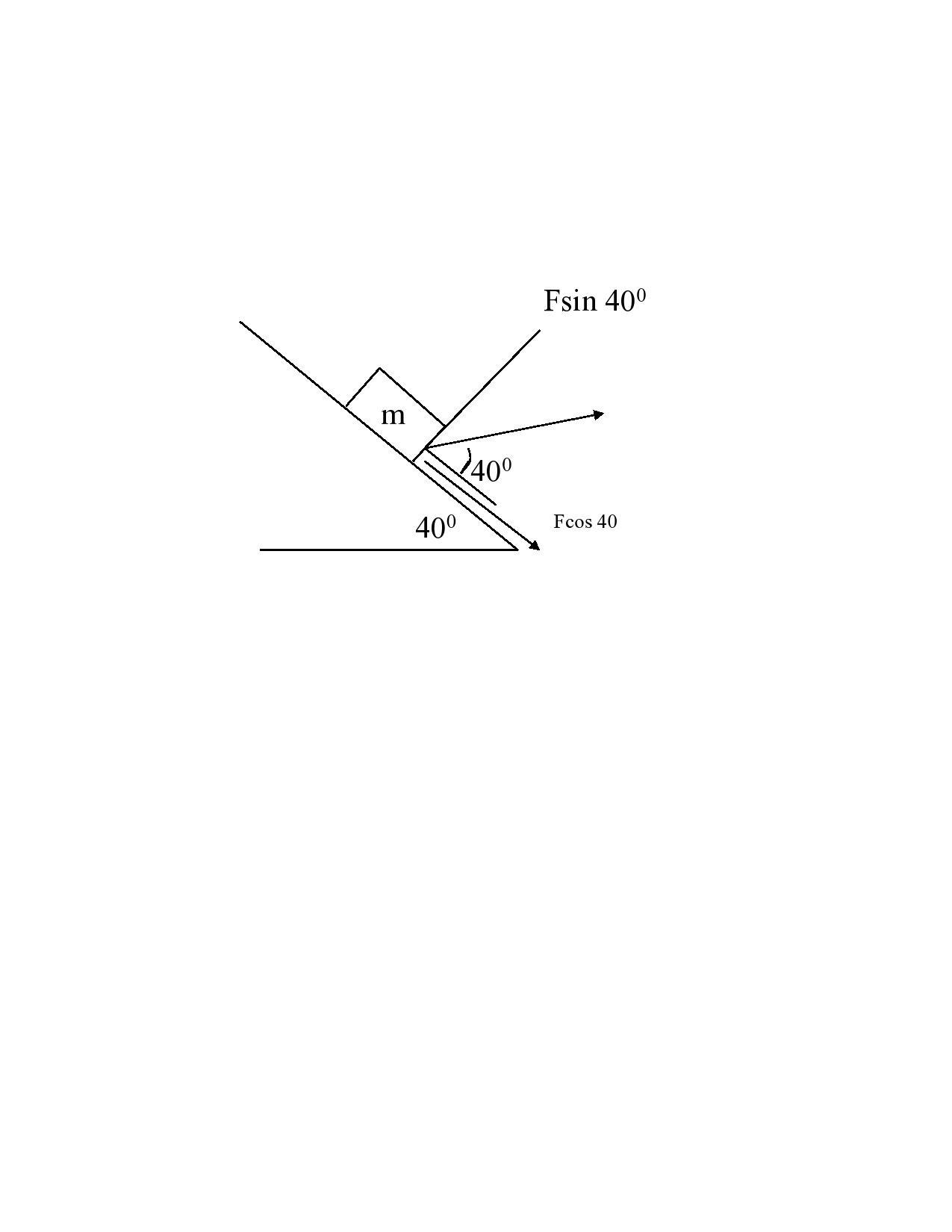
In the diagram shown below;  if we take an integral look at the component of force in the direction of the displacement; we have

F_x= Fcos 40°

F_x= 100 (cos 40°)

F_x= 76.60 N

Workdone by the friction force can now be determined as:

W = F_x × displacement

W = 76.60 × 2

W = 153.2 J

∴  the work done by the friction force = 153.2 J

7 0
2 years ago
Your roommate wants to learn about organizational chart. You can tell her that these charts can tell you all of these about an o
mars1129 [50]

Answer:

Control mechanisms

Explanation:

Organizational chart of any company will give details of different aspects of the company such as the major sub-units of the organization with the names of team leaders for different sub-units, it can also give you the span of control and the division of work within the company. However, the chart can't show you control mechanisms of different departments.

4 0
2 years ago
In a parallel one-dimensional flow in the positive x direction, the velocity varies linearly from zero at y = 0 to 32 m/s at y =
monitta

Answer:

Ψ = 10(y^2) + c

<em><u>y = 1.067m</u></em>

Explanation:

since the flow is one dimensional in positive X direction, the only velocity component is in X, which is denoted by u

while u is a function of y

we find the u in terms of y; u varies linearly wih y

we use similiraty to find the relation

32/1.6 =<em>u/y</em>

<em><u>u = 20y</u></em>

<em><u>Ψ = ∫20ydy</u></em>

<em><u>Ψ = 10(y^2) + c</u></em>

<em><u>(b)</u></em>

<em><u>the flow is half below y = 1.6*(2/3)=1.067 m</u></em>

<em><u>this is because at two third of the height of a triangle lies the centroid of triangle. since the velocity profile forms a right angled triangle , its height is 1.6 m . the flow is halved at y = 1.067m</u></em>

3 0
2 years ago
Consider a normal shock wave in air. The upstream conditions are given by M1=3, p1 = 1 atm, and r1 = 1.23 kg/m3. Calculate the d
mart [117]

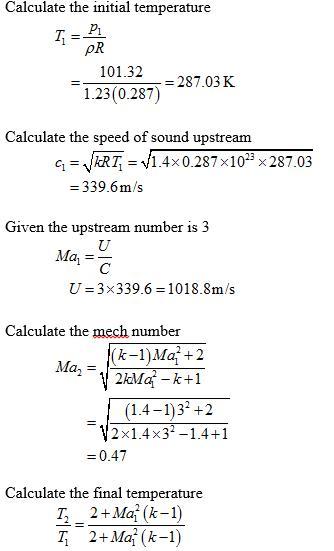
Answer and Explanation:

The answer is attached below

7 0
2 years ago
6.28 A six-lane freeway (three lanes in each direction) in rolling terrain has 10-ft lanes and obstructions 4 ft from the right
dimulka [17.4K]

Answer:

Assume Base free flow speed (BFFS) = 70 mph

Lane width = 10 ft

Reduction in speed corresponding to lane width, fLW = 6.6 mph

Lateral Clearance = 4 ft

Reduction in speed corresponding to lateral clearance, fLC = 0.8 mph

Interchanges/Ramps = 9/ 6 miles = 1.5 /mile

Reduction in speed corresponding to Interchanges/ramps, fID = 5 mph

No. of lanes = 3

Reduction in speed corresponding to number of lanes, fN = 3 mph

Free Flow Speed (FFS) = BFFS – fLW – fLC – fN – fID = 70 – 6.6 – 0.8 – 3 – 5 = 54.6 mph

Peak Flow, V = 2000 veh/hr

Peak 15-min flow = 600 veh

Peak-hour factor = 2000/ (4*600) = 0.83

Trucks and Buses = 12 %

RVs = 6 %

Rolling Terrain

fHV = 1/ (1 + 0.12 (2.5-1) + 0.06 (2.0-1)) = 1/1.24 = 0.806

fP = 1.0

Peak Flow Rate, Vp = V / (PHV*n*fHV*fP) = 2000/ (0.83*3*0.806*1.0) = 996.54 ~ 997 veh/hr/ln

Vp < (3400 – 30 FFS)

S = FFS

S = 54.6 mph

Density = Vp/S = (997) / (54.6) = 18.26 veh/mi/ln

7 0
2 years ago
Other questions:
  • generally compound curves are not filtered recommended for A. Road B. water way C. underground road D. rail way​
    12·1 answer
  • A 1020 CD steel shaft is to transmit 15 kW while rotating at 1750 rpm. Determine the minimum diameter for the shaft to provide a
    10·1 answer
  • The rigid bar CDE is attached to a pin support at E and rests on the 30 mm diameter brass cylinder BD. A 22 mm diameter steel ro
    8·1 answer
  • Technician A says that the most efficient method of EVAP system leak detection is introducing smoke under low pressure from a ma
    7·1 answer
  • A heat recovery device involves transferring energy from the hot flue gases passing through an annular region to pressurized wat
    6·1 answer
  • A pair of spur gears with 20 degree pressure angle, full-depth, involute teeth transmits 65 hp. The pinion is mounted on a shaft
    5·1 answer
  • The velocity distribution for laminar flow between parallel plates is given by u umax = 1 − ( 2y h ) 2 Where h is the distance s
    15·1 answer
  • Determine the design angle ϕ (0∘≤ϕ≤90 ∘) between struts AB and AC so that the 400 lb horizontal force has a component of 600 lb
    10·1 answer
  • 140-character statement that completes this sentence: I pledge to not text and drive because...
    12·1 answer
  • Why is data driven analytics of interest to companies?
    9·1 answer
Add answer
Login
Not registered? Fast signup
Signup
Login Signup
Ask question!