answer.
Ask question
Login Signup
Ask question
All categories
  • English
  • Mathematics
  • Social Studies
  • Business
  • History
  • Health
  • Geography
  • Biology
  • Physics
  • Chemistry
  • Computers and Technology
  • Arts
  • World Languages
  • Spanish
  • French
  • German
  • Advanced Placement (AP)
  • SAT
  • Medicine
  • Law
  • Engineering
NARA [144]
2 years ago
11

A thermocouple element when taken from a liquid at 50°C and plunged into a liquid at 100° C at time t = 0 gave the following e.m

.f. values. Determine the 95% response time. Use linear interpolation inside the intervals
Engineering
1 answer:
Xelga [282]2 years ago
3 0

Answer:

t(@95%) = 75 s

Explanation:

Given:

Time (s)         0          20           40           60            80            100            120

emf  (mV)     2.5        3.8          4.5          4.8           4.9             5.0            5.0

Find:

95 % response time t?

Solution:

To formulate the 95% response time t we need to compute the 95% emf value:

                             emf = emf_o + 0.95*(emf_ss - emf_o)

where,

                              emf_o = 2.5 mV and emf_ss = 5.0 V

                              emf = 2.5 + 0.95*(5.0 - 2.5)

                              emf = 4.875 mV @ 95%

We can see that the 95% response lies in the range of 60 s < t < 80. To determine the time for this response we use interpolation for the above interval:

                              t = m*emf + C          (linear interpolation)

where,

                              m:slope and C: t intercept are constants

                              m = ( 80 - 60 ) / (4.9 - 4.8 ) = 200

                              C = 80 - 200*4.9 = -900 s

                              t(4.875) = 200*4.875 - 900

                               t(@95%) = 75 s

Answer: The time taken to reach 95% of the response is t = 75 s.

You might be interested in
A shaft consisting of a steel tube of 50-mm outer diameter is to transmit 100 kW of power while rotating at a frequency of 34 Hz
nikitadnepr [17]

Answer:

25 - \sqrt[4]{26.66*10^{-8} }  mm

Explanation:

Given data

steel tube : outer diameter = 50-mm

power transmitted = 100 KW

frequency(f) = 34 Hz

shearing stress ≤ 60 MPa

Determine tube thickness

firstly we calculate the ; power, angular velocity and torque of the tube

power = T(torque) * w (angular velocity)

angular velocity ( w ) = 2\pif = 2 * \pi * 34 = 213.71

Torque (T) = power / angular velocity = 100000 / 213.71 = 467.92 N.m/s

next we calculate the inner diameter  using the relation

  \frac{J}{c_{2}  } = \frac{T}{t_{max} }  = 467.92 / (60 * 10^6) =  7.8 * 10^-6 m^3

also

c2 = (50/2) = 25 mm

\frac{J}{c_{2} } = \frac{\pi }{2c_{2} } ( c^{4} _{2} - c^{4} _{1} ) =  \frac{\pi }{0.050} [ ( 0.025^{4} - c^{4} _{1}  ) ]

therefore; 0.025^4 - c^{4} _{1} = 0.050 / \pi (7.8 *10^-6)

c^{4} _{1} = 39.06 * 10 ^-8 - ( 1.59*10^-2 * 7.8*10^-6)

    39.06 * 10^-8 - 12.402 * 10^-8 =26.66 *10^-8

c_{1} = \sqrt[4]{26.66 * 10^{-8} }  =

THE TUBE THICKNESS

c_{2} - c_{1} = 25 - \sqrt[4]{26.66*10^{-8} }  mm

4 0
2 years ago
An electrical utility delivers 6.25E10 kWh of power to its customers in a year. What is the average power required during the ye
Sindrei [870]

Answer:

The overall Utility delivered to customers in a year 'U' = 6.25 X 10¹⁰Kwh

However, the average power P, required for a year, t  = ? Kw

Expressing their relationship, we will have

             U = P x t

Given t = 1 year = 24 x 365 hours (assume a year operation is 365 days)

          t = 8760 hours

P = \frac{62500000000}{8760}

P = 7134.7Kw

Hence, the average power required during the year is 7,135Kw

Now to calculate the energy used by the power plant in a year (in quads)?

Recall, Efficiency, η = Power Output/Power Input (100)

so, we have

η = P₀/P₁, given

0.45 = \frac{7134.7Kw}{P₁}

P₁ = 15,855Kw

the total energy E₁ used in a year = 15,855x24x365 = 138.89MJoules

So to convert this to quads, Note;

1 quads of energy = 10¹⁵ Joules

The total energy used is 0.000000139 quads

Now to find the cubic feet of natural gas required to generate this power?

Note: 0.29Kwh of Power generated  = 1 cubic feet of natural gas used

Since, the power plant generated = 62500000000Kwh

The cubic feet of natural gas used = \frac{62500000000}{0.29}

Hence, 2.155x10²⁰cubic feet of N.gas was used to generate this much power.

8 0
2 years ago
A 60-kg woman holds a 9-kg package as she stands within an elevator which briefly accelerates upward at a rate of g/4. Determine
Anuta_ua [19.1K]

Answer:

force R = 846.11 N

lifting force L = 110.36 N

if cable fail complete both R and L will be zero

Explanation:

given data

mass woman mw = 60 kg

mass package mp = 9 kg

accelerates rate a = g/4

to find out

force R and lifting force L and if cable fail than what values would R and L acquire

solution

we calculate here first reaction R force

we know elevator which accelerates upward

so now by direction of motion , balance the force that is express as

R - ( mw + mp ) × g = ( mw + mp ) × a

here put all these value and a = g/4 and use g = 9.81 m/s²

R - ( 60 + 9 ) × 9.81 = ( 60 + 9  ) × g/4

R = ( 69  ) × 9.81/4  + ( 69 ) 9.81

R = 69  ( 9.81 + 2.4525 )

force R = 846.11 N

and

lifting force is express as here

lifting force = mp ( g + a)

put here value

lifting force = 9 ( 9.81 + 9.81/4)

lifting force L = 110.36 N

and

we know if cable completely fail than body move free fall and experience no force

so both R and L will be zero

5 0
2 years ago
Your task is to fill in the missing parts of the C code to get a program equivalent to the generated assembly code. Recall that
Rudik [331]

Answer:

See Explaination

Explanation:

//Function

long loop (long x, long n)

{

//Declare a variable named result and initialize it to zero

long result = 0;

//Declare a variable named mask

long mask;

//For loop

for(mask = 1; mask != 0; mask = mask << (n & 0xFF))

{

//Calculate

result | = (x&mask);

}

//Return result

return result;

}

6 0
2 years ago
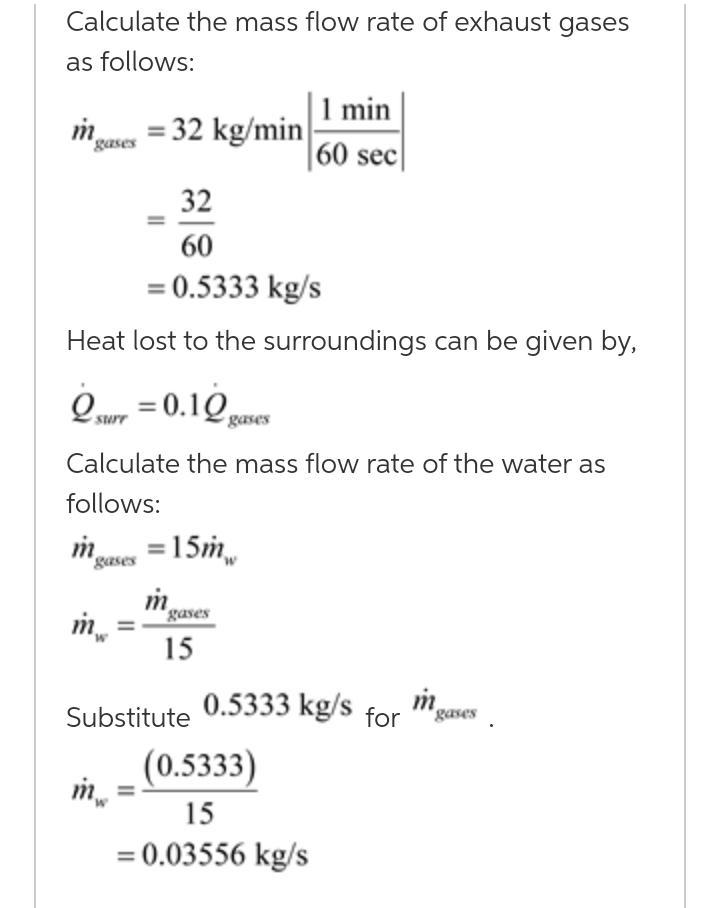
Hot exhaust gases of an internal combustion engine are to be used to produce saturated water vapor at 2 MPa pressure. The exhaus
Anastaziya [24]

Answer:

The flowrate of water is 0.03556kg/s

Explanation:

Exhaust gases inlet temperature T1=4000C

Water inlet temperature T3=150C Exit Pressure of water as saturated vapor P4=2MPa

Mass flow rate of exhaust gases Heat lost to the surroundings Qgases=32kg/min

Mass flow rate of exhaust gases is 15 times that of the water

Heat exchangers typically involve no work interactions (w = 0) and negligible...

7 0
2 years ago
Read 2 more answers
Other questions:
  • A 1020 CD steel shaft is to transmit 15 kW while rotating at 1750 rpm. Determine the minimum diameter for the shaft to provide a
    10·1 answer
  • a. Replacing standard incandescent lightbulbs with energy-efficient compact fluorescent lightbulbs can save a lot of energy. Cal
    9·1 answer
  • A charge of 2.0 × 10⁻¹⁰ C is to be stored on each plate of a parallel-plate capacitor having an area of 650 mm2 (1.0 in.2 ) and
    14·1 answer
  • Plastic parts produced by an injection-molding operation are checked for conformance to specifications. Each tool contains 11 ca
    12·1 answer
  • Water is to be withdrawn from an 8-m-high water reservoir by drilling a 2.2-cm-diameter hole at the bottom surface. Disregarding
    12·2 answers
  • Python Homework
    12·1 answer
  • Which of the following describes boundaries?
    10·1 answer
  • Consider a steady developing laminar flow of water in a constant-diameter horizontal discharge pipe attached to a tank. The flui
    14·1 answer
  • What should always be done before beginning any diagnosis?
    9·1 answer
  • 1. A _____ is applied to a wall or roof rafters to add strength and keep the building straight and plumb.
    9·1 answer
Add answer
Login
Not registered? Fast signup
Signup
Login Signup
Ask question!