answer.
Ask question
Login Signup
Ask question
All categories
  • English
  • Mathematics
  • Social Studies
  • Business
  • History
  • Health
  • Geography
  • Biology
  • Physics
  • Chemistry
  • Computers and Technology
  • Arts
  • World Languages
  • Spanish
  • French
  • German
  • Advanced Placement (AP)
  • SAT
  • Medicine
  • Law
  • Engineering
White raven [17]
2 years ago
4

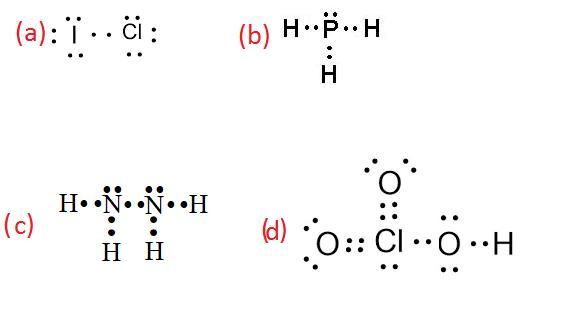
Draw Lewis structures for the following molecules. Be sure to minimize formal charges. (Click in the "draw structure" button to

launch the drawing utility.) (a) ICl (b) PH3 draw structure ... draw structure ... (c) N2H4 (d) HClO3 draw structure ... draw structure ...

Chemistry
1 answer:
zmey [24]2 years ago
7 0

Answer :  The Lewis structures for the following molecules is shown below.

Explanation :

Lewis-dot structure : It shows the bonding between the atoms of a molecule and it also shows the unpaired electrons present in the molecule.

In the Lewis-dot structure the valance electrons are shown by 'dot'.

The representation of valence electrons of an atom by dots around the symbol of an element is said to be the Lewis-dot symbol.

In the representation of Lewis-symbol, one electron dot must put on each side of the element symbol then paired the electrons.

(a) The given molecule is, ICl

As we know that iodine and chlorine has '7' valence electrons.

Therefore, the total number of valence electrons in ICl = 7 + 7 = 14

According to Lewis-dot structure, there are 2 number of bonding electrons and 12 number of non-bonding electrons.

(b) The given molecule is, PH_3

As we know that hydrogen has '1' valence electron and phosphorous has '5' valence electrons.

Therefore, the total number of valence electrons in PH_3 = 5 + 3(1) = 8

According to Lewis-dot structure, there are 6 number of bonding electrons and 2 number of non-bonding electrons.

(c) The given molecule is, N_2H_4

As we know that hydrogen has '1' valence electron and nitrogen has '5' valence electrons.

Therefore, the total number of valence electrons in N_2H_4 = 2(5) + 4(1) = 14

According to Lewis-dot structure, there are 10 number of bonding electrons and 4 number of non-bonding electrons.

(d) The given molecule is, HClO_3

As we know that hydrogen has '1' valence electron, oxygen has '6' valence electrons  and chlorine has '7' valence electrons.

Therefore, the total number of valence electrons in HClO_3 = 1 + 7 + 3(6) = 26

According to Lewis-dot structure, there are 12 number of bonding electrons and 14 number of non-bonding electrons.

Hence, the Lewis structures for the following molecules is shown below.

You might be interested in
Which of the following are examples of plasma?
artcher [175]
The answers are "t<span>ails of comets, the ionosphere, and a neon sign." or options A, D, and E. Tails of comments are mainly made of plasma. Ice cubes are examples of a solid. A gas fire key word gas is example of a gas. The ionosphere is also mainly made of plasma. A neon sign uses plasma in order to work. A flashlight uses a light bulb which isn't a example of plasma therefore  thats a no.

Hope this helps!
</span>
4 0
2 years ago
Read 2 more answers
Which part of experimental design is most important to a scientist when replicating an experiment? Having exactly the same data
yarga [219]

Answer:

The answer to your question is below:

Explanation:

Having exactly the same data as the previous experiment I think that having the same data as the previous experiment is extremely important but not the most important, for me is the second most important.

Using the same procedure and variables as the previous experiment For me, this is the most importan thing when a scientist is designing an experiment, because if he or she follow exactly the same procedure and variables, then the results will be very close.

Conducting an experiment similar to the previous experiment  This characteristic is important but not the most important.

Using the same laboratory that was used in the previous experiment It is not important the laboratory, if the procedure and variables are the same, your experiment must give the same results in whatever laboratory.

5 0
2 years ago
Read 2 more answers
Fluorine gas is placed in contact with calcium metal at high temperatures to produce calcium fluoride powder. What is the formul
Mars2501 [29]

Answer:

Upper F subscript 2 (g) plus upper C a (s) right arrow with delta above upper C a upper F subscript 2 (s).

Explanation:

This is a chemical reaction problem.

In expressing any chemical reaction, we need to understand that there are reactants and products.

  • The reactants are the species on the left hand side that are combining.
  • The products are the species on the right hand side that are formed.
  • Every chemical reaction is obeys the law of conservation of matter i.e equal number of matter on both sides.

Using the statement of this problem, we can deduce that;

 Reactants are Fluorine gas and Calcium metal

  Product is Calcium Fluoride

Note: A metal is a solid(s) and powder is a solid(s). A gas is denoted as (g). They depict the state of the species reacting.

                    F₂_{(g)}     +    Ca_{(s)}               →           CaF₂_{(s)}

We can see that equal number of atoms are on both sides of the expression.

7 0
2 years ago
Read 2 more answers
When 24 mol of methanol and 15 mol of oxygen combine in the combustion reaction, 2 ch3oh(
umka21 [38]
The balanced equation for combustion is as follows;
2CH₃OH + 3O₂ ---> 2CO₂ + 4H₂O
The stoichiometry of CH₃OH to O₂ is 2:3
the limiting reagent is the reactant that is fully consumed during the reaction. The amount of product formed is directly proportional to the amount of limiting reactant produced. The excess reagent is the reactant that is provided in excess and is not fully used up, there will be an amount of this reagent remaining after the reaction.
If methanol is the limiting reactant,
If 2 mol of methanol reacts with 3 moles of O₂
Then 24 mol of methanol reacts with - 3/2 x 24 = 36 mol of O₂ should be present
But only 15 mol of O₂ is present, therefore O₂ is the limiting reactant and methanol is in excess.
3 mol of O₂ reacts with 2 mol of CH₃OH 
then 15 mol of O₂ reacts with 2/3 x 15 = 10 mol of CH₃OH

Excess reactant is methanol, 10 mol are used up therefore 24 - 10 mol = 14 mol are remaining at the end of the reaction 
8 0
2 years ago
You have two compounds that you have spotted on the TLC plate. One compound is more polar than the other. You ran the TLC plate
goldenfox [79]

Answer:

we will except an increase in the polarity of the system and this will cause the Non-polar spot to be near the solvent front, while the polar spot will run at an approximate speed of 0.5 Rf

Explanation:

when we run a TLC plate in a 50/50 mixture of hexanes and ethyl acetate we will except an increase in the polarity of the system and this will cause the Non-polar spot to be near the solvent front, while the polar spot will run at an approximate speed of 0.5 Rf

The speed of the polar spot depends largely on the level of polarity, an increase in the polarity will see both spots of Neat hexane run when we run a TLC  plate in a 50/50 mixture of hexanes and ethyl acetate

3 0
2 years ago
Other questions:
  • Which best describes the motion of pentane molecules in liquid phase?
    8·1 answer
  • In this experiment, 0.170 g of caffeine is dissolved in 10.0 ml of water. the caffeine is extracted from the aqueous solution th
    12·1 answer
  • What fact do scientists believe provides evidence for the big bang theory?a. all comets follow elliptical orbits.b. most extra-s
    10·2 answers
  • Calculate the cell potential E at 25°C for the reaction 2 Al(s) + 3 Fe2+(aq) → 2 Al3+(aq) + 3 Fe(s) given that [Fe 2+] = 0.020 M
    10·1 answer
  • What is the ph of the solution prepared by dissolving 0.927 mol hcl in enough water to make a 150 l aqueous solution?
    11·1 answer
  • Calculate the amount, in moles, of PO43- present at equilibrium when excess Sr3(PO4)2 is added to 750. mL 1.2 M Sr(NO3)2(aq). As
    13·1 answer
  • How many liters of 3.0 M NaOH solution will react with 2.4 mol H2SO4? (Remember to balance the equation.)
    12·1 answer
  • From left, an orange H, then 1 black dot above 1 orange dot, then a black O with 2 black dots both above and below, then 1 black
    5·2 answers
  • A big bully is having a tug-of-war with a small child. There is a ball attached to the middle of the rope.
    11·1 answer
  • Amino acids are the building blocks of proteins. The simplest amino acid is glycine (H2NCH2COOH). Draw a Lewis structure for gly
    9·1 answer
Add answer
Login
Not registered? Fast signup
Signup
Login Signup
Ask question!