answer.
Ask question
Login Signup
Ask question
All categories
  • English
  • Mathematics
  • Social Studies
  • Business
  • History
  • Health
  • Geography
  • Biology
  • Physics
  • Chemistry
  • Computers and Technology
  • Arts
  • World Languages
  • Spanish
  • French
  • German
  • Advanced Placement (AP)
  • SAT
  • Medicine
  • Law
  • Engineering
quester [9]
2 years ago
7

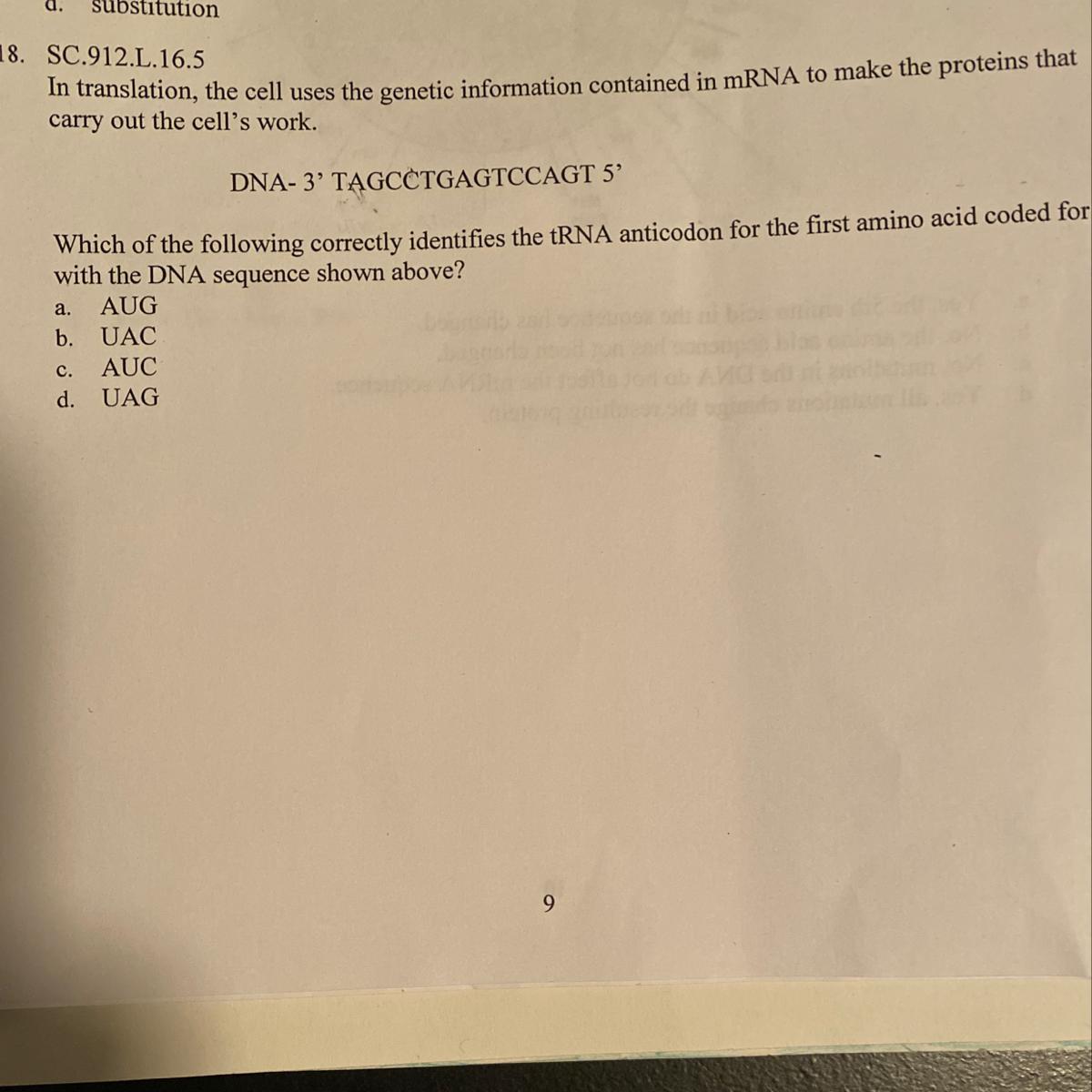
In translation, the cell uses the genetic information contained in mRNA to make the proteins that carry out the cell's work.

Biology
1 answer:
stellarik [79]2 years ago
5 0

Answer:

The correct option is d) UAG

Explanation:

Central dogma can be described as the process in which the transcription and translation occurs. The process by which mRNA is made from the DNA is called transcription and the process by which proteins are made by mRNA is called translation.

The first codon present on the DNA is TAG. The mRNA formed from this codon will be AUC. When this mRNA will travel from the nucleus to the cytoplam, the tRNA will bring the anticodons UAG for the first mRNA codon. Hence, the correct option is D.

You might be interested in
This is an onion root tip at low power (100x). The cells are too small to distinguish individual phases. What phase do most of t
Marysya12 [62]

Answer:

Interphase

Explanation:

The phase in which most of the cells appear to be in is interphase.

This is so because cell's life is spent more in interphase and in this phase growth of cells and at the end their replication takes place. So cells get more time in interphase to grow and replicate, which makes more cells to appear to be in.

Hence, the correct answer is "Interphase".

5 0
1 year ago
Plants use carbohydrates to build things such as cellulose. How do plants acquire these building blocks to build mass?
Liula [17]
<span>In order to obtain the building blocks for larger carbohydrates, such as cellulose and starch, plants rely on photosynthesis to produce a smaller carbohydrate, glucose. During the process of photosynthesis, atmospheric carbon dioxide and water are combined in the presence of light to produce glucose and oxygen. This glucose is then polyemerized in order to create larger, more complex carbohydrates such as cellulose.</span>
4 0
2 years ago
Read 2 more answers
When a bacterial cell is present in an environment where both lactose and glucose are present, the glucose will be metabolized f
Umnica [9.8K]

Answer:

Option (A).

Explanation:

Lac operon system in bacteria explains the lactose metabolism in the cell. The first operon system was discovered by Jacob and Monod. Operon may be defined as the cluster of genes that are transcribed as a single RNA unit.

The bacteria uses glucose if glucose and lactose are present in the media. The bacterial cell can recognize the glucose presence as CAP-cAMP complex are required for the process of transcription and the complex level is low in the presence of glucose. This way bacteria turns off transcription for lactose genes even when the lactose is present.

Thus, the correct answer is option (A).

4 0
2 years ago
What are the benefits and drawbacks to using solar, geothermal, and wind power as alternative sources of energy
Damm [24]
The benefits are that you don't have to rely on limited resources and you won't be contribution to global warming but the drawbacks are that you have to find a way to make it run by itself and deal with it not working sometimes.
5 0
2 years ago
Read 2 more answers
Of the following items listed below, which is the best description for why skeletal muscle stores glycogen? Of the following ite
mars1129 [50]

Answer:

Skeletal muscle stores glycogen because it is a heavy consumer of energy.

Explanation:

Skeletal fiber contractions are based on different physiological and biochemical phenomena that happen in every cell and that need an amount of energy to occur. During muscle contraction, <em>myosin binds to the uncovered actin-binding sites, producing littles power strokes that, continuously, lead to muscle contraction</em>. To make this process possible, the muscle needs energy.  

Glycogen is a very important energetic reserve polysaccharide for animals. It is stored in the liver and muscles, and when the organism needs energy it degrades glycogen into glucose, which is an available form for the metabolism.  In the liver,<em> glycogen</em> is used to maintain constant levels of <em>blood glucose</em>. While in muscles, glycogen plays an important role in the glucose storage as a source of energy, needed and used only for contraction.

During muscle contraction, ATP molecules obtained from glucose are split to ADP and inorganic phosphate.
3 0
2 years ago
Other questions:
  • Which of the following is a feature of exocytosis but not endocytosis?
    13·1 answer
  • Which body parts don’t fossilize because animals tend to consume them?
    8·2 answers
  • Drag each tile to the correct box. The flu vaccine activates adaptive immunity. How does this occur? Antibodies are quickly prod
    5·2 answers
  • Producers, like this plant, take in oxygen and release carbon dioxide during __________________ , just like animals and other li
    10·1 answer
  • Which of the following gases , released by ruminant animals and termites as a waste product of digestion , can add to global war
    7·1 answer
  • Dayton's pupils are dilated and his heart is pounding immediately after he gets terrified by a large groundhog running across hi
    5·1 answer
  • During the transmission of signals across a neuromuscular junction, which of the following happens first?
    14·2 answers
  • a student placed a stack of rocks on a ramp. she added clumps of soil rooted with live grass. using a garden hose, she then appl
    5·1 answer
  • Which part of Earth most likely has the highest albedo value?
    7·2 answers
  • Some chefs sometimes wrap meat in papaya leaves and the meat is marinated for five hours before it is cooked. What is the purpos
    11·1 answer
Add answer
Login
Not registered? Fast signup
Signup
Login Signup
Ask question!
