answer.
Ask question
Login Signup
Ask question
All categories
  • English
  • Mathematics
  • Social Studies
  • Business
  • History
  • Health
  • Geography
  • Biology
  • Physics
  • Chemistry
  • Computers and Technology
  • Arts
  • World Languages
  • Spanish
  • French
  • German
  • Advanced Placement (AP)
  • SAT
  • Medicine
  • Law
  • Engineering
kolbaska11 [484]
2 years ago
14

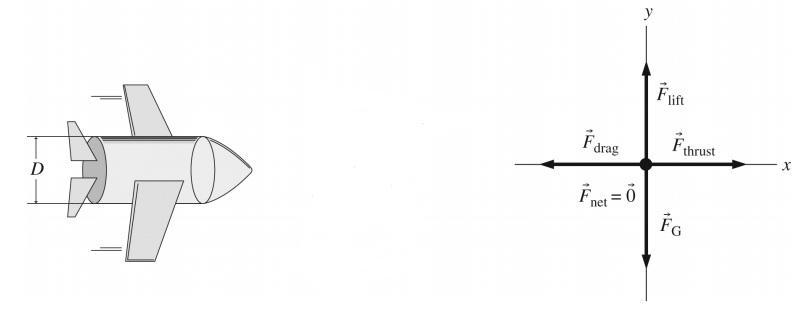
A medium-sized jet has a 3.8-m-diameter fuselage and a loaded mass of 85,000 kg. The drag on an airplane is primarily due to the

cylindrical fuselage, and aerodynamic shaping gives it a drag coefficient of 0.37. How much thrust must the jet’s engines provide to cruise at 230 m/s at an altitude where the air density is 1.0 kg/m3?

Engineering
1 answer:
Monica [59]2 years ago
7 0

Answer:

Fthrust = 110.99 kN

Explanation:

Model:

Ignore the drag on the wings and focus on the cylindrical fuselage.

Visualize:

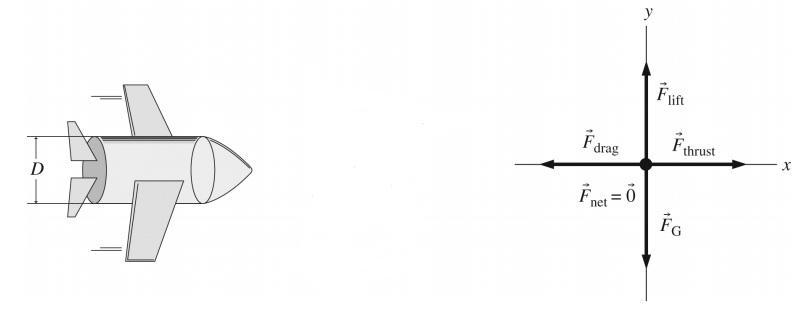
The net force is zero as the jet cruises at 230 m/s, so the thrust must be equal in magnitude to the drag. The  gravitational and lift forces are equal in magnitude and opposite in direction.

Given

D = 3.80 m  ⇒ R = D / 2 = 3.80 m/ 2 = 1.90 m

C = 0.37

ρ = 1.0 kg/m³

v = 230 m/s

m = 85,000 kg

Fthrust = ?

We show the Free Body Diagram in the pic.

Then, we apply

∑Fx = 0  (→+)

Fthrust = Fdrag = (1/2)*C*ρ*A*v²

A = π*R² = π*(1.90 m)² = 11.34 m²

⇒  Fthrust = (1/2)*(0.37)*(1.0 kg/m³)*(11.34 m²)*(230 m/s)²

⇒  Fthrust = 110990.159 N = 110.99 kN

You might be interested in
An 80-L vessel contains 4 kg of refrigerant-134a at a pressure of 160kPa. Determine (a) the temperature, (b) the quality, (c) th
makvit [3.9K]

Answer:

temperature -15.6 C, quality x=0.646, enthalpy h=667.20 KJ, volume of vapor phase Vg= 79.8 L

Explanation:

property table for R-134a

https://www.ohio.edu/mechanical/thermo/property_tables/R134a/R134a_PresSat.html

at 160 KPa , temperature = -15.66 C

quality x=mass of vapour/ total mass of liq-vap mixture

alternaternately: x=(v-vf)/(vg-vf)    

v=total volume i.e. volume of container"80L"   80L=0.08 cubic meter

vf=vol of liquid phase  vg=vol of vapor phase vf, vg values at 160Kpa

x=(0.08-0.0007437)/(0.1235-0.0007437)=0.646

enthalpy

h=hf+xhfg          hf, hfg values at 160Kpa

h=hf+xhfg=31.2+0.646(209.9)=166.80 KJ/Kg

for 4Kg R-134a h=m(166.80 KJ/Kg )=667.20 KJ

volume of vapor phase

vg at 160Kpa=0.1235 cubic meter for quality=1.

in this case quality=0.646 , so it will occupy 64.6% space of the vapor phase at quality=1.

vol. of vapor phase=0.646*0.1235=0.0798 cubic meter=79.8 L
7 0
2 years ago
Identify an object in your house that contains a physical system and list three questions you could use to define the system
jonny [76]

Answer:

ALL CAREFULLY ANSWERED CORRECTLY

Explanation:

1) A loaf of Bread PHYSICAL SYSTEM

✓ How can the environment affect the edibility of the bread

✓ What are the constituents that makes up the bread

✓ What process is involved in these constituents mixing to form the loaf.

2) The law of thermodynamics makes us to understand that when heat/energy passes through a system, the systems internal energy changes with respect to the conservation of energy law. That is energy lost = energy gained. Typically, ice would melt in a cup of hot tea because of the thermal energy in the molecules of the hot tea. When you heat a material, you are adding thermal kinetic energy to its molecules and usually raising its temperature. The temperature of the ice raises due to the kinetic energy added to it and it melts to water.

3) The theory of systems view the world as a complex system of interconnected parts. If we consider the society; (financial systems, political systems, etc) we will agree that they individually have their own components and it's the summation of this components that makes the system, this implies that system thinking could be applicable in this kinda of systems as long as they are made up of components.

4) Technology has boosted every sector of our lives and it has the capacity to do more. Restricting it's importance to entertainment alone would be an underusing of its potentials. Engineering students infact should not need any drive to be encouraged about maximizing all it can do in shaping our world.

5) ~ Nature shows its splendid soul

~Never ceases to leave us in amazement

~And we are in love

4 0
2 years ago
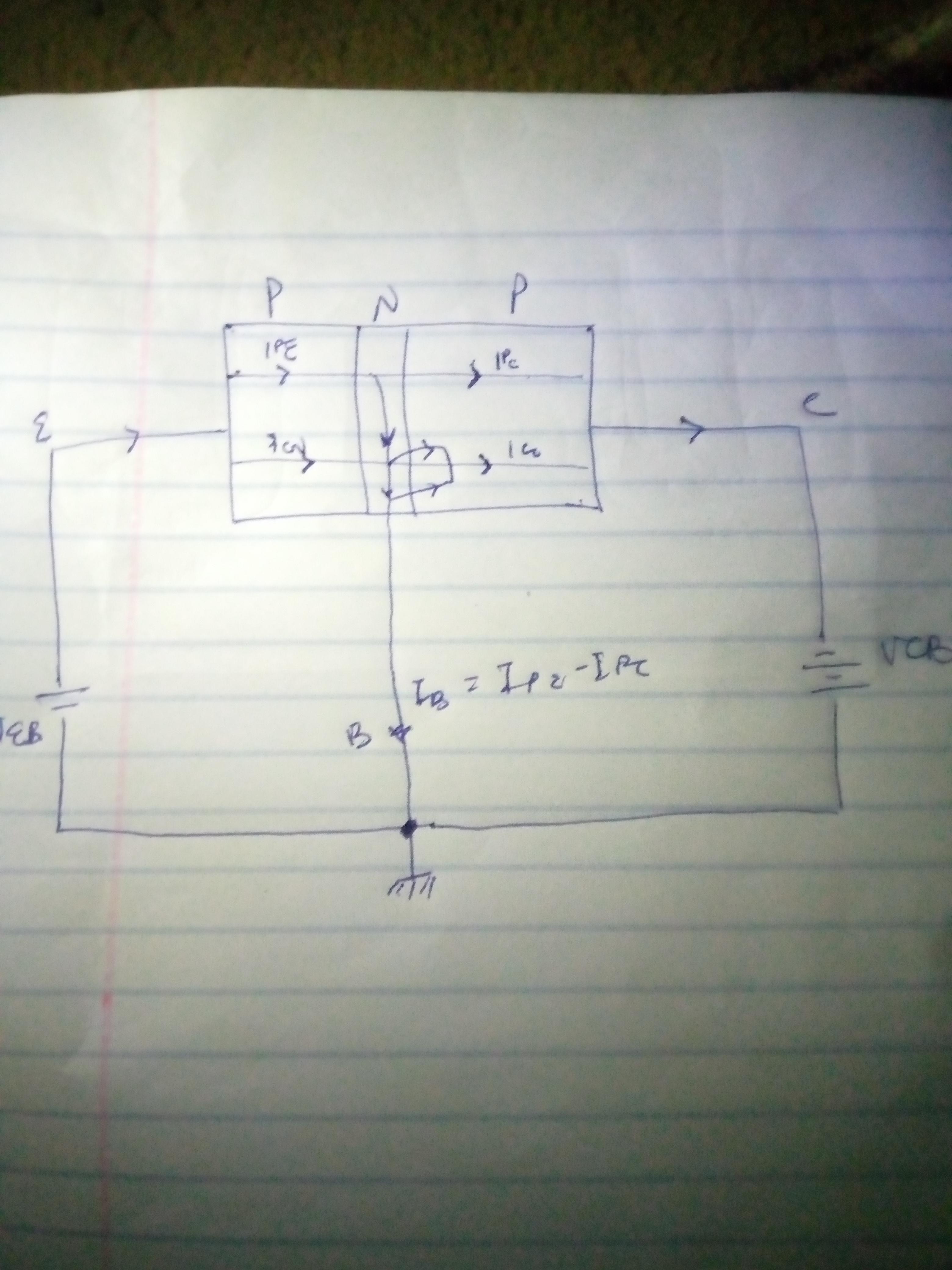
For a p-n-p BJT with NE 7 NB 7 NC, show the dominant current components, with proper arrows, for directions in the normal active
Sonja [21]

Answer:

=> base transport factor = 0.98.

=> emitter injection efficiency = 0.99.

=> common-base current gain = 0.97.

=> common-emitter current gain = 32.34.

=> ICBO = 1 × 10^-6 A.

=> base transit time = 0.325.

=> lifetime = 1.875.

Explanation:

(Kindly check the attachment for the diagram showing the dominant current components, with proper arrows, for directions in the normal active mode).

The following parameters or data are given for a p-n-p BJT with NE 7 NB 7 NC and they are: IEp = 10 mA, IEn = 100 mA, ICp = 9.8 mA, and ICn = 1 mA.

(1). The base transport factor = ICp/IEp=9.8/10 =  0.98.

(2). emitter injection efficiency =IEp/ IEp + ICn = 10/10 + 0.1 =  0.99.

(3).common-base current gain = 0.98 × 0.99 = 0.9702.

(4).common-emitter current gain =0.97 / 1- 0.97  = 32.34.

(5). Icbo = Ico = 1 × 10^-6 A.

(6). base transit time = 1248 × 10^-2 × (1.38× 10^-23/1.603 × 10^-19). = 0.325.

(7).lifetime;

= > 2 = √0.325 + √ lifetime.

= Lifetime = 2.875.

6 0
2 years ago
Derive the probability that a receptor is occupied by a ligand using a model that treats the L ligands in solution as distinguis
love history [14]

that is the same thing as you are not going through this week or something

7 0
2 years ago
The force exerted on a bridge pier in a river is to be tested in a 1:10 scale model using water as the working fluid. In the pro
Len [333]

Answer:

Force on the prototype is 5000 N

Solution:

As per the question:

Depth of water, x = 2.0 m

Flow velocity, v' = 1.5 m/s

Width of the river, w = 20 m

Force on the bridge pier model, F' = 5 N

Pressure, Ratio = Ratio of scale length

Scale = 1:10

Now,

\frac{P'}{P} = \frac{x}{w} = \frac{2.0}{20}

where

P' = pressure on model

P = pressure on prototype

\frac{\frac{F'}{A'}}{\frac{F}{A}} = \frac{1}{10}

where

F' = Force on model

F = Force on prototype

A' = Area of model

A = Area of prototype

Now:

\frac{F'}{F}.\frac{A}{A'} = \frac{1}{10}

\frac{5}{F}.\frac{1}{\frac{1}{10}}.\frac{1}{\frac{1}{10}} = \frac{1}{10}

F = 5000 N

3 0
2 years ago
Other questions:
  • Water at 400 kPa with a quality of 75% has its pressure raised 200 kPa (to 600 kPa) in a constant volume process. What is the ne
    15·1 answer
  • When should you exercise extreme caution around power lines?
    6·1 answer
  • Pipe (2) is supported by a pin at bracket C and by tie rod (1). The structure supports a load P at pin B. Tie rod (1) has a diam
    15·1 answer
  • Carbon dioxide gas enters a pipe at 3 MPa and 500 K at a rate of 2 kg/s. CO2 is cooled at constant pressure as it flows in the p
    10·1 answer
  • You are an electrician on the job. The electrical blueprint shows that eight 500-W lamps are to be installed on the same circuit
    11·1 answer
  • In this module you learned about searching, sorting and algorithms in C++ and how to implement these elements in your C++ progra
    6·1 answer
  • 10. A maker of micromechanical systems can reduce product recalls by 10% with the installation of new packaging equipment. If th
    9·1 answer
  • Explain why failure of this garden hose occurred near its end and why the tear occurred along its length. Use numerical values t
    12·1 answer
  • What action below would tell your computer to "Send" an email?
    14·2 answers
  • Why is data driven analytics of interest to companies?
    9·1 answer
Add answer
Login
Not registered? Fast signup
Signup
Login Signup
Ask question!