answer.
Ask question
Login Signup
Ask question
All categories
  • English
  • Mathematics
  • Social Studies
  • Business
  • History
  • Health
  • Geography
  • Biology
  • Physics
  • Chemistry
  • Computers and Technology
  • Arts
  • World Languages
  • Spanish
  • French
  • German
  • Advanced Placement (AP)
  • SAT
  • Medicine
  • Law
  • Engineering
Alenkasestr [34]
2 years ago
11

1 At a certain location, wind is blowing steadily at 10 m/s. Determine the mechanical energy of air per unit mass and the power

generation potential of a wind turbine with 70-m-diameter blades at that location. Also determine the actual electric power generation assuming an overall efficiency of 30 percent. Take the air density to be 1.25 kg/m3
Engineering
1 answer:
pashok25 [27]2 years ago
8 0

Answer:

electric power generation  = 240.52 kW

Explanation:

given data

wind is blowing steadily =  10 m/s

diameter = 70 m

overall efficiency = 30 percent

air density = 1.25 kg/m³

solution

we know Kinetic energy is the form of  mechanical energy

so wind can  be convert to work entirely

and power potential of the wind is kinetic energy

mass flow rate = \frac{mv^2}{2}   .................1

e (mechanical ) = \frac{v^2}{2}    

put here value

e (mechanical) = \frac{10^2}{2}  

e (mechanical) = 50 J/kg

and

We know the mass relation

mass m = = ρ V A    ..............2

here A is area = \frac{\pi D^2}{4}  

so mass equation will be

mass m = ρ V \frac{\pi D^2}{4}

put here value we get

mass m = (1.25 kg/ m³) ×  ( 10 m/s)  ×  \frac{\pi 70^2}{4}

mass m  = 48105.63 kg/s

so

electric power generation = m ×  e (mechanical)     .........3

electric power generation  = 48105.63  ×  0.0050 KJ/kg

electric power generation  = 240.52 kW

You might be interested in
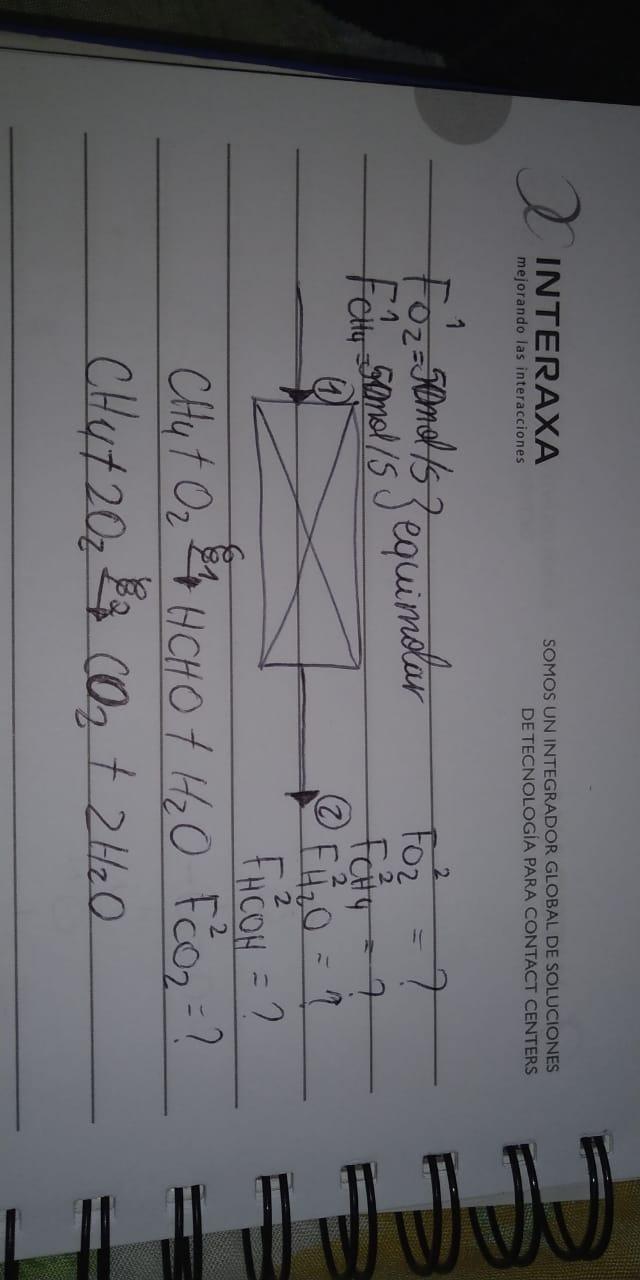
Methane and oxygen react in the presence of a catalyst to form formaldehyde. In a parallel reaction, methane is oxidized to carb
Nezavi [6.7K]

Answer:

y_{CH_4}^2=\frac{5mol/s}{100mol/s}=0.05\\y_{O_2}^2=\frac{3mol/s}{100mol/s}=0.03\\y_{H_2O}^2=\frac{47mol/s}{100mol/s}=0.47\\y_{HCHO}^2=\frac{43mol/s}{100mol/s}=0.43\\y_{CO_2}^2=\frac{2mol/s}{100mol/s}=0.02

Explanation:

Hello,

a. On the attached document, you can see a brief scheme of the process. Thus, to know the degrees of freedom, we state the following unknowns:

- \xi_1 and \xi_2: extent of the reactions (2).

- F_{O_2}^2, F_{CH_4}^2, F_{H_2O}^2, F_{HCHO}^2 and F_{CO_2}^2: Molar flows at the second stream (5).

On the other hand, we've got the following equations:

- F_{O_2}^2=50mol/s-\xi_1-2\xi_2: oxygen mole balance.

- F_{CH_4}^2=50mol/s-\xi_1-\xi_2: methane mole balance.

- F_{H_2O}^2=\xi_1+2\xi_2: water mole balance.

- F_{HCHO}^2=\xi_1: formaldehyde mole balance.

- F_{CO_2}^2=\xi_2: carbon dioxide mole balance.

Thus, the degrees of freedom are:

DF=7unknowns-5equations=2

It means that we need two additional equations or data to solve the problem.

b. Here, the two missing data are given. For the fractional conversion of methane, we define:

0.900=\frac{\xi_1+\xi_2}{50mol/s}

And for the fractional yield of formaldehyde we can set it in terms of methane as the reagents are equimolar:

0.860=\frac{F_{HCHO}^2}{50mol/s}

In such a way, one realizes that the output formaldehyde's molar flow is:

F_{HCHO}^2=0.860*50mol/s=43mol/s

Which is equal to the first reaction extent \xi_1, therefore, one computes the second one from the fractional conversion of methane as:

\xi_2=0.900*50mol/s-\xi_1\\\xi_2=0.900*50mol/s-43mol/s\\\xi_2=2mol/s

Now, one computes the rest of the output flows via:

- F_{O_2}^2=50mol/s-43mol/s-2*2mol/s=3mol/s

- F_{CH_4}^2=50mol/s-43mol/s-2mol/s=5mol/s

- F_{H_2O}^2=43mol/s+2*2mol/s=47mol/s

- F_{HCHO}^2=43mol/s

- F_{CO_2}^2=2mol/s

The total output molar flow is:

F_{O_2}+F_{CH_4}+F_{H_2O}+F_{HCHO}+F_{CO_2}=100mol/s

Therefore the output stream composition turns out into:

y_{CH_4}^2=\frac{5mol/s}{100mol/s}=0.05\\y_{O_2}^2=\frac{3mol/s}{100mol/s}=0.03\\y_{H_2O}^2=\frac{47mol/s}{100mol/s}=0.47\\y_{HCHO}^2=\frac{43mol/s}{100mol/s}=0.43\\y_{CO_2}^2=\frac{2mol/s}{100mol/s}=0.02

Best regards.

7 0
2 years ago
The wires each have a diameter of 12 mm, length of 0.6 m, and are made from 304 stainless steel. Determine the magnitude of forc
Sonbull [250]

Answer:

Magnitude of force P = 25715.1517 N

Explanation:

Given - The wires each have a diameter of 12 mm, length of 0.6 m, and are made from 304 stainless steel.

To find - Determine the magnitude of force P so that the rigid beam tilts 0.015∘.

Proof -

Given that,

Diameter = 12 mm = 0.012 m

Length = 0.6 m

\theta = 0.015°

Youngs modulus of elasticity of 34 stainless steel is 193 GPa

Now,

By applying the conditions of equilibrium, we have

∑fₓ = 0, ∑f_{y} = 0, ∑M = 0

If ∑M_{A} = 0

⇒F_{BC}×0.9 - P × 0.6 = 0

⇒F_{BC}×3 - P × 2 = 0

⇒F_{BC} = \frac{2P}{3}

If ∑M_{B} = 0

⇒F_{AD}×0.9 = P × 0.3

⇒F_{AD} ×3 = P

⇒F_{AD} = \frac{P}{3}

Now,

Area, A = \frac{\pi }{4} X (0.012)^{2} = 1.3097 × 10⁻⁴ m²

We know that,

Change in Length , \delta = \frac{P l}{A E}

Now,

\delta_{AD} = \frac{P(0.6)}{3(1.3097)(10^{-4}) (193)(10^{9}  } = 9.1626 × 10⁻⁹ P

\delta_{BC} = \frac{2P(0.6)}{3(1.3097)(10^{-4}) (193)(10^{9}  } = 1.83253 × 10⁻⁸ P

Given that,

\theta = 0.015°

⇒\theta = 2.618 × 10⁻⁴ rad

So,

\theta =  \frac{\delta_{BC} - \delta_{AD}}{0.9}

⇒2.618 × 10⁻⁴ = (  1.83253 × 10⁻⁸ P - 9.1626 × 10⁻⁹ P) / 0.9

⇒P = 25715.1517 N

∴ we get

Magnitude of force P = 25715.1517 N

6 0
2 years ago
What is the mass per unit area of an 7 inch by 10 inch lead sheet that weighs 192 gm. ____________g / cm2
liq [111]

Answer:

M/A = 0.425 g/cm²

Explanation:

<u>Given the following data;</u>

Mass = 192 grams

Dimensions = 7 * 10 inches.

To find the mass per unit area;

First of all, we would determine the area of the lead sheet;

Area = 7 * 10

Area = 70 in²

<u><em>Conversion:</em></u>

1 square inch = 6.452 square centimeters

70  inches = 70 * 6.452 = 451.64 square centimeters

Next, we find the mass per unit area;

M/A = 192/451.64

<em>M/A = 0.425 g/cm²</em>

8 0
1 year ago
A golfer and her caddy see lightning nearby. the golfer is about to take his shot with a metal club, while her caddy is holding
Sveta_85 [38]

Answer:

The golfer is at greater risk.

Explanation:

The golfer is holding a metal club. Metal is a good conductor for electricity (lightning), meaning electrons can pass through easily. Her caddy is at lesser risk because she is holding a plastic handled umbrella. Plastic is an insulator, which does not easily allow the movement of electrons to pass.

7 0
2 years ago
Both 1042 steel and 4340 steel are used commercially to make quenched round bars of about the same diameter, such as 1 in. Often
IRINA_888 [86]

Answer: iron is the best option because it is b

Explanation:

5 0
2 years ago
Other questions:
  • A hydrogen-filled balloon to be used in high altitude atmosphere studies will eventually be 100 ft in diameter. At 150,000 ft, t
    7·1 answer
  • (a) If 15 kW of power from a heat reservoir at 500 K is input into a heat engine with an efficiency of 37%, what is the power ou
    6·1 answer
  • Air in a 10 ft3 cylinder is initially at a pressure of 10 atm and a temperature of 330 K. The cylinder is to be emptied by openi
    10·2 answers
  • 10. Aluminum-lithium (Al-Li) alloys have been developed by the aircraft industry to reduce the weight and improve the performanc
    7·1 answer
  • Air is compressed adiabatically from p1 1 bar, T1 300 K to p2 15 bar, v2 0.1227 m3 /kg. The air is then cooled at constant volum
    13·1 answer
  • Let Deterministic Quicksort be the non-randomized Quicksort which takes the first element as a pivot, using the partition routin
    13·1 answer
  • 13–27. The conveyor belt is moving downward at 4 m&gt;s. If the coefficient of static friction between the conveyor and the 15-k
    11·1 answer
  • Hot combustion gases, modeled as air behaving as an ideal gas, enter a turbine at 10 bar, 1500 K and exit at 1.97 bar and 900 K.
    7·1 answer
  • The small washer is sliding down the cord OA. When it is at the midpoint, its speed is 28 m/s and its acceleration is 7 m/s 2 .
    13·1 answer
  • A thin-walled tube with a diameter of 12 mm and length of 25 m is used to carry exhaust gas from a smoke stack to the laboratory
    7·1 answer
Add answer
Login
Not registered? Fast signup
Signup
Login Signup
Ask question!