answer.
Ask question
Login Signup
Ask question
All categories
  • English
  • Mathematics
  • Social Studies
  • Business
  • History
  • Health
  • Geography
  • Biology
  • Physics
  • Chemistry
  • Computers and Technology
  • Arts
  • World Languages
  • Spanish
  • French
  • German
  • Advanced Placement (AP)
  • SAT
  • Medicine
  • Law
  • Engineering
Tom [10]
2 years ago
12

The velocity field of a flow is given by where x and y are in feet. Determine the fluid speed at points along the x axis; along

the y axis. What is the angle between the velocity vector and the x axis at points 15, 52, and 10, 52
Engineering
2 answers:
lora16 [44]2 years ago
6 0

Answer:

Using the formula

V =20y/(x^2+y^2)^1/2 - 20x/(x^2+y^2)^1/2

Hence fluid speed at x axis =20x/(x^2+y^2)^1/2

While the fluid speed at y axis =20y/(x^2+y^2)^1/2

Now the angle at 1, 5

We substitute into the formula above

V= 20×5/(1+25)^1/2= 19.61

For x we have

V = 20× 1/(1+25)^1/2= 3.92

Angle = 19.61/3.92= 5.0degrees

Angel at 5, and 2

We substitute still

V = 20×5/(2+25)^1/2=19.24

At 2 we get

V= 20×2/(2+25)^1/2=7.69

Dividing we get 19.24/7.69=2.5degrees

At 1 and 0

V = 20/(1)^1/2=20

At 0, v =0

Angel at 2 and 0 = 20degrees

At 5 and 2

V = 100/(25+ 4)^1/2=18.56

At x = 2

40/(√29)=7.43

Angle =18.56/7.43 = 2.49degrees.

kotykmax [81]2 years ago
5 0

There is a part of the question missing and it says;

The velocity field of a flow is given by V = [20y/(x² + y²)^(1/2)]î − [20x/(x² + y²)^(1/2)] ĵ ft/s, where x and y are in feet.

Answer:

A) At (1,5),angle is -11.31°

B) At (5,2),angle is -68.2°

C) At (1,0), angle is -90°

Explanation:

From the question ;

V = [20y/(x² + y²)^(1/2)]î − [20x/(x² + y²)^(1/2)] ĵ ft/s

Let us assume that u and v are the flow velocities in x and y directions respectively.

Thus we have the expression;

u = [20y/(x² + y²)^(1/2)]

and v = - [20x/(x² + y²)^(1/2)]

Thus, V = √(u² + v²)

V = √[20y/(x² + y²)^(1/2)]² + [-20x/(x² + y²)^(1/2)]²

V = √[400y²/(x²+y²)] +[400x²/(x²+y²)

V = √(400x² + 400y²)/(x²+y²)

Now for the angle;

tan θ = opposite/adjacent

And thus, in this question ;

tan θ = v/u

tan θ = [-20x/(x² + y²)^(1/2)]/ [20y/(x² + y²)^(1/2)]

Simplifying this, we have;

tan θ = - 20x/20y = - x/y

so the angle is ;

θ = tan^(-1)(-x/y)

So let's now find the angle at the various coordinates.

At, 1,5

θ = tan^(-1)(-1/5) = tan^(-1)(-0.2)

θ = -11.31°

At, 5,2;

θ = tan^(-1)(-5/2) = tan^(-1)(-2.5)

θ = -68.2°

At, 1,0;

θ = tan^(-1)(-1/0) = tan^(-1)(-∞)

θ = -90°

At,

You might be interested in
What are the three most common metals used in die casting?
Anit [1.1K]

Answer:

Aluminium,Copper,Magnesium

Explanation:

The three most common metal of die casting are as follows

1.Aluminium

2.Copper

3.Magnesium

Die casting is the process in which metal is forced in the die to produces the desired casting product.Generally two type of machines are used like cold chamber and hot chamber machining,it depends on the metals.Die casting produces simple shape of casting ,it can not use for complex casting.

3 0
2 years ago
A 50-kg iron block and 20-kg copper block, both initially at 80 oC, are dropped into a large lake at 15 oC. Thermal equilibrium
bija089 [108]
I need this answer to please
5 0
2 years ago
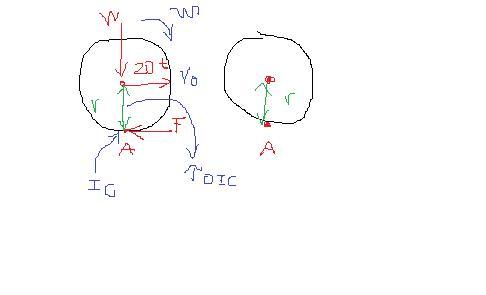
The 30-kg gear is subjected to a force of P=(20t)N where t is in seconds. Determine the angular velocity of the gear at t=4s sta
tatyana61 [14]

Answer:

\omega =\frac{24}{1.14375}=20.983\frac{rad}{s}

Explanation:

Previous concepts

Angular momentum. If we consider a particle of mass m, with velocity v, moving under the influence of a force F. The angular  momentum about point O is defined as the “moment” of the particle’s linear momentum, L, about O. And the correct formula is:

H_o =r x mv=rxL

Applying Newton’s second law to the right hand side of the above equation, we have that r ×ma = r ×F =

MO, where MO is the moment of the force F about point O. The equation expressing the rate of change  of angular momentum is this one:

MO = H˙ O

Principle of Angular Impulse and Momentum

The equation MO = H˙ O gives us the instantaneous relation between the moment and the time rate of change of angular  momentum. Imagine now that the force considered acts on a particle between time t1 and time t2. The equation MO = H˙ O can then be integrated in time to obtain this:

\int_{t_1}^{t_2}M_O dt = \int_{t_1}^{t_2}H_O dt=H_0t2 -H_0t1

Solution to the problem

For this case we can use the principle of angular impulse and momentum that states "The mass moment of inertia of a gear about its mass center is I_o =mK^2_o =30kg(0.125m)^2 =0.46875 kgm^2".

If we analyze the staritning point we see that the initial velocity can be founded like this:

v_o =\omega r_{OIC}=\omega (0.15m)

And if we look the figure attached we can use the point A as a reference to calculate the angular impulse and momentum equation, like this:

H_Ai +\sum \int_{t_i}^{t_f} M_A dt =H_Af

0+\sum \int_{0}^{4} 20t (0.15m) dt =0.46875 \omega + 30kg[\omega(0.15m)](0.15m)

And if we integrate the left part and we simplify the right part we have

1.5(4^2)-1.5(0^2) = 0.46875\omega +0.675\omega=1.14375\omega

And if we solve for \omega we got:

\omega =\frac{24}{1.14375}=20.983\frac{rad}{s}

8 0
2 years ago
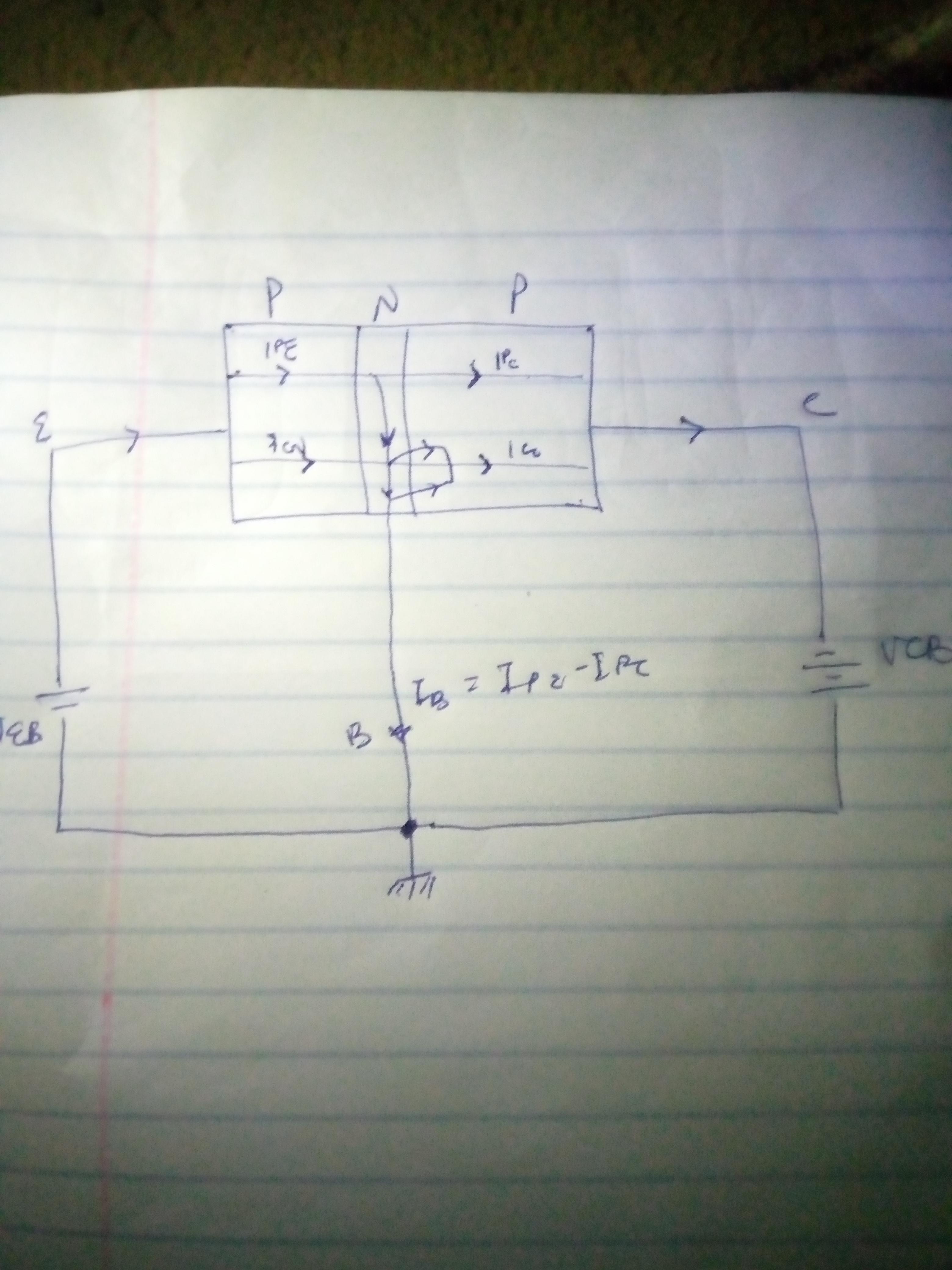
For a p-n-p BJT with NE 7 NB 7 NC, show the dominant current components, with proper arrows, for directions in the normal active
Sonja [21]

Answer:

=> base transport factor = 0.98.

=> emitter injection efficiency = 0.99.

=> common-base current gain = 0.97.

=> common-emitter current gain = 32.34.

=> ICBO = 1 × 10^-6 A.

=> base transit time = 0.325.

=> lifetime = 1.875.

Explanation:

(Kindly check the attachment for the diagram showing the dominant current components, with proper arrows, for directions in the normal active mode).

The following parameters or data are given for a p-n-p BJT with NE 7 NB 7 NC and they are: IEp = 10 mA, IEn = 100 mA, ICp = 9.8 mA, and ICn = 1 mA.

(1). The base transport factor = ICp/IEp=9.8/10 =  0.98.

(2). emitter injection efficiency =IEp/ IEp + ICn = 10/10 + 0.1 =  0.99.

(3).common-base current gain = 0.98 × 0.99 = 0.9702.

(4).common-emitter current gain =0.97 / 1- 0.97  = 32.34.

(5). Icbo = Ico = 1 × 10^-6 A.

(6). base transit time = 1248 × 10^-2 × (1.38× 10^-23/1.603 × 10^-19). = 0.325.

(7).lifetime;

= > 2 = √0.325 + √ lifetime.

= Lifetime = 2.875.

6 0
2 years ago
3.24 Program: Drawing a half arrow (Java) This program outputs a downwards facing arrow composed of a rectangle and a right tria
eimsori [14]

Answer:

Here is the JAVA program:

import java.util.Scanner; // to get input from user

public class DrawHalfArrow{ // start of the class half arrow

public static void main(String[] args) { // starts of main() function body

    Scanner scnr = new Scanner(System.in); //reads input

int arrowBaseHeight = 0; // stores the height of arrow base

int arrowBaseWidth  = 0; // holds width of arrow base

int arrowHeadWidth = 0; // contains the width of arrow head

// prompts the user to enter arrow base height, width and arrow head width

System.out.println("Enter arrow base height: ");

arrowBaseHeight = scnr.nextInt(); // scans and reads the input as int

System.out.println("Enter arrow base width: ");

arrowBaseWidth = scnr.nextInt();

/* while loop to continue asking user for an arrow head width until the value entered is greater than the value of arrow base width */

while (arrowHeadWidth <= arrowBaseWidth) {

    System.out.println("Enter arrow head width: ");

    arrowHeadWidth = scnr.nextInt(); }

//start of the nested loop

//outer loop iterates a number of times equal to the height of the arrow base

 for (int i = 0; i < arrowBaseHeight; i++) {

//inner loop prints the stars asterisks

      for (int j = 0; j <arrowBaseWidth; j++) {

          System.out.print("*");        } //displays stars

          System.out.println();          }

//temporary variable to hold arrowhead width value

int k = arrowHeadWidth;

//outer loop to iterate no of times equal to the height of the arrow head

for (int i = 1; i <= arrowHeadWidth; i++)

{     for(int j = k; j > 0; j--)     {//inner loop to print stars

       System.out.print("*");    } //displays stars

   k = k - 1;

   System.out.println(); } } } // continues to add more asterisks for new line

Explanation:

The program asks to enter the height of the arrow base, width of the arrow base and the width of arrow head. When asking to enter the width of the arrow head, a condition is checked that the arrow head width arrowHeadWidth should be less than or equal to width of arrow base arrowBaseWidth. The while loop keeps iterating until the user enters the arrow head width larger than the value of arrow base width.

The loop is used to output an arrow base of height arrowBaseHeight. So point (1) is satisfied.

The nested loop is being used which as a whole outputs an arrow base of width arrowBaseWidth. The inner loop draws the stars and forms the base width of the arrow, and the outer loop iterates a number of times equal to the height of the arrow. So (2) is satisfied.

A temporary variable k is used to hold the original value of arrowHeadWidth so that it keeps safe when modification is done.

The last nested loop is used to output an arrow head of width arrowHeadWidth. The inner loop forms the arrow head and prints the stars needed to form an arrow head. So (3) is satisfied.

The value of temporary variable k is decreased by 1 so the next time it enters  the nested for loop it will be one asterisk lesser.

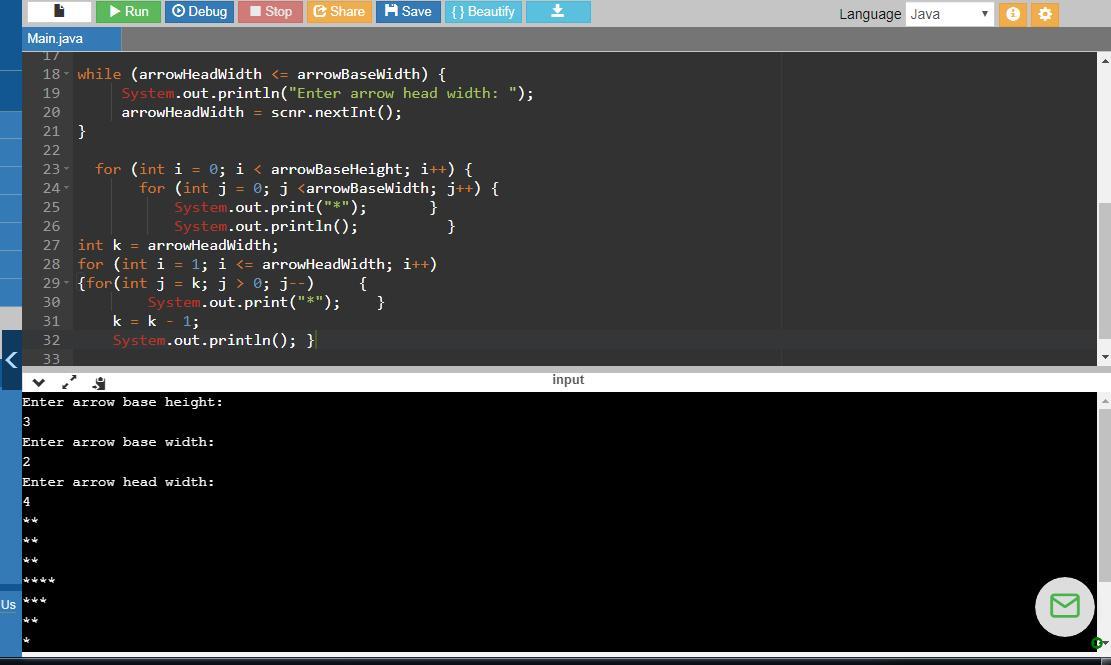
The screenshot of output is attached.

3 0
2 years ago
Other questions:
  • Tin atoms are introduced into a FCC copper crystal, producing an alloy with a lattice pa- rameter of 3.7589 x 10⁻⁸ cm and a dens
    8·1 answer
  • generally compound curves are not filtered recommended for A. Road B. water way C. underground road D. rail way​
    12·1 answer
  • Water has a density of 1.94 slug/ft^3. What is the density expressed in SI units? Express the answer to three significant figure
    8·1 answer
  • Small droplets of carbon tetrachloride at 68 °F are formed with a spray nozzle. If the average diameter of the droplets is 200 u
    10·1 answer
  • A ________ is only achieved through control and involves a specific change in one event (dependent variable) that can reliably b
    5·1 answer
  • An electric field is expressed in rectangular coordinates by E = 6x2ax + 6y ay +4az V/m.Find:a) VMN if point M and N are specifi
    14·1 answer
  • A mass of 12 kg saturated refrigerant-134a vapor is contained in a piston-cylinder device at 240 kPa. Now 300 kJ of heat is tran
    8·1 answer
  • What is the PW (at i 5%) of SuperTool's new test equipment? The development cost is $1.2M. Net revenues will begin at $300,000 f
    9·1 answer
  • A liquid with a specific gravity of 2.6 and a viscosity of 2.0 cP flows through a smooth pipe of unknown diameter, resulting in
    6·1 answer
  • Is an isothermal process necessarily internally reversible? Explain your answer with an example
    7·1 answer
Add answer
Login
Not registered? Fast signup
Signup
Login Signup
Ask question!