answer.
Ask question
Login Signup
Ask question
All categories
  • English
  • Mathematics
  • Social Studies
  • Business
  • History
  • Health
  • Geography
  • Biology
  • Physics
  • Chemistry
  • Computers and Technology
  • Arts
  • World Languages
  • Spanish
  • French
  • German
  • Advanced Placement (AP)
  • SAT
  • Medicine
  • Law
  • Engineering
xxTIMURxx [149]
1 year ago
7

Is an isothermal process necessarily internally reversible? Explain your answer with an example

Engineering
1 answer:
torisob [31]1 year ago
5 0

Answer:

please give me brainlist and follow

Explanation:

Example of an irreverseble isothermal process is mixing of two fluids on the same temperature - it requires a lot of energy to unmix Jack and coke. ... Example of an reversible process with changing temperature is isentropic expansion.

You might be interested in
A spring-loaded toy gun is used to shoot a ball of mass m = 1.50 kg straight up in the air. The spring has spring constant k = 6
adell [148]

Answer:

1) a) Mechanical energy is conserved because no dissipative forces perform work on the ball.

2) The muzzle velocity of the ball is approximately 5.272 meters per second.

3) The maximum height of the ball is 1.417 meters.

Explanation:

1) Which of the following statements are true?

a) Mechanical energy is conserved because no dissipative forces perform work on the ball.

True, statement indicates that there is no air resistence and no friction between ball and the inside of the gun because the first never touches the latter one.

b) The forces of gravity and the spring have potential energies associated with them.

False, force of gravity do work on the ball and spring receives a potential energy at being deformated by the ball.

c) No conservative forces act in this problem after the ball is released from the spring gun.

False, the absence of no conservative forces is guaranteed for the entire system according to the statement of the problem.

2) According to the statement, we understand that spring is deformed and once released and just after reaching its equilibrium position, the muzzle velocity is reached. As spring deformation is too small in comparison with height, we can neglect changes in gravitational potential energy. By Principle of Energy Conservation, we describe the motion of the ball by the following expression:

U_{k, 1}+K_{1}=U_{k,2}+K_{2} (Eq. 1)

Where:

U_{k,1}, U_{k,2} - Initial and final elastic potential energies of spring, measured in joules.

K_{1}, K_{2} - Initial and final translational kinetic energies of the ball, measured in joules.

After using definitions of elastic potential and translational kinetic energies, we expand the equation above as:

\frac{1}{2}\cdot m\cdot (v_{2}^{2}-v_{1}^{2}) = \frac{1}{2}\cdot k\cdot (x_{1}^{2}-x_{2}^{2})

And the final velocity is cleared:

m\cdot (v_{2}^{2}-v_{1}^{2}) = k\cdot (x_{1}^{2}-x_{2}^{2})

v_{2}^{2}-v_{1}^{2} =\frac{k}{m}\cdot (x_{1}^{2}-x_{2}^{2})

v_{2}^{2} =v_{1}^{2}+\frac{k}{m}\cdot (x_{1}^{2}-x_{2}^{2})

v_{2} = \sqrt{v_{1}^{2}+\frac{k}{m}\cdot (x_{1}^{2}-x_{2}^{2}) } (Eq. 2)

Where:

v_{1}, v_{2} - Initial and final velocities of the ball, measured in meters per second.

k - Spring constant, measured in newtons per meter.

m - Mass of the ball, measured in kilograms.

x_{1}, x_{2} - Initial and final position of spring, measured in meters.

If we know that v_{1} = 0\,\frac{m}{s}, k = 667\,\frac{N}{m}, m = 1.50\,kg, x_{1} = -0.25\,m and x_{2} = 0\,cm, the muzzle velocity of the ball is:

v_{2} =\sqrt{\left(0\,\frac{m}{s} \right)^{2}+\left(\frac{667\,\frac{N}{m} }{1.50\,kg} \right)\cdot [(-0.25\,m)^{2}-(0\,m)^{2}]}

v_{2}\approx 5.272\,\frac{m}{s}

The muzzle velocity of the ball is approximately 5.272 meters per second.

3) After leaving the toy gun, the ball is solely decelerated by gravity. We construct this model by Principle of Energy Conservation:

U_{g,2}+K_{2} = U_{g,3}+K_{3} (Eq. 3)

Where:

U_{g,2}, U_{g,3} - Initial and gravitational potential energies of the ball, measured in joules.

K_{2}, K_{3} - Initial and final translational kinetic energies of the ball, measured in joules.

After applying definitions of gravitational potential and translational kinetic energies, we expand the equation above and solve the resulting for the final height:

m\cdot g \cdot (h_{3}-h_{2}) = \frac{1}{2}\cdot m \cdot (v_{2}^{2}-v_{3}^{2})

h_{3}-h_{2}=\frac{v_{2}^{2}-v_{3}^{2}}{2\cdot g}

h_{3} = h_{2} +\frac{v_{2}^{2}-v_{3}^{2}}{2\cdot g} (Eq. 4)

h_{2}, h_{3} - Initial and final heights of the ball, measured in meters.

v_{2}, v_{3} - Initial and final velocities of the ball, measured in meters per second.

g - Gravitational acceleration, measured in meters per square second.

If we get that v_{2} = 5.272\,\frac{m}{s}, v_{3} = 0\,\frac{m}{s}, h_{2} = 0\,m and g = 9.807\,\frac{m}{s^{2}}, the maximum height of the ball is:

h_{3} = 0\,m+\frac{\left(5.272\,\frac{m}{s} \right)^{2}-\left(0\,\frac{m}{s} \right)^{2}}{2\cdot \left(9.807\,\frac{m}{s^{2}} \right)}

h_{3} = 1.417\,m

The maximum height of the ball is 1.417 meters.

5 0
2 years ago
Steam enters a turbine operating at steady state at 1 MPa, 200 °C and exits at 40 °C with a quality of 83%. Stray heat transfer
Andrei [34K]

Answer:

(a) Work out put=692.83\frac{KJ}{Kg}

(b) Change in specific entropy=0.0044\frac{KJ}{Kg-K}

Explanation:

Properties of steam at 1 MPa and 200°C

        h_1=2827.4\frac{KJ}{Kg},s_1=6.69\frac{KJ}{Kg-K}

We know that if we know only one property in side the dome then we will find the other property by using steam property table.

Given that dryness or quality of steam at the exit of turbine is 0.83 and temperature T=40°C.So from steam table we can find pressure corresponding to saturation temperature 40°C.

Properties of saturated steam at 40°C

      h_f= 167.5\frac{KJ}{Kg} ,h_g= 2537.4\frac{KJ}{Kg}

 s_f= 0.57\frac{KJ}{Kg-K} ,s_g= 8.25\frac{KJ}{Kg-K}

So the enthalpy of steam at the exit of turbine  

h_2=h_f+x(h_g-h_f)\frac{KJ}{Kg}

h_2=167.5+0.83(2537.4-167.5)\frac{KJ}{Kg}

h_2=2134.57\frac{KJ}{Kg}

s_2=s_f+x(s_g-s_f)\frac{KJ}{Kg-K}

s_2=0.57+0.83(8.25-0.57)\frac{KJ}{Kg-K}

s_2=6.6944\frac{KJ}{Kg-K}

(a)

Work out put =h_1-h_2

                      =2827.4-2134.57 \frac{KJ}{Kg}

Work out put =692.83 \frac{KJ}{Kg}

(b) Change in specific entropy

     s_2-s_1=6.6944-6.69\frac{KJ}{Kg-K}

Change in specific entropy =0.0044\frac{KJ}{Kg-K}

3 0
2 years ago
(3) Calculate the heat flux through a sheet of brass 7.5 mm (0.30 in.) thick if the temperatures at the two faces are 150°Cand 5
bezimeni [28]

Answer:

a.) 1.453MW/m2,  b.)  2,477,933.33 BTU/hr  c.) 22,733.33 BTU/hr  d.) 1,238,966.67 BTU/hr

Explanation:

Heat flux is the rate at which thermal (heat) energy is transferred per unit surface area. It is measured in W/m2

Heat transfer(loss or gain) is unit of energy per unit time. It is measured in W or BTU/hr

1W = 3.41 BTU/hr

Given parameters:

thickness, t = 7.5mm = 7.5/1000 = 0.0075m

Temperatures 150 C = 150 + 273 = 423 K

                        50 C = 50 + 273 = 323 K

Temperature difference, T = 423 - 323 = 100 K

We are assuming steady heat flow;

a.) Heat flux, Q" = kT/t

K= thermal conductivity of the material

The thermal conductivity of brass, k = 109.0 W/m.K

Heat flux, Q" = \frac{109 * 100}{0.0075} = 1,453,333.33 W/m^{2} \\ Heat flux, Q" = 1.453MW/m^{2} \\

b.) Area of sheet, A = 0.5m2

Heat loss, Q = kAT/t

Heat loss, Q = \frac{109*0.5*100}{0.0075} = 726,666.667W

Heat loss, Q = 726,666.667 * 3.41 = 2,477,933.33 BTU/hr

c.) Material is now given as soda lime glass.

Thermal conductivity of soda lime glass, k is approximately 1W/m.K

Heat loss, Q=\frac{1*0.5*100}{0.0075} = 6,666.67W

Heat loss, Q = 6,666.67 * 3.41 = 22,733.33 BTU/hr

d.) Thickness, t is given as 15mm = 15/1000 = 0.015m

Heat loss, Q=\frac{109*0.5*100}{0.015} =363,333.33W

Heat loss, Q = 363,333.33 * 3.41 = 1,238,966.67 BTU/hr

5 0
2 years ago
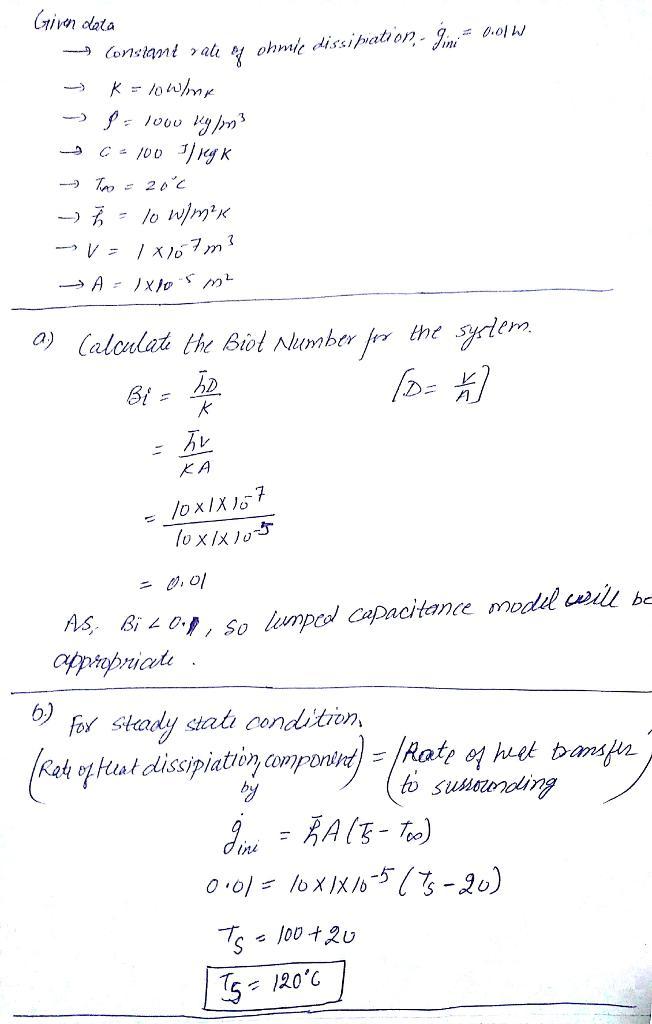
During normal operation, an electrical component experiences a constant rate of ohmic dissipation ini g = 0.01 W that causes the
Llana [10]

Answer:

Check the explanation

Explanation:

Kindly check the attached image below for the step by step explanation to your answer.

4 0
2 years ago
Tech A says that as moisture levels increase in brake fluid, the boiling point of the brake fluid decreases. Tech B says that fi
dezoksy [38]

Answer: Both Technician A and B are correct.

Explanation:

Technicians A and B are both right about their diagnosis. The Society of Automotive Engineers performed extensive research on vehicle brake fluids and found that there is typically a 2% moisture content in the brake fluid after a year of operating a vehicle. And as the moisture content of the brake fluid rises, the boiling point of the brake fluid decreases as well.

4 0
2 years ago
Other questions:
  • The pressure at any point in a static fluid depends only on the Select one a)- depth, surface pressure, and specific weight. b)-
    11·1 answer
  • Mary is interested in developing new machines that would increase the productivity of small scale farmers. After high school, wh
    8·1 answer
  • generally compound curves are not filtered recommended for A. Road B. water way C. underground road D. rail way​
    12·1 answer
  • A pitfall cited in Section 1.10 is expecting to improve the overall performance of a computer by improving only one aspect of th
    6·1 answer
  • Write a program with total change amount as an integer input, and output the change using the fewest coins, one coin type per li
    15·1 answer
  • One mole of iron (6 1023 atoms) has a mass of 56 grams, and its density is 7.87 grams per cubic centimeter, so thecenter-to-cent
    15·1 answer
  • Reconsider Couette flow between two parallel plates as derived in class, but with the top plate moving with a known velocity +i
    13·1 answer
  • Draw an ERD for each of the following situations. (If you believe that you need to make additional assumptions, clearly state th
    15·1 answer
  • Water at 70 kPa and 1008C is compressed isentropically in a closed system to 4 MPa. Determine the final temperature of the water
    6·1 answer
  • Find the velocity and rate of flow of water through a rectangular channel of 6m wide and 3m deep when it's running full. The cha
    13·1 answer
Add answer
Login
Not registered? Fast signup
Signup
Login Signup
Ask question!