answer.
Ask question
Login Signup
Ask question
All categories
  • English
  • Mathematics
  • Social Studies
  • Business
  • History
  • Health
  • Geography
  • Biology
  • Physics
  • Chemistry
  • Computers and Technology
  • Arts
  • World Languages
  • Spanish
  • French
  • German
  • Advanced Placement (AP)
  • SAT
  • Medicine
  • Law
  • Engineering
Salsk061 [2.6K]
2 years ago
15

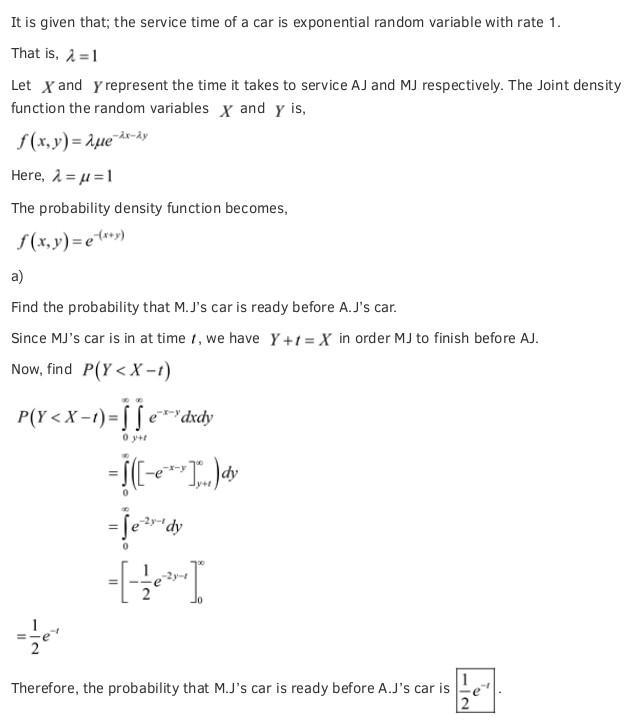
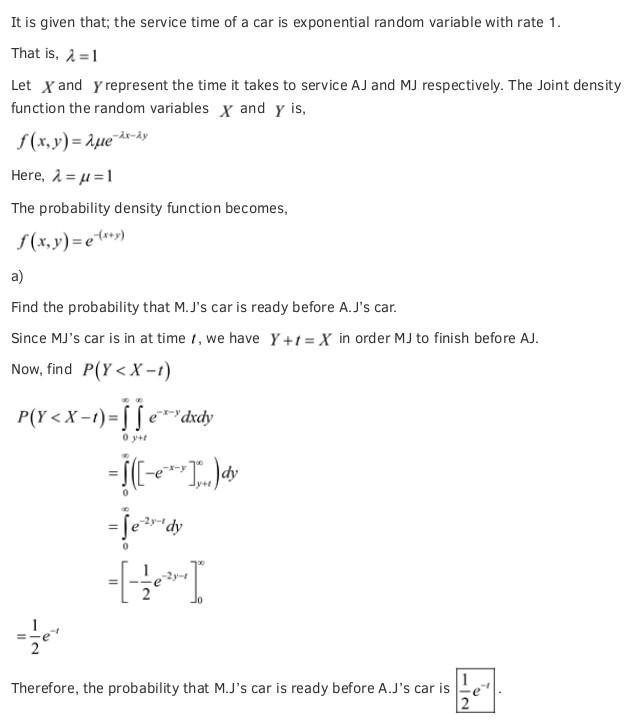
The time that it takes to service a car is an exponential random variable with rate 1. If Lightning McQueen (L.M.) brings his ca

r in at time 0 and Sally Carrera (S.C) brings her car in at time t, what is the probability that S.C.'s car is ready before L.M.'s car? Assume that service times are independent and service begins upon arrival of the car. Be sure to: 1) define all random variables used, 2) explain how independence of service times plays a part in your solution, 3) show all integration steps. If both cars are brought in at time 0, with work starting on S.C.'s car only when L.M.'s car has been completely serviced, what is the probability that S.C.'s car is ready before time 2?

Mathematics
1 answer:
Paraphin [41]2 years ago
4 0

Answer:

Please find attached solution.

Step-by-step explanation:

You might be interested in
To plan the budget for next year a college must update its estimate of the proportion of next year's freshmen class that will ne
Naily [24]

Answer:

Null hypothesis:p\leq 0.35  

Alternative hypothesis:p > 0.35  

z=\frac{0.447 -0.35}{\sqrt{\frac{0.35(1-0.35)}{150}}}=2.491  

p_v =P(z>2.491)=0.0064  

So the p value obtained was a very low value and using the significance level assumed \alpha=0.05 we have p_v so we can conclude that we have enough evidence to reject the null hypothesis, and we can said that at 5% of significance the proportion of applicants who request financial aid is significantly higher than 0.35

Step-by-step explanation:

Data given and notation

n=150 represent the random sample taken

X=67 represent the applicants who request financial aid

\hat p=\frac{67}{150}=0.447 estimated proportion of applicants who request financial aid

p_o=0.35 is the value that we want to test

\alpha represent the significance level

z would represent the statistic (variable of interest)

p_v represent the p value (variable of interest)  

Concepts and formulas to use  

We need to conduct a hypothesis in order to test the claim that the true proportion of applicants who request financial aid is higher than 0.35.:  

Null hypothesis:p\leq 0.35  

Alternative hypothesis:p > 0.35  

When we conduct a proportion test we need to use the z statistic, and the is given by:  

z=\frac{\hat p -p_o}{\sqrt{\frac{p_o (1-p_o)}{n}}} (1)  

The One-Sample Proportion Test is used to assess whether a population proportion \hat p is significantly different from a hypothesized value p_o.

Calculate the statistic  

Since we have all the info requires we can replace in formula (1) like this:  

z=\frac{0.447 -0.35}{\sqrt{\frac{0.35(1-0.35)}{150}}}=2.491  

Statistical decision  

It's important to refresh the p value method or p value approach . "This method is about determining "likely" or "unlikely" by determining the probability assuming the null hypothesis were true of observing a more extreme test statistic in the direction of the alternative hypothesis than the one observed". Or in other words is just a method to have an statistical decision to fail to reject or reject the null hypothesis.  

The next step would be calculate the p value for this test.  

Since is a right tailed test the p value would be:  

p_v =P(z>2.491)=0.0064  

So the p value obtained was a very low value and using the significance level assumed \alpha=0.05 we have p_v so we can conclude that we have enough evidence to reject the null hypothesis, and we can said that at 5% of significance the proportion of applicants who request financial aid is significantly higher than 0.35
5 0
2 years ago
What is the distance from the origin of point P graphed on the complex plane below?
ZanzabumX [31]

Answer:

b) √29

Step-by-step explanation:

Given: The origin is (0, 0), the point P is (2, -5).

We need to use the distance formula.

Distance formula = \sqrt{(x2 -x1)^2 + (y2 - y1)^2} \\

Here x2 = 2, x 1 = 0, y1 =0, y2 = -5

Distance = \sqrt{(2 -0)^2 + (-5 - 0)^2}

= \sqrt{2^2 + (5)^2}

= √(4 + 25)

= √29

The answer is b) √29

Hope you will understand the concept.

Thank you.

7 0
2 years ago
Read 2 more answers
Which of the following is the radical expression of a to the four ninths power?
iogann1982 [59]

Step-by-step explanation:

\sqrt[n]{a^m}=a^\frac{m}{n}\\\\\large\huge\boxed{a^\frac{4}{9}=\sqrt[9]{a^4}}

3 0
2 years ago
Read 2 more answers
A turtle walks 7/8 of a mile in 50 minutes. What is the unit rate when the turtle’s speed is expressed in miles per hour?
yKpoI14uk [10]

Answer:

21/20

Step-by-step explanation:

a) One hour is equivalent to 60 minutes.

So we can multiply 50 minutes by the fraction \frac{1 hour}{60 minutes}, so we could convert 50 minutes to hours.

It is:

50 minutes * \frac{1 hour}{60 minutes}=\frac{50}{60}hours

If we simplify the fraction, we have:

50 minutes = \frac{5}{6}hours

b) In order to express the turtle's speed in miles per hour, we have to divide

\frac{7}{8}miles by  \frac{5}{6}hours

So:

\frac{\frac{7}{8}miles }{\frac{5}{6}hours }

We simplify the expression by multiplying 7 mile by 6 and 8 by 5 hours:

\frac{\frac{7}{8}miles }{\frac{5}{6}hours}=\frac{42 miles}{40 hours} =\frac{21 miles}{20 hours}

4 0
2 years ago
Read 2 more answers
Two of the steps in the derivation of the quadratic formula are shown below. Step 6: StartFraction b squared minus 4 a c Over 4
sergeinik [125]

Answer:

Step-by-step explanation:

From the step given step 6

(b² — 4ac) / 4a² = (x + b/2a)²

Mistake in question it is (x + b/2a)²

Step 7 given

±√(b² —4ac) /2a = x + b/2a

Mistake in question it is over 2a and not 1a.

1. The step taken from step 6 to step 7 is taking square roots of both sides

(b² — 4ac) / 4a² = (x + b/2a)²

Taking square of both sodes

√(b²—4ac) / √4a² = √(x + b/2a)²

√(b²—4ac) / 2a = x + b/2a

This is the required step 7.

Now, subtracting b/2a from both sides

√(b²—4ac) / 2a - b/2a= x + b/2a -b/2a

√(b²—4ac) / 2a — b/2a = x

(√(b²—4ac)  — b)/2a = x

x = [—b ± √(b²—4ac)] / 2a

So, this is the required formula method

The discriminant is D = b²—4ac.

6 0
2 years ago
Read 2 more answers
Other questions:
  • What are the domain,range,and asymptote of h(x=6^x-4
    6·1 answer
  • there are 30 students on the debate team and 20 students on the math team. ten students are on both the math team and debate tea
    12·2 answers
  • You have a litre bottle of water and drink 375 millilitres.<br><br> How much is left?
    13·1 answer
  • Jackson bought 555 ounces of raisins for \$4$4dollar sign, 4.
    15·2 answers
  • The following appeared in the magazine Financial Times, March 23,1995: "When Elvis Presley died in 1977, there were 48 professio
    5·1 answer
  • Make x the subject of the formula 6x+a=5(x+t)
    15·2 answers
  • The top of a building is 65 meters away from a spot located 16 meters away from the foot of the building. What is the height of
    9·1 answer
  • The tables represent the functions f(x) and g(x). A table showing g(x) equals 2 x plus 15 with 2 columns and 7 rows. The first c
    12·1 answer
  • The position of a paddle on a waterwheel after t seconds is modeled by f(t) = 5.25 cosine (StartFraction pi Over 16 EndFraction
    11·2 answers
  • Which of the following represent the distance formula? Select all that apply.
    13·1 answer
Add answer
Login
Not registered? Fast signup
Signup
Login Signup
Ask question!
