answer.
Ask question
Login Signup
Ask question
All categories
  • English
  • Mathematics
  • Social Studies
  • Business
  • History
  • Health
  • Geography
  • Biology
  • Physics
  • Chemistry
  • Computers and Technology
  • Arts
  • World Languages
  • Spanish
  • French
  • German
  • Advanced Placement (AP)
  • SAT
  • Medicine
  • Law
  • Engineering
SVEN [57.7K]
2 years ago
5

An air duct heater consists of an aligned array of electrical heating elements in which the longitudinal and transverse pitches

are SL = ST = 24 mm. There are 3 rows of elements in the flow direction (NL = 3) and 4 elements per row (NT = 4). Atmospheric air with an upstream velocity of 12 m/s and a temperature of 25°C moves in cross-flow over the elements, which have a diameter of 12 mm, a length of 250 mm, and are maintained at a surface temperature of 350°C.
(A) Determine the total heat transfer to the air and the temperature of the air leaving the duct heater.

(B) Determine the pressure drop across the element bank and the fan power requirement.

(C) Compare the average convection coefficient obtained in your analysis with the value for an isolated (single) element. Explain the difference between the results.

Engineering
1 answer:
MariettaO [177]2 years ago
4 0

Answer:

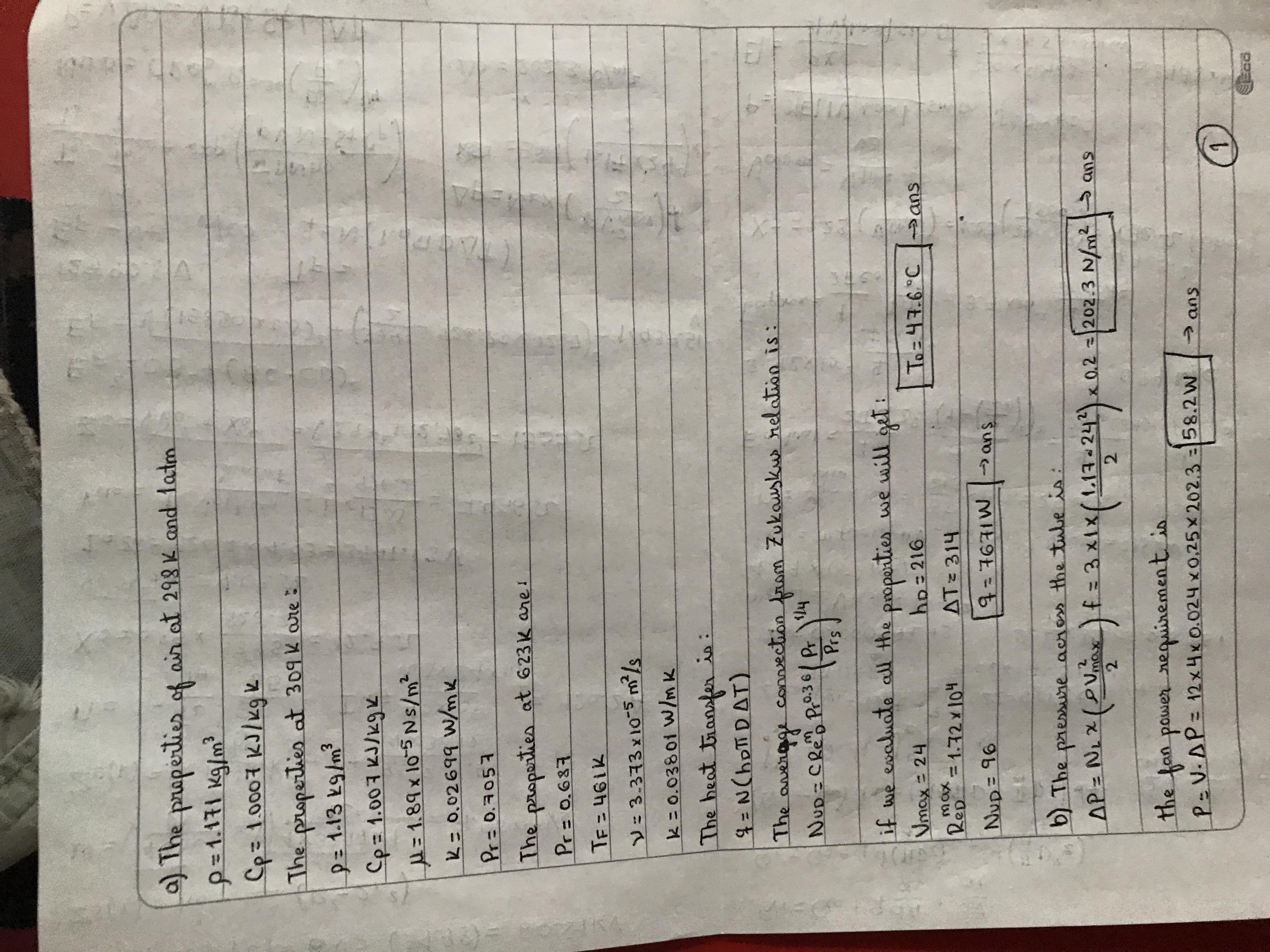
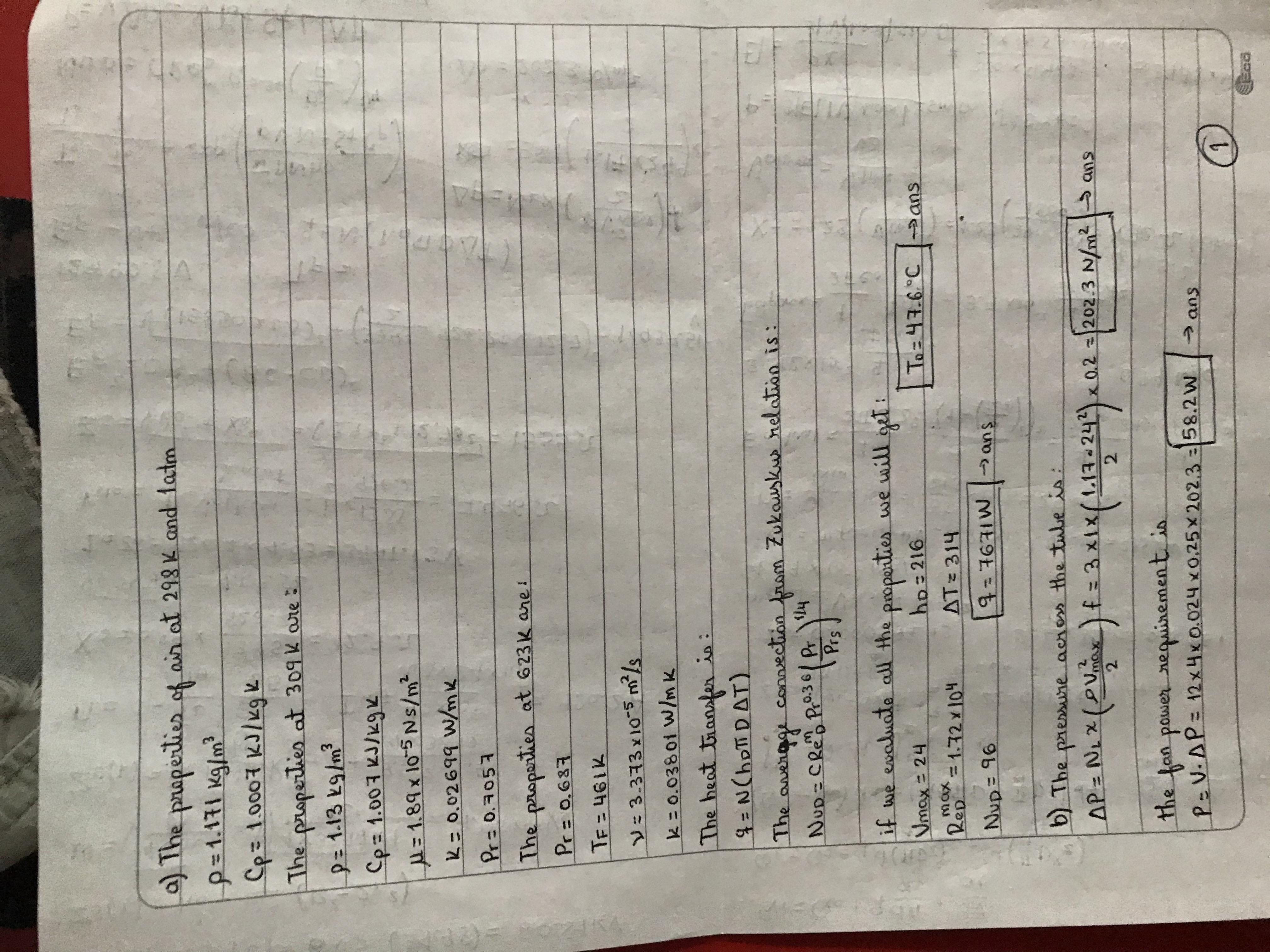
a) q = 7671 W

T0 = 47.6°C

b) ΔP = 202.3 N/m²

P = 58.2 W

c) hDarray = 2 times hD isolated element

Explanation:

look at the image, you will find the solution

You might be interested in
1. Which type of sketch most accurately represents what the finished product will look like?
a_sh-v [17]

Answer:

1. The correct answer is B. Ideations Sketch

2. The correct answer is A. How a product actually works  

Explanation:

1. The correct answer is B. Ideations Sketch

Due to the fact that in the process sketch the idea is to show all the steps that need to be followed to achieve or construct the final product, in the persuasive sketch it is intended to know about the possible influence over the audience and make them want the design notion, in the explanatory sketch what is wanted is to communicate about the structure, function and form in a clear way focusing on how it would be possible to use the product or idea design; and finally in the ideations sketch is used to propose solutions to any concer, in this way the concept is to create a prototype of what the final product would be.  

2. The correct answer is A. How a product actually works  

Because the word function comes from the latin function which means “to perform”. This lead us to define function as the capacity to perform an activity that a product or idea has or what it can do for a consumer or customer.

7 0
2 years ago
A system consisting of 3 lb of water vapor in a piston–cylinder assembly, initially at 350°F and a volume of 71.7 ft3, is expand
Alla [95]

Answer:

isobaric expansion = 281.09 Btu

isothermal compression= 72 Btu

Explanation:

The first law of thermodynamics is:

Q_{AB}=W_{AB}+deltaU_{AB}

where:

Q=heat transferred

W= work

U=internal energy  

W_{AB}=P*(V_{B}-V_{A})

U_{AB}=n*C_{v}(T_{2}-T_{1})

P=pressure, V= volume, T= temperature, n =  moles, Cv= specific heat at constant volume.

In a isobaric process heat transferred is:

Q=P*(V_{B}-V_{A})+n*C_{v}(T_{2}-T_{1})

For an isothermal process (T2-T1 = 0) so

Q=P*(V_{B}-V_{A})= W_{AB}

From the data we know that the energy transferred to the system in the isothermal compression by work was 72 Btu that is the heat transferred to the system.

For the first process

Q=P*(V_{B}-V_{A})+n*C_{v}(T_{2}-T_{1})

we have to properties at the beginning of the process : temperature (350°F) and specific volume (V/mass)

specific-volume=\frac{71.7 ft^{3}}{3Lb}=23.9\frac{ft^{3}}{Lb}

we use this information in the appropriate unit to find the pressure in thermodynamic tables.

T1= 176°C

v1= 1.49 m^3/kg

P=1.37 bar

in the second state we have

P=1.37 bar =137000Pa

v_{2}=\frac{85.38ft^{3}}{3Lb}= 28.46\frac{ft^{3}}{Lb}

with thee properties we check in the thermodynamic tables

T2= 255°C

n=mass/Mw = 3Lb*\frac {1kg}{2.2Lb}*\frac{1000gr}{1kg}*\frac{1mol}{18gr}=75.75 mol

we usually find Cp on tables for water but from the Mayer relation we have:

C_{v}=C_{p}+R

Cp for water vapor is: 33.12 J/mol*K

R=8.314 J/mol*K

Cv= 41.434 J/mol*K

replacing in the equation for Q

Q=137000 Pa*(2.41m^{3}-2.030m^{3})+75.75mol*41.434\frac{ J}{mol*K}*(528.15-449.81 K)=296569J

296569J =281.09 Btu

5 0
2 years ago
On the reality television show "Survivor," two tribes compete for luxuries such as food and shelter. During such challenges, one
Ivan

Answer:

Realistic Group Conflict Theory

Explanation:

Realistic Group Conflict theory is a socio-psychological model of internal conflicts among groups.

These groups may compete for a scarce resources based on reality or perception.

These conflicts may be over political power, capital, or social status, etc.

According to this theory, in the competition, only one group wins over the scarce resources while the other has to lose.

Thus The reality show on the television showing two tribes competing for food and shelter where the success of one is the failure for the other is based on Realistic Group Conflict Theory.

5 0
2 years ago
three balls each have a mass m if a has a speed v just before a direct collision with B determine the speed of C after collision
ratelena [41]

Answer:

Vc2= V(l+e) ^2/4

Vg2= V(l-e^2)/4

Explanation:

Conservation momentum, when ball A strikes Ball B

Where,

M= Mass

V= Velocity

Ma(VA)1+ Mg(Vg)2= Ma(Va)2+ Ma(Vg)2

MV + 0= MVg2

Coefficient of restitution =

e= (Vg)2- (Va)2/(Va)1- (Vg)1

e= (Vg)2- (Va)2/ V-0

Solving equation 1 and 2 yield

(Va)2= V(l-e) /2

(Vg)2= V(l+e)/2

Conservative momentum when ball b strikes c

Mg(Vg)2+Mc(Vc)1 = Mg(Vg)3+Mc(Vc)2

=> M[V(l+e) /2] + 0 = M(Vg)3 + M(Vc) 2

Coefficient of Restitution,

e= (Vc)2 - (Vg)2/(Vg)2- (Vc)1

=> e= (Vc)2 - (Vg)2/V(l+e) /2

Solving equation 3 and 4,

Vc2= V(l+e) ^2/4

Vg2= V(l-e^2)/4

8 0
2 years ago
Read 2 more answers
Radioactive wastes are temporarily stored in a spherical container, the center of which is buried a distance of 10 m below the e
puteri [66]

Given:

outer radius, R' = 10 m

inner diameter, d = 2 m

inner radius, R = \frac{d}{2} = 1 m

surface temperature, T' = 20^{\circ}C

Thermal conductivity of soil, K = 0.52 W/mK

Solution:

To calculate the thermal temperature of conductor, T, we know amount of heat, Q is given by :

Q =  \frac{T - T'}{\frac{R' - R}{4\pi KRR'}}

500 =  (T - 20)\frac{4\pi \times0.52\times 1\times 10}{10 - 1}

T = 68.86 +20 = 88.865^{\circ}C  

Therefore, outside surface temperature is 88.865^{\circ}C  

4 0
2 years ago
Other questions:
  • You are working in a lab where RC circuits are used to delay the initiation of a process. One particular experiment involves an
    13·1 answer
  • A hydrogen-filled balloon to be used in high altitude atmosphere studies will eventually be 100 ft in diameter. At 150,000 ft, t
    7·1 answer
  • A 1020 CD steel shaft is to transmit 15 kW while rotating at 1750 rpm. Determine the minimum diameter for the shaft to provide a
    10·1 answer
  • Some states have osha programs, but you should always defer to the federal program.
    8·2 answers
  • Air is compressed adiabatically from p1 1 bar, T1 300 K to p2 15 bar, v2 0.1227 m3 /kg. The air is then cooled at constant volum
    13·1 answer
  • The small 5-oz slider A moves without appreciable friction in the hollow tube, which rotates in a horizontal plane with a consta
    7·1 answer
  • Suggest how any sorting algorithm can be augmented in a way to make the best-case count of its key comparisons equal to just n−1
    6·1 answer
  • Write cout statements with stream manipulators that perform the following:
    8·1 answer
  • Mr. Ray deposited $200,000 in the Old and Third National Bank. If the bank pays 8% interest, how much will he have in the accoun
    10·2 answers
  • It has been stated that crime rates are impacted by ecological conditions. Which of the following
    13·1 answer
Add answer
Login
Not registered? Fast signup
Signup
Login Signup
Ask question!