answer.
Ask question
Login Signup
Ask question
All categories
  • English
  • Mathematics
  • Social Studies
  • Business
  • History
  • Health
  • Geography
  • Biology
  • Physics
  • Chemistry
  • Computers and Technology
  • Arts
  • World Languages
  • Spanish
  • French
  • German
  • Advanced Placement (AP)
  • SAT
  • Medicine
  • Law
  • Engineering
rusak2 [61]
2 years ago
4

Consider the following information about a business Diane opened last year: price = $15, quantity sold = 25,000; implicit cost =

$155,000; explicit cost = $260,000. What was Diane's economic profit? What was Diane’s accounting profit? Show your work!!
Business
2 answers:
kvv77 [185]2 years ago
8 0

Answer:

Economic profit = $-40,000

Accounting profit = $115,000

Explanation:

Accounting profit is total revenue less total cost or explicit cost.

Accounting profit = Total revenue - Total cost

Total revenue = 25,000 x $15 = $375,000

Total cost =  $260,000

Accounting profit = $375,000 -  $260,000 = $115,000

Economic profit is accounting profit less implicit cost or opportunity cost

Economic profit = Accounting profit -Implicit cost

= $115,000 - $155,000 = $-40,000

I hope my answer helps you

gayaneshka [121]2 years ago
7 0

Answer:

Accounting Profit = $115.000 and Economic Profit= -40.000

Explanation:

Accounting profit is the monetary costs a firm pays out and the revenue a firm receives.

Accounting Profit = Total Revenues - Explicit Costs

Accounting Profit = ($15 x 25000) -$260,000=375.000-$260,000

Accounting Profit = $115.000

Economic profit is the difference between the total revenue received by a business and the total explicit and implicit costs for a firm.

Economic Profit = Accounting Profit - Implicit Cost

Economic Profit= $115.000 -$155,000

Economic Profit= -40.000

You might be interested in
Marko, Inc., is considering the purchase of ABC Co. Marko believes that ABC Co. can generate cash flows of $6,200, $11,200, and
Serggg [28]

Answer:

$27,965.4393

Explanation:

Given:

Cash flow for first year (C1) = $6,200

Cash flow for second year (C2) = 116,200

Cash flow for third year (C3) = $17,400

Rate of return = 10% = 10/100 = 0.1

Computation of total price :

Total Price = \frac{C1}{(1+r)^1} +\frac{C2}{(1+r)^2} +\frac{C3}{(1+r)^3}

Total\ price = \frac{6,200}{(1+0.1)^1} +\frac{11,200}{(1+0.1)^2} +\frac{17,400}{(1+0.1)^3}\\\\Total\ price = \frac{6,200}{(1.1)^1} +\frac{11,200}{(1.1)^2} +\frac{17,400}{(1.1)^3}\\\\Total\ price = \frac{6,200}{(1.1)} +\frac{11,200}{(1.21)} +\frac{17,400}{(1.331)}\\\\Total\ price = 5,636.36364 + 9256.19835 +13,072.8775\\\\Total\ price = 27,965.4393\\\\

Therefore, Marko Inc. will  pay $27,965.4393  

8 0
2 years ago
Please describe the circumstances of the following case study and recommend a course of action. Explain your approach to the pro
Cloud [144]

Answer:

In this case, an analyst is presented with recommending the best option between internal production and external acquisition of  goods (outsourcing) for resale.  Through relevant quantitative and qualitative analyses it will be decided whether the company should make or buy the engines or vacuums.  To make 50,000 units of the engines, production costs will be incurred as given in the question.

After considering the qualitative factors, including availability of production capacity, space, and labor, the next would be to undertake a  costs /benefits quantitative analysis of making the engines in-house versus buying from outside for resale.  The outcomes are then compared to understand their financial effects.  The option that makes better financial sense or that is more profitable should be chosen because the payoff outweighs the other and the company's assets and stockholders will be better off with the more profitable option, either in the direction of making more profits or reducing the cost profile.

In any make or buy decision situation, the costs that are relevant are the costs that change with the option.  Any costs that do not change with a chosen option is disregarded.  This include items like depreciation and other indirect fixed costs.

b) Computations:

1. To make:

Description                    Cost per Month

Direct Materials                    $75,000

Direct Labor                        $100,000

Variable factory overhead $375,000 ($7.50 x 50,000)

Total variable costs =        $550,000

Selling price =                 $7,500,000 ($150 x 50,000)

Contribution =                $6,950,000

Fixed factory overhead     $150,000 (150% of $100,000)

Net Income                    $6,800,000

2. To buy:

Cost of goods  - $3,000,000

Selling price       $7,500,000

Contribution      $4,500,000

Fixed costs            $112,500 (75% of $150,000)

Net Income       $4,387,500

c) The company should go ahead and produce the engines internally.  This is far more profitable, all quantitative factors considered.

Explanation:

In arriving at a decision in a make or buy decision situation, only relevant costs that change with the option should be analysed.  Fixed indirect costs and depreciation should not be considered.

From the above quantitative analyses, the company will make a contribution (profit) of $6.95 million instead of $4.5 million if it chooses to make the engines internally.

Even a review of the bottomline (after factoring in the fixed costs) shows that the company would make a net income of $6.8 million by producing the engines in-house.  The net income above the buy option is more than $2 million.

7 0
2 years ago
On January 1, 2017, a subsidiary sold equipment to its parent for $520,000. The subsidiary's original cost was $200,000 and as o
Mnenie [13.5K]

Answer:

C. $340,000

Explanation:

Compute the Subsidiary's Unrealized Profit

This will help to determine, this will help us get the amount by which the Equipment Account will be reduced.

First, we calculate the Unrealized profit made on selling of the equipment

The equipment was sold for $520,000

The original cost to the Subsidiary was $200,000.

Furthermore, the Accumulated Depreicaiton of the Asset = $20,000

The Net Book Value of the Equipment = Cost - Accumulated Depreciation

The Net Book Value = $200,000 - $20,000 = $180,000

The Profit on Sale of the Equipment

= Sales Value - The Net Book Value

= $520,000 - $180,000 = $340,000

7 0
2 years ago
Steve's basis in his SAW Partnership interest is $200,000 at the beginning of the tax year, including all adjustments. His alloc
LiRa [457]
This is true...........
4 0
2 years ago
Read 2 more answers
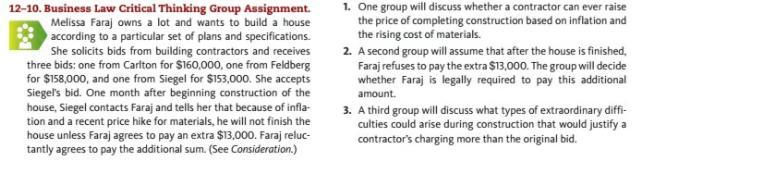
Is Faraj legally required to pay this additional amount in this case? Melissa Faraj owns a lot and wants to build a house accord
lubasha [3.4K]

Answer:

The issues that arises between the Faraj and Siegel can be discussed by three different groups in resolving the contract agreement.

Note: Kindly find an attached copy of the complete question below.

Explanation:

Solution

In this case between Faraj and Siege'ls building contractors the following issue are discussed by three groups as follows:

(1) The contractor can increase the price of finishing construction based on inflation and the cost of raising materials during inflation prices for the materials increases or goes up and this will affect the customer gradually.

(2) Faraj will not pay the additional amount requested by Siegel because according to the contract the amount she has to pay is $153,000

(3) Issues or problems that might come up during construction is listed below:

  • Poor communication
  • Not feasible or impractical forecasting
  • The unavailability of structure

3 0
2 years ago
Other questions:
  • Lake Corporation is considering the elimination of one of its segments. The segment incurs the following fixed costs. If the seg
    15·1 answer
  • Lakeside Components wishes to purchase parts in one month for sale in the next. On June 1, the company has 11,000 parts in stock
    6·1 answer
  • Neakanie Industries sells specialized mountain bikes. Each specialized bike purchased includes free maintenance service for 12 m
    8·1 answer
  • Jackie Swain obtains a $65,000 loan on her home. The principal and interest payments are based on a factor of 8.05 per $1,000. T
    7·1 answer
  • What concept involves breaking down the production of a product into a series of small, elementary tasks, each of which is perfo
    9·1 answer
  • Because there are a significant number of "green-conscious" consumers, it is a legitimate market segment for many companies that
    12·1 answer
  • Describe the unique challenge marketers face when attempting to use differentiated marketing for different cultures and ethnicit
    10·1 answer
  • After creating a product prototype, a company tests it within the firm to see how it performs in different applications. The com
    9·1 answer
  • Suppose that the Federal Reserve (the "Fed") sells $1.5 million of bonds to a bond dealer, who pays the Fed by writing a check a
    10·1 answer
  • A company that usually sells satellite TV equipment for $50 and two years of satellite TV service for $450 has a special, time-l
    11·1 answer
Add answer
Login
Not registered? Fast signup
Signup
Login Signup
Ask question!