answer.
Ask question
Login Signup
Ask question
All categories
  • English
  • Mathematics
  • Social Studies
  • Business
  • History
  • Health
  • Geography
  • Biology
  • Physics
  • Chemistry
  • Computers and Technology
  • Arts
  • World Languages
  • Spanish
  • French
  • German
  • Advanced Placement (AP)
  • SAT
  • Medicine
  • Law
  • Engineering
Andreyy89
2 years ago
4

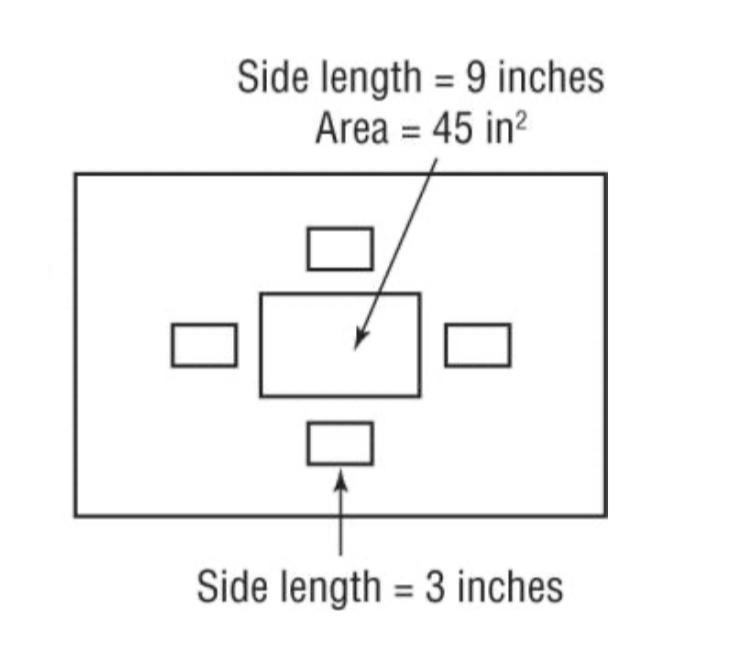
a quilt design has one large rectangle surrounded by four congruent rectangles, similar to the large rectangle. If the large rec

tangle has an area of 45 square inches, what is the area of each small rectangle?

Mathematics
2 answers:
krek1111 [17]2 years ago
6 0

Answer:

Area of each small rectangle = 5 in²

Step-by-step explanation:

Let the length of the large rectangle be L

Let the breadth of the large rectangle be B

The small rectangles are said to be congruent, that is, they have the same shape and sizes.

Let the length of the small rectangles each be l

And their breadths, each be b

Area of the large rectangle = 45 in²

Side length of the large rectangle = 9 in.

Area of a rectangle = (length) × (breadth)

A = L × B

45 = 9 × breadth

Breadth = B = (45/9) = 5 in.

The small rectangles are similar to the large rectangle, that is, the ratio of their sizes are the same.

So,

(l/b) = (L/B)

or

(l/L) = (b/B)

l = 3 in. (Given in the diagram of the question)

L = 9 in.

b = ?

B = 5 in.

(3/b) = (9/5)

b = (3×5/9) = (5/3) in.

Area of each of the small rectangles = l × b

Area of each small rectangle = 3 × (5/3)

= 5 in²

Hope this Helps!!!
Salsk061 [2.6K]2 years ago
3 0

Answer:

Area of each smaller rectangle = 5inches^2

Explanation:

Bigger rectangle:

Area (A)= 45inches^2

Length (L)= 9inches

Breadth (B) = area/length = 45/9

Breadth = 5inches

Smaller rectangle:

Area (a)= unknown

Length (l) = 3inches

Breadth (b)= unknown

Since the bigger rectangle is similar to the 4 smaller congruent rectangles, we find ratio of the length and breath of smaller rectangle to the bigger one.

Scale factor is calculated from any two sides (length or breadth).

Ratio of length = l/L = 3/9 = 1/3

Ratio of breadth = b/B = b/5

Sum of polygon theorem states that if the ratio of two figures is c/d, the ratio of the area of the two similar polygons is equal to the square of the ratio of the two figures (c/d)^2.

a/A = (l/L)^2 = (b/B)^2

l/L = b/B (similar polygons)

1/3 = b/5

3b = 5

b = 5/3

Smaller breadth = 5/3

Area of smaller rectangle (a) = l × b

Area of smaller rectangle = 3 × 5/3

Area of each smaller rectangle = 5inches^2

You might be interested in
Maria said that -4n + 3 +9n - 4 is equivalent to 4n. What error did maria likely make?
ivann1987 [24]
Maria combined all of the factors, which were not all like terms. She should’ve did -4n+9n and 3-4 to get 5n-1
8 0
2 years ago
Read 2 more answers
Maria has 14 pencils, Ted has 9 pencils, Tom has 12 pencils, Lucinda has 13 pencils, and Jumana has 12 pencils. How can they red
Alisiya [41]

5 people.

14 + 9 + 12 + 13 + 12 = 60 total pencils.

60 pencils /  5 people = 12 pencils each.

7 0
2 years ago
Read 2 more answers
In developing an interval estimate for a population mean, a sample of 50 observations was used. the interval estimate was 19.76
alexandr402 [8]


The formula for interval estimate would be: μ = M ± Z(<span>sM</span>)

Where: μ is estimate

M is the mean 

Z is the z value

(<span>sM</span>) is the standard error


μ = M ± Z(<span>sM</span>)

n = 200 rather than 50 (√200 = 2√50)

<span>⇒ ME = (1/2) * 1.32 = .66</span>

<span>Using the formula above, plugging this in will give us: μ = 19.76 ± .66</span>

<span> = 19.76  ±  .66 is the confidence interval or interval estimate</span>

4 0
2 years ago
Ken grew 4/5 of an inch last year. sang grew3/8 of an inch . who grew more and by how much?
Licemer1 [7]
Sang grew more. and by 17/40 ( I could be wrong)
4 0
2 years ago
Find the quotient. (5x4 – 3x2 4) ÷ (x 1)
Vlada [557]

Keywords:

<em>Divide, polynomial, quotient, divisor, dividend, rest </em>

For this case, we must find the quotient by dividing the polynomial (5x ^ 4-3x ^ 2 + 4)\ by\ (x + 1). We must build a quotient that, when multiplied by the divisor, eliminates the terms of the dividend until it reaches the rest, as shown in the attached figure. At the end of the division, to verify we must bear in mind that:

Dividend = Quotient * Divider + Remainder

Answer:

See attached image

4 0
2 years ago
Read 2 more answers
Other questions:
  • The endpoints of (line segment )AB are A(2, 2) and B(3, 8). (line segment ) AB is dilated by a scale factor of 3.5 with the orig
    6·2 answers
  • What is the circumference of this circle, in millimeters? use 22/7 for pi<br><br> r = 49
    15·2 answers
  • Clayton Road is 2.25 miles long. Wood Pike Road is 1.8 miles long. Kisha used a quick picture to find the combined length of Cla
    15·1 answer
  • There are 4500 people in Springfield. 1/3 of the population of Springfield are under the age of 21. how many people are under 21
    13·1 answer
  • Rochelle deposits $5,000 in an IRA. What will be the value of her investment in 25 years if the investment is earning 8% per yea
    6·1 answer
  • In a large corporate computer network, user log-ons to the system can be modeled as a Poisson RV with a mean of 25 log-ons per h
    5·1 answer
  • Find the largest degree of x that can be factored out of all the terms<br> 9x + 45
    14·1 answer
  • What is the slope of a line perpendicular to the line whose equation is 3x-12y=2163x−12y=216.
    9·2 answers
  • The cost of 8 kg of butter is $ 904. what will be the cost of 14 kg of butter
    7·1 answer
  • A rectangle has height and width changing in such a way that the area remains constant 2 square feet. At the instant the height
    13·1 answer
Add answer
Login
Not registered? Fast signup
Signup
Login Signup
Ask question!
