answer.
Ask question
Login Signup
Ask question
All categories
  • English
  • Mathematics
  • Social Studies
  • Business
  • History
  • Health
  • Geography
  • Biology
  • Physics
  • Chemistry
  • Computers and Technology
  • Arts
  • World Languages
  • Spanish
  • French
  • German
  • Advanced Placement (AP)
  • SAT
  • Medicine
  • Law
  • Engineering
pogonyaev
2 years ago
4

Select the correct answer. A manager at a coffee shop gives an ""Employee of the Month"" award to her employees for exceptional

performance in a given month. Which leadership theory does this situation match with? A. trait theory B. Big 5 personality framework C. behavioral theory D. contingency theory
Business
1 answer:
creativ13 [48]2 years ago
4 0

Answer:

D. contingency theory

Explanation:

  • Leadership theory is those that focus on the schools of thought to explain how the leadership develops and these theories put emphasis on the traits of an individual and the organization that leads them to the fulfillment of the aims and objectives.  
  • A contingent leader applies the there style of leadership to the right situation as its base on the decision making.
You might be interested in
QS 15-4 Raw materials journal entries LO P1 During the current month, a company that uses job order costing purchases $90,000 in
Temka [501]

Answer:

The journal entries are shown below:

Explanation:

The journal entries are as follows

Raw materials inventory $90,000  

      To  Cash  $90,000

(Being the raw material is purchase for cash is recorded)

Factory overhead $17,000  

         Raw materials inventory  $17,000

(Being the factory supplies is recorded)

Work in process inventory $66,100  

         Raw materials inventory $66,100

(Being the work in process is recorded)

Only these three entries are to be recorded)

8 0
2 years ago
Tempe is considering replacing its fleet of gasoline powered cars with electric cars. The manufacturer of the electric cars clai
Kruka [31]

Answer:

The question is about making use of Decision Tree to evaluate the options. The choice is between the existing gasoline powered cars and electric cars. There are three possibilities 1. savings of $1.5 million, 2. loss of $700,000 and 3. breakeven ( no savings no loss). A consultant hired by the city estimated the probabilities as 30%, 30% and 40% respecvtively for the above mentioned possibilities.

Further city has the opportunity to have a pilot project costing $75,000 for a period of three months with rented small number of electric cars. The results ( three outcomes) of pilot project will not be conclusive but provide crucial information about probabilities of likely output of the main project. Relationships between outcomes of pilot project and that of main project are given in the form of a table in terms of probabilities.

Therefore the problem has three options to begin with(Decision box 1) namely 1. no action (no change) 2. Act and go for change of existing cars with electric cars 3. First Pilot Program followed by two options ( Decision boxes ) no action and Act... as mentioned earlier [ Problem of two stage decision making]

First option of no action has net inflow/outflow zero.

Second option of Act will have expected value = .30*1,500,000 + .30* (-700,000) + .40*0 = 240,000

Third Option may result in three outcomes: savings, loss and breakeven and on these outcomes there will be decision box having options of no change and Act for change which will have outcomes similiar to above

The probabilities of savings, loss and breakeven of project program are .37 (.6*.3+.1*.3+.4*.4), .23(.1*.3+.4*.3+.2*.4) and .40(.3*.3+.3*.5+.4*.4)

The option of no action after project program will have loss of cost of project (75,000) whereas the other branches of act gives values of .37*240,000, .23*240,000 and .40*240,000 for outcomes savings, loss and breakeven

5 0
2 years ago
The following table shows a person's nominal and real wages for three years, as well as the price level (price index) for each y
matrenka [14]

Answer:

Year  Nominal wage  Real wage  Price level  Inflation rate

1                  $7                  $5                140             Nil

2                 $9                  $6                150               7.14 %

3                 $12                 $7.5             160              6.67 %

Explanation:

Note: The table for the question is attached as picture

Price level in Year 1 = (Nominal wage in year 1/Real wage in year 1) * 100  

Price level in Year 1 = ($7.00 / $5.00) * 100

Price level in Year 1 = 1.4 * 100

Price level in Year 1 = 140

Real wage in Year 2 = (Nominal wage in year 2 / Price level in year 2) * 100.

Real wage in Year 2 = ($9.00 / 150.00) * 100

Real wage in Year 2 = $6

Nominal wage in Year 3 = (Real wage in Year 3 * Price level in Year 3) / 100.

Nominal wage in Year 3 = ($7.50 * 160) / 100

Nominal wage in Year 3 = $1,200 / 100

Nominal wage in Year 3 = $12

Inflation rate in Year 2 = (Price level in Year 2 - Price level in Year 1) / Price level in Year 1.

Inflation rate in Year 2 = (150 - 140) / 140

Inflation rate in Year 2 = 10 / 140

Inflation rate in Year 2 = 0.0714

Inflation rate in Year 2 = 7.14 %

Inflation rate in Year 3 = (Price level in Year 3 - Price level in Year 2) / Price level in Year 2.

Inflation rate in Year 3 = (160 - 150) / 150

Inflation rate in Year 3 = 10 / 150

Inflation rate in Year 3 = 0.0667

Inflation rate in Year 3 = 6.67%.

6 0
2 years ago
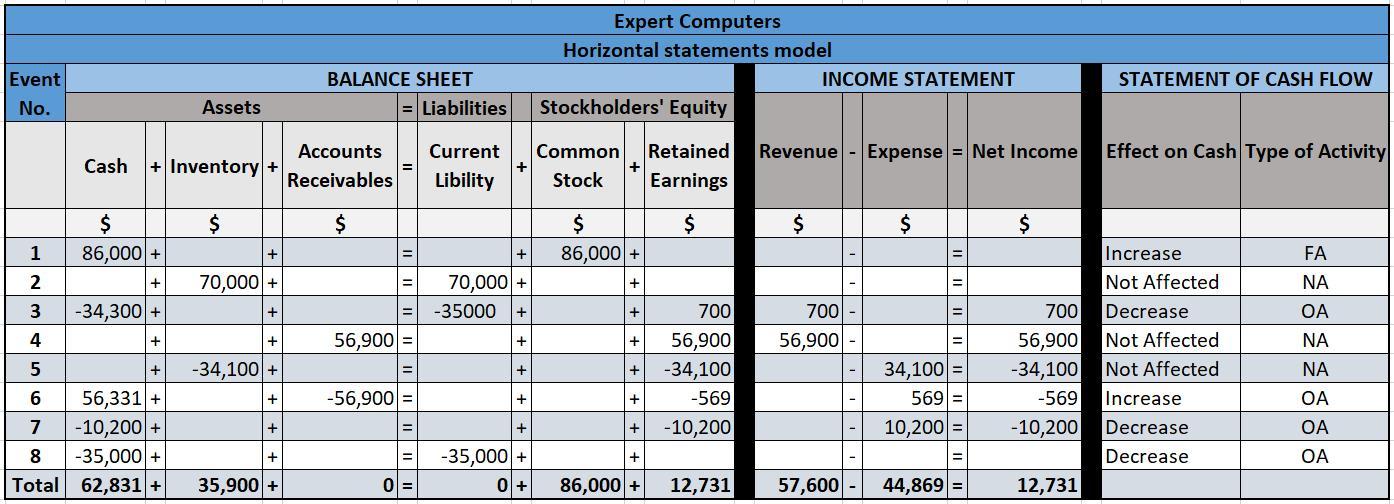
Expert Computers was started in 2018. The company experienced the following accounting events during its first year of operation
Nesterboy [21]

Answer:

The events have been explained below while the Horizontal Statement is attached for Expert Computers as of 2018.

Explanation:

Expert Computers

Horizontal statements model

For the year ending 2018

2. It means that if Expert Computers opt to pay for merchandise inventory within 10 days than they can avail the discount of 2%, otherwise they will be paying net amount in 30 days.

3. A/C Payable Balance = $70,000

Paid 1 Half = $70,000 x 1/2 = $35,000

Discount = $35,000 x 2% = $700

Cash Decrease by = $35,000 - $700 = $34,300

4. It means that if the buyer pays the amount within 20 days of the purchase than Expert Computers will give 1% discount, otherwise full amount needs to be paid within 30 days.

5. This is the cost of goods sold.

6. Account Receivables = $56,900

Discount Allowed = $56,900 x 1% = $569

Cash = $56,900 - $569 = $56,331

8. Since the discount is not availed as payment to vendor made within 30 days. Hence, the remaining amount of current liability will balance out with $35,000.

3 0
2 years ago
Crystal Apple Sales Company began 2014 with cash of $2,000, inventory of $3,600 (200 crystal apples that cost $18 each), $2,500
Andru [333]

Answer and Explanation:

a. The computation of ending inventory and cost of goods sold using the three different cost flow assumptions: FIFO, LIFO, and Weighted Average is shown below:-

Cost of goods sold = (200 × $18) + (800 × $20) + (1,040 × (2,040-200-800)

= (200 × $18) + (800 × $20) + (1,040 × $24)

= $3,600 + $16,000 + $24,960

= $44,560

Ending Inventory Under FIFO = (1,200 - 1,040) × (2,040-200-800)

= 160 × $24

= $3,840

Under LIFO method

Cost of goods sold is

= (1,200 × $24) + (800 × $20) + (40 × $18)

= $28,800 + $16,000 + $720

= $45,520

Ending Inventory Under LIFO is

= (200 - 40) × $18

= 160 × $18

= $2,880

Weighted Average cost flow Assumption

Weighted Average cost per apple = Cost of Beginning inventory and purchase ÷ Total apple available

Cost of Beginning inventory and purchases is

= (200 × $18) + (800 × $20) + (1,200 × $24)

= $3,600 + $16,000 + $28,800

= $48,400

Total apples available is

= 200 + 800 + 1,200

= 2,200  

Weighted Average cost per apple is

= $48,400 ÷ 2,200

= $22

Cost of goods sold is  

= 2,040 × $22

= $44,880

Ending Inventory is

= 160 × $22

= $3,520

b. The Preparation of income statement, a balance sheet, and a statement of cash flows under each of the three cost flow assumptions is prepared below:-

Income Statement                       Amount

Sales (2,040 × $40)                     $81,600

Less: Cost of goods sold            ($44,560)

Gross Profit                                  $37,040

Less: Operating Expenses         ($26,000)

Income before income taxes      $11,040

Less: Income tax (30% × $11,280) ($3,312)

Net Income                                     $7,728

Balance Sheet

Assets  

Cash                                                   $9,488

Inventory                                             $3,840

Total Assets                                        $13,328

Liabilities and Stockholder's Equity

Common Stock                                   $2,500

Retained Earnings                              $10,828

Total Liabilities and Equity                $13,328

Working note

cash = (opening + Sales - Purchases - Operating expenses - Income tax expenses )

= $2,000 + $81,600 - $44,800 - $26,000 - $3,312

= $9,488

Retained earning = (Opening + Net Income)

= $3,100 + $7,728

= $10,828

Statement of Cash Flow

Cash Flow from Operating Activities  

Cash Sales                                               $81,600

Payment to Accounts Payable              ($44,800)

Operating Expenses                              ($26,000)

Income tax paid                                      ($3,312)

Net Increase in cash and

cash equivalents                                     $7,488

Add: Opening Cash and

cash equivalents                                     $2,000

Closing Cash and cash equivalents      $9,488

LIFO cost flow Assumption

Income Statement

Sales (2,040 × $40)                                 $81,600

Less: Cost of goods sold                         ($45,520)

Gross Profit                                              $36,080

Less: Operating Expenses                     ($26,000)

Income before income taxes                  $10,080

Less: Income tax (30% × $10,080)             ($3,024)

Net Income                                               $7,056

Balance Sheet

Assets  

Cash                                                           $9,776

Inventory                                                    $2,880

Total Assets                                               $12,656

Liabilities and Stockholder's Equity

Common Stock                                           $2,500

Retained Earnings                                       $10,156

Total Liabilities and Equity                         $12,656

Working note:-

Cash = (opening + Sales - Purchases payment - Operating expenses -Income tax expenses)

= $2,000 + $81,600 - $44,800 - $26,000 - $3,024

= $9,776

Retained earning = (Opening + Net Income)

= $3,100 + $7,056

= $10,156

Statement of Cash Flows  

Cash Flow from Operating Activities  

Cash Sales                                             $81,600

Payment to Accounts Payable            ($44,800)

Operating Expenses                            ($26,000)

Income tax paid                                     ($3,024)

Net Increase in cash and

cash equivalents                                     $7,776

Add: Opening Cash and

cash equivalents                                     $2,000

Closing Cash and cash equivalents       $9,776

Weighted Average cost flow Assumption

Income Statement  

Sales (2,040 × $40)                                   $81,600

Less: Cost of goods sold                         ($44,880)

Gross Profit                                               $36,720

Less: Operating Expenses                       ($26,000)

Income before income taxes                   $10,720

Less: Income tax (30% × $10,720)           ($3,216)

Net Income                                                $7,504

Balance Sheet  

Assets  

Cash                                                           $9,584

Inventory                                                   $3,520

Total Assets                                              $13,104

Liabilities and Stockholder's Equity

Common Stock                                         $2,500

Retained Earnings                                     $10,604

Total Liabilities and Equity                       $13,104

Working note

Cash = opening + Sales - Purchases payment - Operating expenses - Income tax expenses )

= $2,000 + $81,600 - $44,800 - $26,000 - $3,126

= $9,584

Retained earning = (Opening + Net Income)

= $3,100 + $7,504

= $10,604

Statement of Cash Flows

Cash Flow from Operating Activities

Cash Sales                                       $81,600

Payment to Accounts Payable      ($44,800)

Operating Expenses                       ($26,000)

Income tax paid                               ($3,216)

Net Increase in cash and

cash equivalents                              $7,584

Add: Opening Cash and

cash equivalents                            $2,000

Closing Cash and

cash equivalents                               $9,584

8 0
2 years ago
Other questions:
  • What strategies would you recommend that apple pursue in order to assure widespread consumer adoption of apple pay?
    13·1 answer
  • You work as an assistant coach on the university swim team and earn $15 per hour. One day, you decide to skip the hour-long prac
    6·1 answer
  • Aaron norman earned $24,900 for the year from marcus company. the company is subject to a suta tax of 4.7% on the first $9,900 o
    13·1 answer
  • (Ignore income taxes in this problem.) Ataxia Fitness Center is considering an investment in some additional weight training equ
    15·1 answer
  • In a business environment, persuasion is critical to success. Persuasion is necessary when you anticipate resistance or when you
    7·1 answer
  • Mountaineer excavation operates in a low-lying area that is subject to heavy rains and flooding. because of this, mountaineer pu
    9·1 answer
  • Peter is the vice president of accounting and finance. For the past year he has solely provided the resources necessary to get t
    9·1 answer
  • Emeril is the owner of a restaurant. He decides to raise the wages of his workers even though he faces an excess supply of labor
    6·1 answer
  • Suppose Asarta Inc. is polluting yucko and they have been tasked with cleaning up some of their waste. The company decides to cl
    13·1 answer
  • According to this excerpt, what is one major way in which the World Bank differs from a regular bank? The World Bank is a source
    13·1 answer
Add answer
Login
Not registered? Fast signup
Signup
Login Signup
Ask question!