answer.
Ask question
Login Signup
Ask question
All categories
  • English
  • Mathematics
  • Social Studies
  • Business
  • History
  • Health
  • Geography
  • Biology
  • Physics
  • Chemistry
  • Computers and Technology
  • Arts
  • World Languages
  • Spanish
  • French
  • German
  • Advanced Placement (AP)
  • SAT
  • Medicine
  • Law
  • Engineering
SSSSS [86.1K]
2 years ago
13

"Crayon Colors The file ShortColors.txt initially contains the names of all the colors in a full box of Crayola crayons. Write a

program that deletes all colors from the file whose name contains more than six characters."

Computers and Technology
1 answer:
s2008m [1.1K]2 years ago
4 0

Answer:

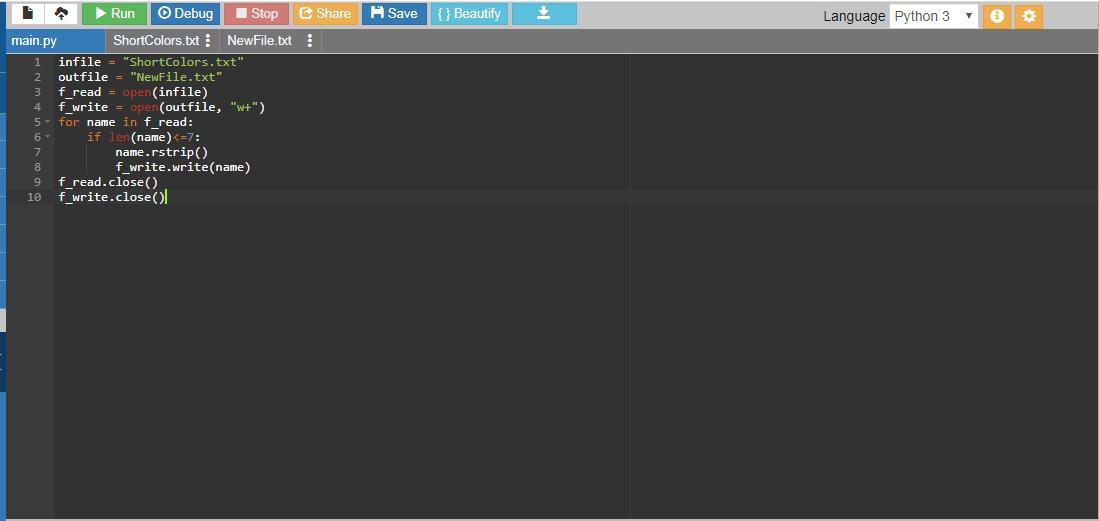
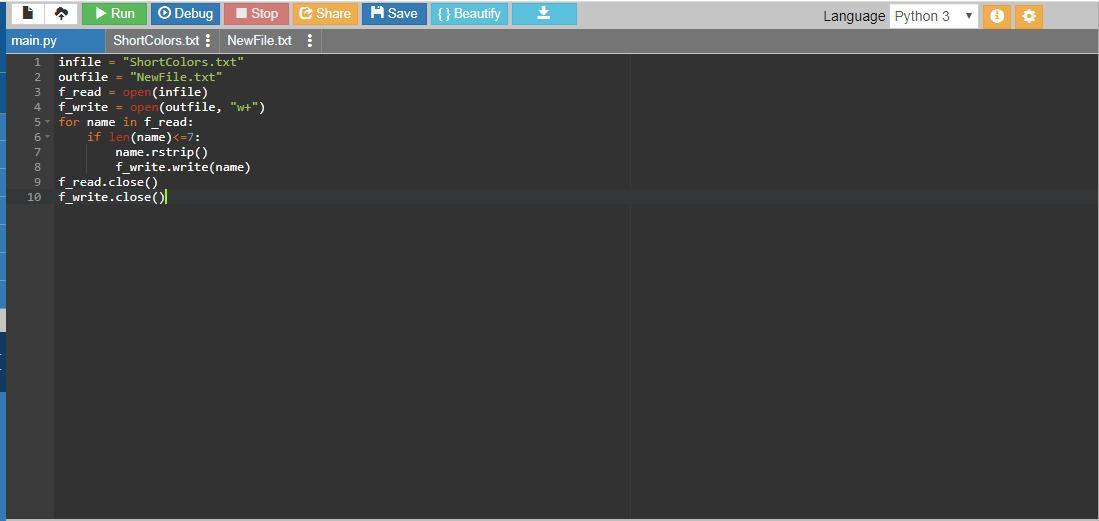
I am writing the Python program. Since you have not attached the ShortColors.txt file so i am taking my own text containing the names of the colors. You can use this program for your ShortColors.txt file.

infile = "ShortColors.txt"

outfile = "NewFile.txt"

f_read = open(infile)

f_write = open(outfile, "w+")

for name in f_read:

   if len(name)<=7:

       name.rstrip()

       f_write.write(name)

f_read.close()

f_write.close()

Explanation:

I will explain the program line by line.

infile = "ShortColors.txt"  creates an object named infile which is used to access and manipulate the text file ShortColors.txt. This file contains names of colors. This object will basically be used to access and read the file contents.

outfile = "NewFile.txt"  creates an object named outfile which is used to access and manipulate the text file NewFile.txt. This text file is created to contain the colors from ShortColors.txt whose name contains less than or equal to six characters. This means NewFile.txt will contain the final color names after deletion of color names containing more than six characters.

f_read = open(infile)  in this statement open() method is used to open the ShortColors.txt file. f_read is an object. Basically the text file is opened to read its contents.

f_write = open(outfile, "w+")   in this statement open() method is used to open the NewFile.txt file. f_write is an object. Basically this text file is opened in w+ mode which means write mode. This is opened in write mode because after deleting the colors the rest of the colors with less than or equal to six characters are to be written in this NewFile.txt.

for name in f_read:  this is where the main work begins to remove the colors with more than six characters. The loop reads each name from the ShortColors.txt file and here f_read object is used in order use this text file. This loop continues to read each name in the text file and executes the statements within the body of this loop.

if len(name)<=7:  this if condition in the body of for loop checks if the length of the color name is less than or equal to 7. Here each character is counted from 0 to 6 so that is why 7 is used. To check the length of every color name len() method is used which returns the length of each name.

name.rstrip()  this method rstrip() is used to remove the characters from each name whose length is greater than 6.

f_write.write(name)  now write() method is used to write the names of all the colors with less than or equal to six characters in NewFile.txt. For this purpose f_write object is used.

Here i did not remove the colors from the original file ShortColors.txt to keep all the contents of the file safe and i have used NewFile.txt to display color names after deletion of all colors whose name contains more than six characters.

After the whole process is done both the files are closes using close() method.

Attached screenshots are of the program, the ShortColors.txt and NewFile.txt.

You might be interested in
Which of the following is NOT a benefit of virtual memory? speed up of process creation increases in the effective access time o
lubasha [3.4K]

Answer:

speed up of process creation increases in the effective access time of memory

Explanation:

Virtual memories are often used in order to save up ram for other applications and not being limited by the actual physical memory that we have, in this case the virtual memory is slower than normal memories since they are not actual memories and are restricted to the spee of the connection or the speed of the disk where they are located.

8 0
2 years ago
Describe the output when the following code executes in 64-bit mode: .data dividend_hi QWORD 00000108h dividend_lo QWORD 3330002
iragen [17]

Answer:

RAX = 333000h (16 bits with preceding zeros removed)

RDX = 20h (also 16 bits with preceding zeros removed)

Explanation:

The "div" opcode in the assembly language source code is used to divide operands. It accepts a divisor ( the denominator) and divides the content of the AX register. The result is saved in the AX register while the remainder (if any) is saved in the DX register. If the DX register holds any data, the data is replaced with the divisor remnant.

The code above divides the content of the RAX register with the divisor variable and saves the result and remainder in the RAX and RDX respectively.

7 0
2 years ago
Jim has excellent oral and written communication skills. He enjoys public speaking and wants a job in which he will interact wit
lianna [129]
The best job for Jim would be public relations specialist.
7 0
2 years ago
Read 2 more answers
This question involves the creation of user names for an online system. A user name is created based on a user’s first and last
Evgen [1.6K]

Answer:

See explaination

Explanation:

import java.util.*;

class UserName{

ArrayList<String> possibleNames;

UserName(String firstName, String lastName){

if(this.isValidName(firstName) && this.isValidName(lastName)){

possibleNames = new ArrayList<String>();

for(int i=1;i<firstName.length()+1;i++){

possibleNames.add(lastName+firstName.substring(0,i));

}

}else{

System.out.println("firstName and lastName must contain letters only.");

}

}

public boolean isUsed(String name, String[] arr){

for(int i=0;i<arr.length;i++){

if(name.equals(arr[i]))

return true;

}

return false;

}

public void setAvailableUserNames(String[] usedNames){

String[] names = new String[this.possibleNames.size()];

names = this.possibleNames.toArray(names);

for(int i=0;i<usedNames.length;i++){

if(isUsed(usedNames[i],names)){

int index = this.possibleNames.indexOf(usedNames[i]);

this.possibleNames.remove(index);

names = new String[this.possibleNames.size()];

names = this.possibleNames.toArray(names);

}

}

}

public boolean isValidName(String str){

if(str.length()==0) return false;

for(int i=0;i<str.length();i++){

if(str.charAt(i)<'a'||str.charAt(i)>'z' && (str.charAt(i)<'A' || str.charAt(i)>'Z'))

return false;

}

return true;

}

public static void main(String[] args) {

UserName person1 = new UserName("john","smith");

System.out.println(person1.possibleNames);

String[] used = {"harta","hartm","harty"};

UserName person2 = new UserName("mary","hart");

System.out.println("possibleNames before removing: "+person2.possibleNames);

person2.setAvailableUserNames(used);

System.out.println("possibleNames after removing: "+person2.possibleNames);

}

}
8 0
2 years ago
Considering the following algorithm, which of the following requirements are satisfied?
Alisiya [41]

Answer:

b) Bounded Waiting

Explanation:

int currentThread = 1;

bool thread1Access = true;

bool thread2Access = true;

thread1 { thread2 {

While (true) {

                   While (true)

                                   {

                     while(thread2Access == true)

                                       {

                                      while(thread1Access == true)

                                       {

                                            If (currentThread == 2) {

                                              If (currentThread == 1)

                                                {        

                                                  thread1Access = false; thread2Access = false;

                                                  While (currentThread == 2);

                                                 While (currentThread == 1);

                                                  thread1Access = true; thread2Access = true;

} }

/* start of critical section */ /* start of critical section */

currentThread = 2 currentThread = 1

… ...

/* end of critical section */ /* end of critical section */

thread1Access = false; thread2Access = false;

… ...

} }

} }

} }

It can be seen that in all the instances, both threads are programmed to share same resource at the same time, and hence this is the bounded waiting. For Mutual exclusion, two threads cannot share one resource at one time. They must share simultaneously. Also there should be no deadlock. For Progress each thread should have exclusive access to all the resources. Thus its definitely the not the Progress. And hence its Bounded waiting.

4 0
2 years ago
Other questions:
  • Robin wants her presentation to move from one slide to another with special motion effects. Which option should Robin use?
    15·2 answers
  • [20 POINTS] Jaime has to configure the dmz network of his organization to the optimum level. Which is the best practice to do so
    7·2 answers
  • Which of the following is technically not a programming language?
    12·2 answers
  • Programming challenge description: Write a program that, given two binary numbers represented as strings, prints their sum in bi
    6·1 answer
  • Betsy recently assumed an information security role for a hospital located in the United States. What compliance regulation appl
    6·1 answer
  • In the game of $Mindmaster$, secret codes are created by placing pegs of any of seven different colors into four slots. Colors m
    5·1 answer
  • Write an expression that executes the loop body as long as the user enters a non-negative number. Note: If the submitted code ha
    7·1 answer
  • Identifying Characters
    11·2 answers
  • Which of the following best describes the protocols used on the Internet?
    12·1 answer
  • Even though Wordpress is basically free, what is the company trying to accomplish?
    11·1 answer
Add answer
Login
Not registered? Fast signup
Signup
Login Signup
Ask question!