answer.
Ask question
Login Signup
Ask question
All categories
  • English
  • Mathematics
  • Social Studies
  • Business
  • History
  • Health
  • Geography
  • Biology
  • Physics
  • Chemistry
  • Computers and Technology
  • Arts
  • World Languages
  • Spanish
  • French
  • German
  • Advanced Placement (AP)
  • SAT
  • Medicine
  • Law
  • Engineering
aleksandr82 [10.1K]
2 years ago
13

Start with the following Python code. alphabet = "abcdefghijklmnopqrstuvwxyz" test_dups = ["zzz","dog","bookkeeper","subdermatog

lyphic","subdermatoglyphics"] test_miss = ["zzz","subdermatoglyphic","the quick brown fox jumps over the lazy dog"] # From Section 11.2 of: # Downey, A. (2015). Think Python: How to think like a computer scientist. Needham, Massachusetts: Green Tree Press. def histogram(s): d = dict() for c in s: if c not in d: d[c] = 1 else: d[c] += 1 return d Copy the code above into your program but write all the other code for this assignment yourself. Do not copy any code from another source. Part 1 Write a function called has_duplicates that takes a string parameter and returns True if the string has any repeated characters. Otherwise, it should return False. Implement has_duplicates by creating a histogram using the histogram function above. Do not use any of the implementations of has_duplicates that are given in your textbook. Instead, your implementation should use the counts in the histogram to decide if there are any duplicates. Write a loop over the strings in the provided test_dups list. Print each string in the list and whether or not it has any duplicates based on the return value of has_duplicates for that string. For example, the output for "aaa" and "abc" would be the following. aaa has duplicates abc has no duplicates Print a line like one of the above for each of the strings in test_dups. Part 2 Write a function called missing_letters that takes a string parameter and returns a new string with all the letters of the alphabet that are not in the argument string. The letters in the returned string should be in alphabetical order. Your implementation should use a histogram from the histogram function. It should also use the global variable alphabet. It should use this global variable directly, not through an argument or a local copy. It should loop over the letters in alphabet to determine which are missing from the input parameter. The function missing_letters should combine the list of missing letters into a string and return that string. Write a loop over the strings in list test_miss and call missing_letters with each string. Print a line for each string listing the missing letters. For example, for the string "aaa", the output should be the following. aaa is missing letters bcdefghijklmnopqrstuvwxyz If the string has all the letters in alphabet, the output should say it uses all the letters. For example, the output for the string alphabet itself would be the following. abcdefghijklmnopqrstuvwxyz uses all the letters Print a line like one of the above for each of the strings in test_miss. Submit your Python program. It should include the following. The provided code for alphabet, test_dups, test_miss, and histogram. Your implementation of the has_duplicates function. A loop that outputs duplicate information for each string in test_dups. Your implementation of the missing_letters function. A loop that outputs missing letters for each string in test_miss. Also submit the output from running your program. Your submission will be assessed using the following Aspects. Does the program include a function called has_duplicates that takes a string parameter and returns a boolean? Does the has_duplicates function call the histogram function? Does the program include a loop over the strings in test_dups that calls has_duplicate on each string? Does the program correctly identify whether each string in test_dups has duplicates? Does the program include a function called missing_letters that takes a string parameter and returns a string parameter? Does the missing_letters function call the histogram function? Does the missing_letters function use the alphabet global variable directly? Does the program include a loop over the strings in test_miss that calls missing_letters on each string? Does the program correctly identify the missing letters for each string in test_miss, including each string that "uses all the letters"?

Computers and Technology
1 answer:
trapecia [35]2 years ago
3 0

Answer:

alphabet = "abcdefghijklmnopqrstuvwxyz"

test_dups = ["zzz","dog","bookkeeper","subdermatoglyphic","subdermatoglyphics"]

test_miss = ["zzz","subdermatoglyphic","the quick brown fox jumps over the lazy dog"]

# From Section 11.2 of: # Downey, A. (2015). Think Python: How to think like a computer scientist. Needham, Massachusetts: Green Tree Press.

def histogram(s):

   d = dict()

   for c in s:

       if c not in d:

           d[c] = 1

       else:

           d[c] += 1

   return d

#Part 1 Write a function called has_duplicates that takes a string parameter and returns True if the string has any repeated characters. Otherwise, it should return False.

def has_duplicates(stringP):

   dic = histogram(stringP)

   for key,value in dic.items():

       if value>1:

           return True

   return False

# Implement has_duplicates by creating a histogram using the histogram function above. Write a loop over the strings in the provided test_dups list.

# Print each string in the list and whether or not it has any duplicates based on the return value of has_duplicates for that string.

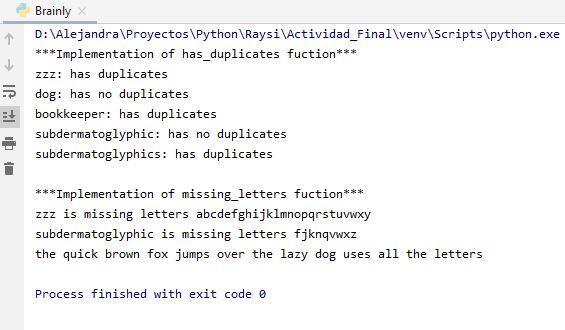
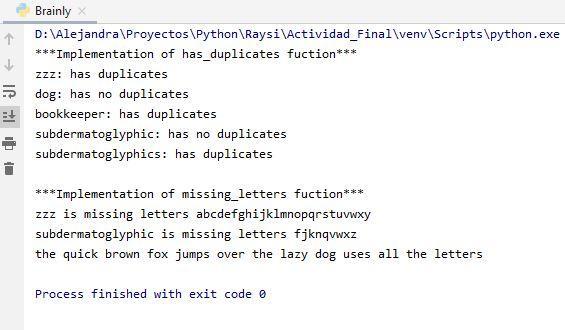
# For example, the output for "aaa" and "abc" would be the following. aaa has duplicates abc has no duplicates Print a line like one of the above for each of the strings in test_dups.

print("***Implementation of has_duplicates fuction***")

for sTr in test_dups:

   if has_duplicates(sTr):

       print(sTr+": has duplicates")

   else:

       print(sTr+": has no duplicates")

#Part 2 Write a function called missing_letters that takes a string parameter and returns a new string with all the letters of the alphabet that are not in the argument string.

#The letters in the returned string should be in alphabetical order. Your implementation should use a histogram from the histogram function. It should also use the global variable alphabet.

#It should use this global variable directly, not through an argument or a local copy. It should loop over the letters in alphabet to determine which are missing from the input parameter.

#The function missing_letters should combine the list of missing letters into a string and return that string.

def missing_letters(sTr):

   missingLettersList = []

   dic = histogram(sTr)

   for l in alphabet:

       if l not in dic:

           missingLettersList.append(l)

   missingLettersList.sort()

   return "".join(missingLettersList)

#Write a loop over the strings in list test_miss and call missing_letters with each string. Print a line for each string listing the missing letters.

#For example, for the string "aaa", the output should be the following. aaa is missing letters bcdefghijklmnopqrstuvwxyz

#If the string has all the letters in alphabet, the output should say it uses all the letters.

#For example, the output for the string alphabet itself would be the following. abcdefghijklmnopqrstuvwxyz uses all the letters

#Print a line like one of the above for each of the strings in test_miss.

print("\n***Implementation of missing_letters fuction***")

for lTm in test_miss:

   sTr = missing_letters(lTm.replace(" ",""))

   if sTr!="":

       print(lTm+" is missing letters "+sTr)

   else:

       print(lTm +" uses all the letters")
You might be interested in
In which of the security mechanism does the file containing data of the users/user groups have inbuilt security?
max2010maxim [7]

Answer:

The answer is "It uses the section access with in the qlikview script".

Explanation:

QlikView is now QlikSense, it comes with section access, that protects against this danger. It a way of determining, which can display certain details, it is also known as objects, that can be displayed by whom and out of which domain, etc.

  • It can also be configured using the publishing of the company. In the data load script, users can use section access to maintain security.  
  • It uses the data for authentication and authorization within segment access and automatically decreases the information, such that users only have their information.
8 0
2 years ago
5. You just bought a new hard drive for youYou plan to use this as a secondary hard drive to store allcomputeryour UMA files. On
wel
Format and mount the drive. 
Formatting erases the drive and sets it up so the system can read and write to it.
Mounting the drive allows the system to have access to the drive and read and write to it. 

If you want to get more specific in Windows you can open registry editor and change the paths of the drive to save in the new location.
4 0
2 years ago
Given three dictionaries, associated with the variables, canadian_capitals, mexican_capitals, and us_capitals, that map province
Nookie1986 [14]

Answer:

The Python code to combine the three dictionaries are is given as follows:

  1. canadian_capital = {
  2.    cash: "SOME VALUES",
  3.    assets: "SOME VALUES"
  4. }
  5. mexican_capital = {
  6.    cash: "SOME VALUES",
  7.    assets: "SOME VALUES"
  8. }
  9. us_capital = {
  10.    cash: "SOME VALUES",
  11.    assets: "SOME VALUES"
  12. }
  13. nafta_capital = {
  14.    canadian: canadian_capital,
  15.    mexican : mexican_capital,
  16.    us: us_capital
  17. }

Explanation:

<u>Line 1 - 14 :</u>

Create three Python dictionaries and name them as <em>canadian_capitals, mexican_capital </em>and<em> us_capitals</em>. Please note a Python dictionaries should be enclosed in curly braces { }.  

We just define two samples of relevant keys (<em>cash </em>and <em>asset</em>) in each of the dictionaries. Python dictionary can map a key to a value.

Since we are not given any capital values from the question,  a dummy string "<em>SOME VALUES</em>" is tentatively set as the value for each of the keys.

In practice, we should replace those dummy strings with the real values of capital. The values can be a number, a string, a list and even a nested dictionary.

<u>Line 16 - 20 : </u>

Create one more Python dictionary and name it as <em>nafta_capital</em>.

Since our aim is to combine the three previous dictionaries (<em>canadian_capitals, mexican_capital </em>and <em>us_capitals</em>) and associate it with <em>nafta_capital</em>, we can define three different keys (<em>canadian, mexican </em>and <em>us</em>) in our dictionary nafta_capital.

As mentioned, a value associated with a key can be a nested dictionary. Hence, we just map <em>canadian_capitals, mexican_capital </em>and <em>us_capitals</em> as the value of the keys (<em>canadian, mexican </em>and<em> us</em>) in dictionary<em> nafta_capital,</em> respectively,

By doing so, we have managed to combine three target dictionaries (<em>canadian_capitals, mexican_capital </em>and <em>us_capitals</em> ) into a single dictionary, <em>nafta_capital</em>.

4 0
2 years ago
JAVA
barxatty [35]

Answer:

Answer is in the provided screenshot! This was a lot of fun to make!

Explanation:

We need to create a new Array which has to be the size of amount * original - as we now that we are going to have that many elements. Then we just iterate through all the values of the new array and set them equal to each of the elements in order.

Ignore the code in my main function, this was to print to the terminal the working code - as you can see from the output at the bottom!

5 0
2 years ago
Which set of variables will make code easier to understand?
Alecsey [184]

Answer:

sum, price, count

Explanation:

Programmers should use significant names for the variables.

Not only it makes it easier for them to remember what kind of information is stored in each variable, but it also makes life simpler for anyone who would read the code later.

Names like sum, price and count are significant names ( assuming they actually hold this kind of data), and will make the re-reading of the program code much easier.

8 0
2 years ago
Other questions:
  • A telephone-repair technician uses a meter to measure voltage on a phone line. This meter is an example of _____. hardware softw
    10·2 answers
  • The basic components of cartridges and shotshells are similar. Shot pellets and a bullet are examples of which basic component?
    13·1 answer
  • Judd puts password protection on all of his files, makes sure not to have any patient information open on his computer when he t
    12·2 answers
  • In Python, what kind of error is returned by the following code? (e.g. NameError, ValueError, IOError, etc.) def my_func(n1, n2)
    8·1 answer
  • Write a program that prints the U.S. presidential election years from 1792 to present day, knowing that such elections occur eve
    9·1 answer
  • Consider the following network: proxy-cache On average there are 35 objects downloaded per second, and the average object size i
    14·1 answer
  • Develop an EER model for the following situation using the traditional EER notation, the Visio notation, or the subtypes inside
    8·1 answer
  • A company has deployed four 48-port access layer switches to a switch block. For redundancy each access layer switch will connec
    14·1 answer
  • To reduce costs and the environmental impact of commuting, your company decides to close a number of offices and to provide supp
    14·1 answer
  • Explain the emerging trends in microcomputer technology in relation to size​
    11·1 answer
Add answer
Login
Not registered? Fast signup
Signup
Login Signup
Ask question!