answer.
Ask question
Login Signup
Ask question
All categories
  • English
  • Mathematics
  • Social Studies
  • Business
  • History
  • Health
  • Geography
  • Biology
  • Physics
  • Chemistry
  • Computers and Technology
  • Arts
  • World Languages
  • Spanish
  • French
  • German
  • Advanced Placement (AP)
  • SAT
  • Medicine
  • Law
  • Engineering
Alexeev081 [22]
2 years ago
4

Which type of engineering design uses an already existing design?

Engineering
1 answer:
skelet666 [1.2K]2 years ago
6 0

Answer:

The correct option is;

C. Bottom-up design

Explanation:

The bottom-up design is meant for system redesign or re-engineering of an existing design involving component upgrading or legacy systems replacement

The bottom-up design approach is also meant for applications where there is a new interface requirement for the original system in order to determine the functionality of the newly combined systems and also where a novel component is incorporated into the existing design.

The bottom-up approach starts with the analysis of the interoperability of the components to the modules and eventually the analysis of the system requirements.

You might be interested in
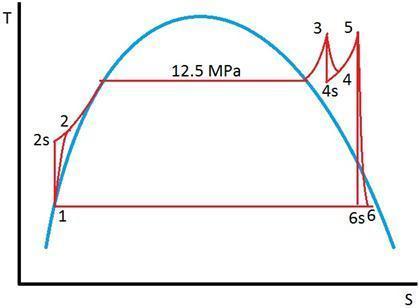
A steam power plant operates on the reheat Rankine cycle. Steam enters the highpressure turbine at 12.5 MPa and 550°C at a rate
gayaneshka [121]

Answer:

A) condenser pressure = 9.73 kPa,

B) 10242 kw

C) 36.9%

Explanation:

given data

entrance pressure of steam = 12.5 MPa

temperature of steam = 550⁰c

flow rate of steam = 7.7 kg/s

outer pressure = 2 MPa

reheated steam temperature = 450⁰c

isentropic efficiency of turbine( nt ) = 85% = 0.85

isentropic efficiency of pump = 90% = 0.90

From steam tables

at 12.5 MPa and 550⁰c ; h3 = 3476.5 kJ/kg,  S3 = 6.6317 kJ/kgK

also for an Isentropic expansion

S4s = S3 .

therefore when S4s = 6.6317 kJ/kg and P4 = 2 MPa

h4s = 2948.1 kJ/kg

nt = 0.85

nt (0.85) = \frac{h3-h4}{h3-h4s} = \frac{3476.5 - h4}{3476.5 - 2948.1}

making h4 subject of the equation

h4 = 3476.5 - 0.85 (3476.5 - 2948.1)

h4 = 3027.3 kj/kg

at P5 = 2 MPa and T5 = 450⁰c

h5 = 3358.2 kj/kg,  s5 = 7.2815 kj/kgk

at P6 , x6 = 0.95  and s5 = s6

using nt = 0.85 we can calculate for h6 and h6s

from the chart attached below we can see that

p6 = 9.73 kPa, h6 = 2463.3 kj/kg

B) the net power output

solution is attached below

c) thermal efficiency

thermal efficiency = 1 - \frac{qout}{qin} = 1 - ( 2273.7/ 3603.8) = 36.9% ≈ 37%

8 0
2 years ago
A six- lane freeway ( three lanes in each direction) in a scenic area has a measured free- flow speed of 55 mi/ h. The peak- hou
Novosadov [1.4K]

Answer:

0.867

Explanation:

The driver population factor (f_{p})can be estimated using the equation below:

f_{p} = \frac{V}{PHF*N*f_{HV}*v_{p}}

The value of the heavy vehicle factor (f_{HV}) is determined below:

The values of the E_{T} = 2 and E_{R} = 3 are gotten from the tables for the RVs, trucks and buses upgrades for passenger-car equivalents. Therefore:

f_{HV} = 1/[1+0.08(2-1)+0.06(3-1)] = 1/[1+0.08+0.12] = 1/1.2 = 0.833

Furthermore, the vp is taken as 2250 pc/(h*In) from the table of LOS criteria for lane freeway using the 15 minutes flow rate. Therefore:

f_{p} = 3900/[0.8*3*0.833*2250] = 3900/4498.2 = 0.867

6 0
2 years ago
. A cylindrical metal specimen having an original diameter of 12.8 mm (0.505 in.) and gauge length of 50.80 mm (2.000 in.) is pu
kogti [31]

Answer:

% reduction in area==PR=0.734=73.4%

% elongation=EL=0.42=42%

Explanation:

given do=12.8 mm

df=6.60

Lf=72.4 mm

Lo=50.8 mm

% reduction in area=((\pi*(do/2)^2)-(\pi*(df/2)^2)))/\pi*(do/2)^2

substitute values

% reduction in area=73.4%

% elongation=EL=((Lf-Lo)/Lo))*100

% elongation=((72.4-50. 8)/50.8)*100=42%

6 0
2 years ago
The 30-kg gear is subjected to a force of P=(20t)N where t is in seconds. Determine the angular velocity of the gear at t=4s sta
tatyana61 [14]

Answer:

\omega =\frac{24}{1.14375}=20.983\frac{rad}{s}

Explanation:

Previous concepts

Angular momentum. If we consider a particle of mass m, with velocity v, moving under the influence of a force F. The angular  momentum about point O is defined as the “moment” of the particle’s linear momentum, L, about O. And the correct formula is:

H_o =r x mv=rxL

Applying Newton’s second law to the right hand side of the above equation, we have that r ×ma = r ×F =

MO, where MO is the moment of the force F about point O. The equation expressing the rate of change  of angular momentum is this one:

MO = H˙ O

Principle of Angular Impulse and Momentum

The equation MO = H˙ O gives us the instantaneous relation between the moment and the time rate of change of angular  momentum. Imagine now that the force considered acts on a particle between time t1 and time t2. The equation MO = H˙ O can then be integrated in time to obtain this:

\int_{t_1}^{t_2}M_O dt = \int_{t_1}^{t_2}H_O dt=H_0t2 -H_0t1

Solution to the problem

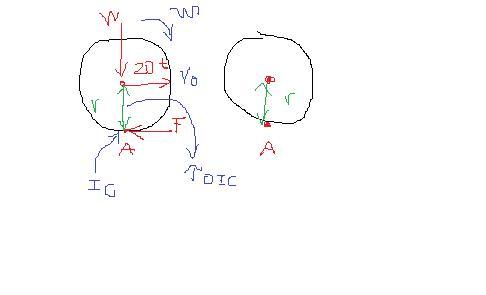
For this case we can use the principle of angular impulse and momentum that states "The mass moment of inertia of a gear about its mass center is I_o =mK^2_o =30kg(0.125m)^2 =0.46875 kgm^2".

If we analyze the staritning point we see that the initial velocity can be founded like this:

v_o =\omega r_{OIC}=\omega (0.15m)

And if we look the figure attached we can use the point A as a reference to calculate the angular impulse and momentum equation, like this:

H_Ai +\sum \int_{t_i}^{t_f} M_A dt =H_Af

0+\sum \int_{0}^{4} 20t (0.15m) dt =0.46875 \omega + 30kg[\omega(0.15m)](0.15m)

And if we integrate the left part and we simplify the right part we have

1.5(4^2)-1.5(0^2) = 0.46875\omega +0.675\omega=1.14375\omega

And if we solve for \omega we got:

\omega =\frac{24}{1.14375}=20.983\frac{rad}{s}

8 0
2 years ago
A thermal energy storage unit consists of a large rectangular channel, which is well insulated on its outer surface and encloses
yaroslaw [1]

Answer:

the temperature of the aluminum at this time is 456.25° C

Explanation:

Given that:

width w of the aluminium slab = 0.05 m

the initial temperature T_1 = 25° C

T{\infty} =600^0C

h = 100 W/m²

The properties of Aluminium at temperature of 600° C by considering the conditions for which the storage unit is charged; we have ;

density ρ = 2702 kg/m³

thermal conductivity k = 231 W/m.K

Specific heat c = 1033 J/Kg.K

Let's first find the Biot Number Bi which can be expressed by the equation:

Bi = \dfrac{hL_c}{k} \\ \\ Bi = \dfrac{h \dfrac{w}{2}}{k}

Bi = \dfrac{hL_c}{k} \\ \\ Bi = \dfrac{100 \times \dfrac{0.05}{2}}{231}

Bi = \dfrac{2.5}{231}

Bi = 0.0108

The time constant value \tau_t is :

\tau_t = \dfrac{pL_cc}{h} \\ \\ \tau_t = \dfrac{p \dfrac{w}{2}c}{h}

\tau_t = \dfrac{2702* \dfrac{0.05}{2}*1033}{100}

\tau_t = \dfrac{2702* 0.025*1033}{100}

\tau_t = 697.79

Considering Lumped capacitance analysis since value for Bi is less than 1

Then;

Q= (pVc)\theta_1 [1-e^{\dfrac {-t}{ \tau_1}}]

where;

Q = -\Delta E _{st} which correlates with the change in the internal energy of the solid.

So;

Q= (pVc)\theta_1 [1-e^{\dfrac {-t}{ \tau_1}}]= -\Delta E _{st}

The maximum value for the change in the internal energy of the solid  is :

(pVc)\theta_1 = -\Delta E _{st}max

By equating the two previous equation together ; we have:

\dfrac{-\Delta E _{st}}{\Delta E _{st}{max}}= \dfrac{  (pVc)\theta_1 [1-e^{\dfrac {-t}{ \tau_1}}]} { (pVc)\theta_1}

Similarly; we need to understand that the ratio of the energy storage to the maximum possible energy storage = 0.75

Thus;

0.75=  [1-e^{\dfrac {-t}{ \tau_1}}]}

So;

0.75=  [1-e^{\dfrac {-t}{ 697.79}}]}

1-0.75=  [e^{\dfrac {-t}{ 697.79}}]}

0.25 =  e^{\dfrac {-t}{ 697.79}}

In(0.25) =  {\dfrac {-t}{ 697.79}}

-1.386294361= \dfrac{-t}{697.79}

t = 1.386294361 × 697.79

t = 967.34 s

Finally; the temperature of Aluminium is determined as follows;

\dfrac{T - T _{\infty}}{T_1-T_{\infty}}= e ^ {\dfrac{-t}{\tau_t}}

\dfrac{T - 600}{25-600}= e ^ {\dfrac{-967.34}{697.79}

\dfrac{T - 600}{25-600}= 0.25

\dfrac{T - 600}{-575}= 0.25

T - 600 = -575 × 0.25

T - 600 = -143.75

T = -143.75 + 600

T = 456.25° C

Hence; the temperature of the aluminum at this time is 456.25° C

3 0
2 years ago
Other questions:
  • 5. A typical paper clip weighs 0.59 g and consists of BCC iron. Calculate (a) the number of
    5·1 answer
  • Suppose that a class CalendarDate has been defined for storing a calendar date with month, day and year components. (In our sect
    6·1 answer
  • tech A says that a Hall-effect sensor can be used in an electronic ignition system. Tech B says that an optical-type sensor can
    6·1 answer
  • The small 5-oz slider A moves without appreciable friction in the hollow tube, which rotates in a horizontal plane with a consta
    7·1 answer
  • Sea water with a density of 1025 kg/m3 flows steadily through a pump at 0.21 m3 /s. The pump inlet is 0.25 m in diameter. At the
    8·1 answer
  • A thin-walled tube with a diameter of 12 mm and length of 25 m is used to carry exhaust gas from a smoke stack to the laboratory
    7·1 answer
  • A pair of spur gears with 20 degree pressure angle, full-depth, involute teeth transmits 65 hp. The pinion is mounted on a shaft
    5·1 answer
  • What ratio between differential gain and common-mode gain is called​
    9·1 answer
  • What is the linear distance traveled in one revolution of a 36-inch wheel
    6·1 answer
  • Tech A says that proper footwear may include both leather and steel-toed shoes. Tech B says that when working in the shop, you o
    15·1 answer
Add answer
Login
Not registered? Fast signup
Signup
Login Signup
Ask question!